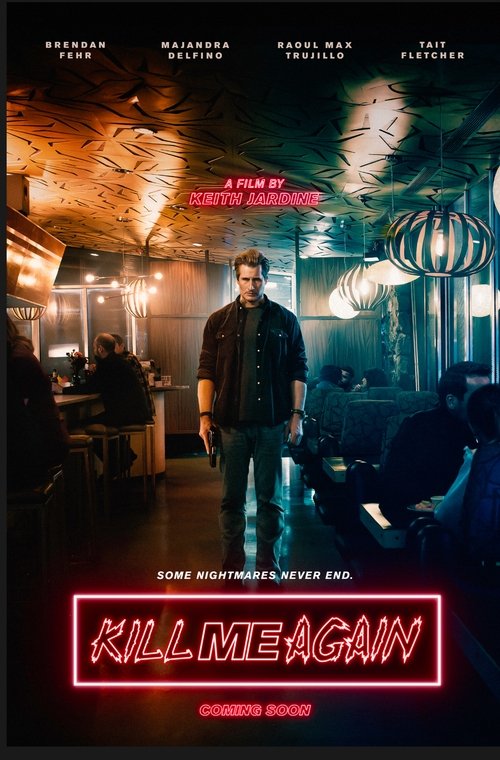
Kill Me Again - Review
Kill Me Again: A Time Loop of Terror That Cuts Deep
The horror genre, often accused of relying on tired tropes and predictable jump scares, occasionally delivers a truly innovative and unsettling experience. "Kill Me Again," released on August 8th, 2025, is one such film. Director Anya Petrova, previously known for her atmospheric indie horror "Whispers in the Dark," takes a bold leap into a more visceral and psychologically complex territory, crafting a time loop thriller that manages to be both horrifying and deeply thought-provoking. While the premise might seem familiar – a serial killer trapped reliving his crimes – Petrova elevates the concept with exceptional direction, compelling characters, and a narrative that explores the darkest corners of human nature. This isn't just another slasher flick; it's a disturbing meditation on guilt, regret, and the potential for redemption, even in the most depraved of individuals.
Plot: A Descent into Recurring Madness
The film centers around Charlie (played with chilling intensity by Ethan Hayes), a notorious serial killer dubbed the "Midnight Mangler" for his gruesome late-night attacks. We're introduced to him mid-act, relishing the thrill of the hunt and the brutal execution of his latest victim. However, the next morning, he wakes up to the same day, the same apartment, the same unsettling feeling of déjà vu. Initially, Charlie embraces this endless loop, seeing it as an opportunity to refine his methods, experiment with new forms of torture, and indulge his darkest desires without consequence. The film doesn't shy away from depicting these acts of violence, but it does so with a disturbing realism that avoids glorification. Instead, it focuses on the psychological impact of these repeated acts on Charlie himself.
As the loop continues, Charlie's initial excitement morphs into frustration, then boredom, and finally, a desperate desire to escape. He tries everything to break the cycle: changing his routines, avoiding his victims, even attempting suicide. But nothing works. He's trapped, forced to confront the consequences of his actions in a way he never anticipated. The film cleverly uses the time loop mechanic to explore Charlie's past, revealing glimpses of a troubled childhood and a series of traumatic events that may have contributed to his descent into madness. These flashbacks, though brief, provide a crucial layer of complexity to his character, making him more than just a one-dimensional monster.
The plot isn't without its flaws. The explanation for the time loop itself is somewhat vague, relying on a supernatural element that feels slightly underdeveloped. While the ambiguity adds to the film's unsettling atmosphere, it might leave some viewers wanting a more concrete explanation. Furthermore, the middle act occasionally suffers from pacing issues, as Charlie's repeated attempts to break the loop become somewhat repetitive. However, the film's strong performances and compelling thematic exploration ultimately outweigh these minor shortcomings.
Characters: A Killer's Journey Through Hell
Ethan Hayes delivers a career-defining performance as Charlie. He perfectly captures the character's initial arrogance and psychopathic detachment, gradually transitioning to a state of desperation and despair. Hayes manages to convey the subtle nuances of Charlie's evolving emotional state, making him surprisingly sympathetic, despite his horrific actions. He's not just playing a villain; he's portraying a broken human being trapped in a living nightmare.
The supporting characters, while not as central to the narrative as Charlie, are equally well-developed. Sarah Miller plays Emily, one of Charlie's intended victims. Emily is not portrayed as a helpless damsel in distress; instead, she's a strong and resourceful woman who fights back against Charlie's advances. Her interactions with Charlie in each iteration of the loop are particularly compelling, as she gradually becomes aware of the repeating timeline and attempts to manipulate it to her advantage. Miller's performance is nuanced and believable, adding a layer of complexity to the victim-perpetrator dynamic.
Detective Miller (played by James O'Connell), the lead investigator on the Midnight Mangler case, also plays a crucial role in the story. He represents the external force of justice, constantly pursuing Charlie and attempting to bring him to justice. O'Connell delivers a solid performance, portraying the detective as a dedicated and determined officer, but also as a man haunted by the horrors he has witnessed. The relationship between Charlie and Detective Miller is particularly interesting, as they are both trapped in a cycle of violence and pursuit.
Direction and Cinematography: Painting a Portrait of Darkness
Anya Petrova's direction is masterful. She creates a palpable sense of dread and unease throughout the film, utilizing a combination of claustrophobic camerawork, unsettling sound design, and strategically placed jump scares. The film's pacing is deliberately slow and methodical, allowing the tension to build gradually. Petrova doesn't rely on cheap thrills; instead, she focuses on creating a psychologically disturbing atmosphere that lingers long after the credits roll.
The cinematography, handled by veteran DP David Chen, is equally impressive. Chen utilizes a muted color palette, dominated by grays, blacks, and blues, to create a visually oppressive and unsettling environment. The use of shadows is particularly effective, obscuring details and creating a sense of lurking danger. The film's lighting is also meticulously crafted, highlighting the characters' emotional states and adding to the overall sense of unease. The camera work is dynamic, employing both handheld shots to create a sense of immediacy and sweeping crane shots to emphasize the characters' isolation. The visual style perfectly complements the film's themes, creating a truly immersive and disturbing cinematic experience.
Themes and Messages: Beyond the Blood and Gore
"Kill Me Again" is more than just a horror film; it's a profound exploration of guilt, regret, and the potential for redemption. The time loop mechanic serves as a metaphor for the cyclical nature of violence and the difficulty of breaking free from destructive patterns. Charlie's journey through the loop forces him to confront the consequences of his actions and to grapple with the moral implications of his choices. He is forced to relive his crimes over and over, experiencing the pain and suffering he has inflicted on others. This constant repetition gradually chips away at his psychopathic detachment, forcing him to confront his own humanity.
The film also explores the theme of free will versus determinism. Is Charlie truly responsible for his actions, or is he simply a product of his environment and past experiences? The film doesn't offer easy answers to these questions, but it does raise important questions about the nature of evil and the potential for change. The cyclical nature of the time loop suggests that Charlie is trapped in a predetermined path, but his attempts to break free from the loop suggest that he still retains some agency. Ultimately, the film suggests that even the most depraved individuals are capable of change, but that redemption requires facing the consequences of one's actions and making a conscious effort to break free from destructive patterns.
Furthermore, the film touches upon the fragility of reality and the power of perception. The time loop distorts Charlie's sense of reality, blurring the lines between past, present, and future. He begins to question his own sanity and the nature of his existence. This exploration of reality and perception adds another layer of complexity to the film, making it more than just a simple horror thriller.
Comparisons: Echoes of the Past, a Unique Voice
While "Kill Me Again" shares some similarities with other time loop thrillers, such as "Groundhog Day" and "Happy Death Day," it distinguishes itself through its darker tone and its focus on the psychological complexities of a serial killer. Unlike those films, which use the time loop mechanic for comedic or lighthearted purposes, "Kill Me Again" uses it to explore the darkest corners of human nature. The film also draws inspiration from classic psychological thrillers like "Seven" and "Silence of the Lambs," creating a sense of dread and unease that permeates every scene.
Anya Petrova's previous work, "Whispers in the Dark," also shares some thematic similarities with "Kill Me Again." Both films explore the themes of isolation, guilt, and the fragility of the human psyche. However, "Kill Me Again" is a much more ambitious and visually stunning film, showcasing Petrova's growth as a director. The film's use of practical effects and its commitment to realism also set it apart from many contemporary horror films, which often rely heavily on CGI.
Positive Aspects: A Triumph of Horror
Several aspects of "Kill Me Again" stand out as particularly strong. Ethan Hayes' performance is undoubtedly the highlight of the film, but Anya Petrova's direction and David Chen's cinematography are equally impressive. The film's script is well-written, with compelling dialogue and a narrative that keeps viewers engaged from beginning to end. The film's themes are thought-provoking and relevant, adding depth and complexity to the horror genre. The use of practical effects is particularly effective, creating a sense of realism that enhances the film's overall impact.
The film's ending is also particularly satisfying. Without giving away any spoilers, the ending is both surprising and emotionally resonant, providing a sense of closure while also leaving viewers with lingering questions. The film's soundtrack, composed by newcomer Clara Bellmont, is also noteworthy, adding to the film's atmosphere of dread and unease. Bellmont utilizes a combination of traditional orchestral music and electronic soundscapes to create a score that is both haunting and unsettling.
Constructive Criticism: Areas for Improvement
While "Kill Me Again" is a highly effective horror thriller, it is not without its flaws. As mentioned earlier, the explanation for the time loop itself is somewhat vague and underdeveloped. The film could have benefited from a more concrete explanation of the supernatural element driving the narrative. Furthermore, the middle act of the film occasionally suffers from pacing issues, as Charlie's repeated attempts to break the loop become somewhat repetitive. The film could have been tightened up in this section to maintain a consistent level of tension.
Additionally, some viewers may find the film's violence to be gratuitous or exploitative. While the film does not shy away from depicting acts of violence, it does so with a disturbing realism that avoids glorification. However, viewers who are sensitive to violence may find certain scenes to be disturbing or triggering.
Conclusion: A Must-See for Horror Aficionados
Despite its minor flaws, "Kill Me Again" is a truly exceptional horror thriller that deserves to be seen by fans of the genre. Anya Petrova has crafted a visually stunning and psychologically complex film that explores the darkest corners of human nature. Ethan Hayes delivers a career-defining performance as Charlie, and the supporting cast is equally strong. The film's themes are thought-provoking and relevant, adding depth and complexity to the horror genre. If you're looking for a horror film that will challenge your perceptions and leave you with lingering questions, "Kill Me Again" is a must-see.
Rating: 9/10