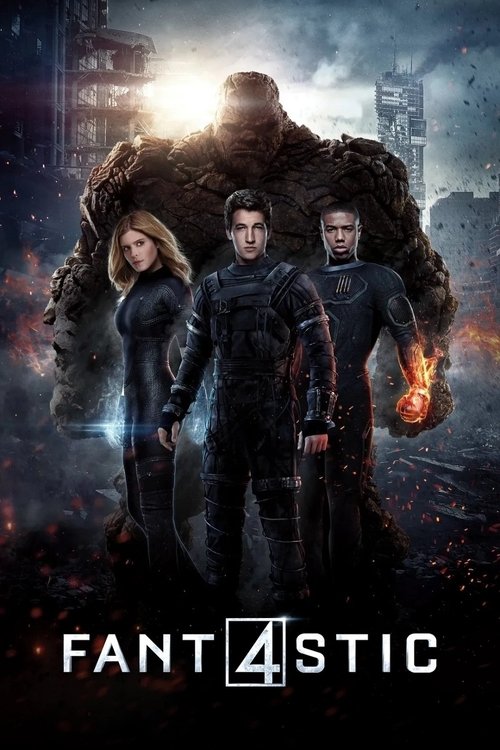
Fantastic Four - Review
Fantastic Flop: A Deep Dive into the 2015 "Fantastic Four"
The year is 2015. Superhero movies are dominating the box office. Hopes are high for a gritty, grounded reboot of the "Fantastic Four," aiming to distance itself from the campier previous iterations. What we got instead was…well, let's just say it's a film that continues to be a point of contention amongst comic book fans and cinephiles alike. This isn't just a bad movie; it's a fascinating case study in studio interference, creative clashes, and the perils of attempting to reinvent a beloved franchise without a clear vision. Buckle up, because we're diving deep into the abyss that is Josh Trank's "Fantastic Four."
Plot: A Promising Start, a Disastrous Finish
The film opens with a young Reed Richards, a brilliant but socially awkward kid obsessed with teleportation. We see his early experiments with Ben Grimm, his loyal friend and confidant. This initial focus on the scientific curiosity and burgeoning friendship is arguably the strongest part of the film. It establishes a believable bond between Reed and Ben, setting the stage for the tragedy that awaits them. Years later, Reed is recruited to a government-funded project led by Dr. Franklin Storm, aimed at building a quantum gate to another dimension. He joins forces with Storm's children, Sue and Johnny, as well as the disgruntled but equally brilliant Victor Von Doom. Together, they successfully build the portal.
The first act, centered around scientific discovery and the building of the portal, is relatively engaging. It feels like a grounded science fiction film, reminiscent of early Cronenberg or even a low-budget Christopher Nolan. The potential is palpable. However, this is where the wheels begin to come off. Against protocol, Reed, Johnny, and Victor decide to take the portal for a joyride, dragging Ben along for the ride. What they find on the other side – Planet Zero – is initially intriguing, but the exploration is rushed and underdeveloped. Disaster strikes quickly, exposing the team to strange energies that alter their DNA, granting them their powers.
The aftermath is a muddled mess. The team is quarantined and studied by the government. Reed, consumed by guilt and fear, escapes. The narrative jumps forward in time, showing the remaining members struggling to control their abilities. This section of the film feels disjointed and lacks emotional resonance. The characters are reactive rather than proactive, simply responding to the government's demands. The development of their powers is also disappointingly brief. We see glimpses of their potential, but never truly witness them mastering their abilities or learning to work together as a team.
The final act is a complete disaster. Victor Von Doom returns from Planet Zero, now a nihilistic and power-hungry villain. His motivations are vague and unconvincing. He wants to destroy Earth because… reasons. The ensuing battle is anticlimactic and visually uninspired. The team, still struggling with their powers and barely functioning as a unit, manages to defeat Doom in a rushed and unsatisfying showdown. The film ends abruptly, leaving the audience feeling cheated and unfulfilled.
Characters: Underdeveloped Potential
The characters in "Fantastic Four" suffer from a lack of depth and inconsistent writing. While the actors do their best with the material, they are ultimately let down by a script that fails to explore their motivations and relationships in a meaningful way.
- Reed Richards (Miles Teller): Teller's portrayal of Reed is arguably one of the film's few redeeming qualities. He manages to convey Reed's intelligence and awkwardness, but the script fails to fully explore his guilt and responsibility for the events that unfold. His transformation into Mr. Fantastic feels rushed and incomplete.
- Sue Storm (Kate Mara): Mara is given very little to work with. Sue is primarily relegated to being the team's medic and the love interest for Reed. Her powers are poorly defined, and her character lacks agency. The film completely misses the opportunity to explore her intelligence and scientific curiosity.
- Johnny Storm (Michael B. Jordan): Jordan brings charisma and energy to the role of Johnny, but his character is underdeveloped. His rebellious streak is hinted at but never fully explored. His relationship with his father and sister is also glossed over.
- Ben Grimm (Jamie Bell): Bell delivers a sympathetic performance as Ben, the loyal friend who is tragically transformed into the Thing. However, the film fails to delve into the psychological impact of his transformation. He is primarily used as a brute force weapon, lacking the emotional depth and complexity that the character deserves.
- Victor Von Doom (Toby Kebbell): Kebbell's portrayal of Doom is universally considered to be one of the film's biggest failures. His motivations are unclear, his transformation is unconvincing, and his dialogue is laughably bad. He is a generic villain with no compelling backstory or personality.
Direction: A Vision Lost in Translation
Josh Trank, fresh off the success of his found-footage superhero film "Chronicle," was initially seen as a promising choice to direct "Fantastic Four." He had a clear vision for a darker, more realistic take on the characters. However, his vision was ultimately compromised by studio interference and creative differences. The final product feels like a Frankensteinian creation, stitched together from different ideas and lacking a cohesive identity.
Trank's direction is uneven throughout the film. The first act shows glimpses of his talent, with its focus on character development and scientific exploration. However, the film quickly loses its way in the second and third acts. The pacing becomes erratic, the editing is choppy, and the visual effects are subpar. The action sequences are poorly choreographed and lack excitement. It's evident that Trank's original vision was significantly altered during post-production.
The behind-the-scenes drama surrounding "Fantastic Four" is well-documented. Reports of on-set conflicts, reshoots, and studio interference paint a picture of a production in disarray. Trank himself has publicly disowned the film, claiming that his original vision was destroyed. While it's impossible to know the full extent of what happened behind the scenes, it's clear that the film suffered from a lack of clear direction and a fractured creative process.
Cinematography: A Muted Palette of Disappointment
The cinematography of "Fantastic Four" is as underwhelming as the rest of the film. Matthew Jensen, who had previously worked on "Chronicle" with Trank, attempts to create a gritty and realistic visual style. However, the overall effect is dull and uninspired. The film is visually dark and muted, lacking the vibrant colors and dynamic compositions that one would expect from a superhero movie.
The visual effects are particularly disappointing. The Thing's design is clunky and unconvincing. The portrayal of Johnny Storm's fire powers is equally lackluster. The visual representation of Planet Zero is bland and uninspired. For a film with a reported budget of $120 million, the visual effects are surprisingly poor.
The lack of visual flair contributes to the film's overall sense of disappointment. Superhero movies are inherently visual spectacles, and "Fantastic Four" fails to deliver on that front. The film lacks the visual creativity and imagination that are essential to bringing these characters and their world to life.
Performances: Trying Their Best with a Bad Hand
The actors in "Fantastic Four" deserve some credit for trying their best with a weak script and a troubled production. While their performances are not necessarily outstanding, they manage to bring some degree of humanity and believability to their characters.
- Miles Teller delivers a solid performance as Reed Richards, capturing his intelligence and awkwardness.
- Kate Mara is hampered by a poorly written character, but she manages to bring some degree of strength and resilience to Sue Storm.
- Michael B. Jordan brings charisma and energy to the role of Johnny Storm, but his character is underdeveloped.
- Jamie Bell delivers a sympathetic performance as Ben Grimm, conveying his loyalty and his pain.
- Toby Kebbell is the weakest link in the cast, delivering a bland and unconvincing portrayal of Victor Von Doom.
It's important to remember that actors can only work with the material they are given. In the case of "Fantastic Four," the actors were given a weak script, a troubled production, and a lack of clear direction. Under these circumstances, it's difficult to blame them for the film's failures.
Themes and Messages: Lost in the Void
The film attempts to explore themes of scientific responsibility, the dangers of unchecked ambition, and the importance of family and teamwork. However, these themes are underdeveloped and ultimately lost in the film's muddled narrative. The film fails to delve into the ethical implications of the team's scientific discoveries, and the characters' emotional journeys are rushed and unconvincing.
The film also attempts to comment on the nature of heroism and the burden of responsibility. However, these themes are poorly executed and lack emotional resonance. The characters never truly grapple with the consequences of their actions, and their transformation into superheroes feels arbitrary and unearned.
Ultimately, "Fantastic Four" fails to deliver any meaningful themes or messages. The film is more concerned with setting up a sequel than with exploring the deeper aspects of the characters and their world.
Comparison to Other Films
Compared to other superhero films, "Fantastic Four" falls far short. It lacks the visual spectacle of Marvel's Cinematic Universe, the emotional depth of Christopher Nolan's "Dark Knight" trilogy, and the humor and self-awareness of films like "Guardians of the Galaxy." The film also pales in comparison to previous adaptations of the "Fantastic Four" comic book, including the much-maligned but arguably more entertaining 2005 film and its sequel.
Compared to Josh Trank's previous work, "Fantastic Four" is a significant step down. "Chronicle" was a compelling and original superhero film that explored themes of power and responsibility in a realistic and grounded way. "Fantastic Four," on the other hand, feels generic and uninspired. It lacks the originality and creativity that made "Chronicle" such a success.
The film's failure can be attributed to a number of factors, including studio interference, creative differences, and a lack of clear vision. However, ultimately, "Fantastic Four" is a film that simply failed to live up to its potential. It is a cautionary tale about the dangers of attempting to reinvent a beloved franchise without a clear understanding of what makes it special.
Positive Aspects (Few and Far Between)
It's difficult to find many positive aspects in "Fantastic Four," but there are a few glimmers of hope:
- The first act: The initial focus on scientific discovery and the budding friendship between Reed and Ben is relatively engaging.
- Miles Teller's performance: Teller manages to bring some degree of humanity and believability to the role of Reed Richards.
- The potential: The film had the potential to be a darker, more realistic take on the "Fantastic Four" comic book.
However, these positive aspects are ultimately overshadowed by the film's many flaws.
Constructive Criticism: Where Did It All Go Wrong?
"Fantastic Four" is a film that is ripe for criticism. Here are some of the film's biggest flaws:
- Weak script: The script is poorly written, with underdeveloped characters, muddled plot points, and generic dialogue.
- Poor direction: Josh Trank's direction is uneven and uninspired. The film lacks a clear vision and a cohesive identity.
- Underwhelming visual effects: The visual effects are subpar, particularly the design of the Thing and the portrayal of Johnny Storm's fire powers.
- Lack of emotional depth: The film fails to explore the characters' emotional journeys in a meaningful way.
- Anticlimactic ending: The final act is rushed and unsatisfying, with a generic villain and a poorly choreographed battle.
- Studio interference: The film suffered from significant studio interference, which ultimately compromised the director's vision.
The film's failure can be attributed to a combination of these factors. It is a cautionary tale about the dangers of attempting to reinvent a beloved franchise without a clear understanding of what makes it special.
Conclusion: A Fantastic Failure
"Fantastic Four" (2015) is a cinematic disaster. It's a film that promised a gritty, grounded reboot of a beloved franchise but delivered a muddled, uninspired, and ultimately forgettable experience. The characters are underdeveloped, the plot is disjointed, the direction is uneven, and the visual effects are subpar. The film fails to deliver any meaningful themes or messages, and it pales in comparison to other superhero films and previous adaptations of the "Fantastic Four" comic book. The behind-the-scenes drama and studio interference only add to the film's overall sense of disappointment. This film is a prime example of how not to make a superhero movie. It's a cautionary tale of what happens when a director's vision is compromised, and a studio attempts to shoehorn a franchise into a pre-determined mold. Avoid at all costs unless you're a glutton for cinematic punishment.