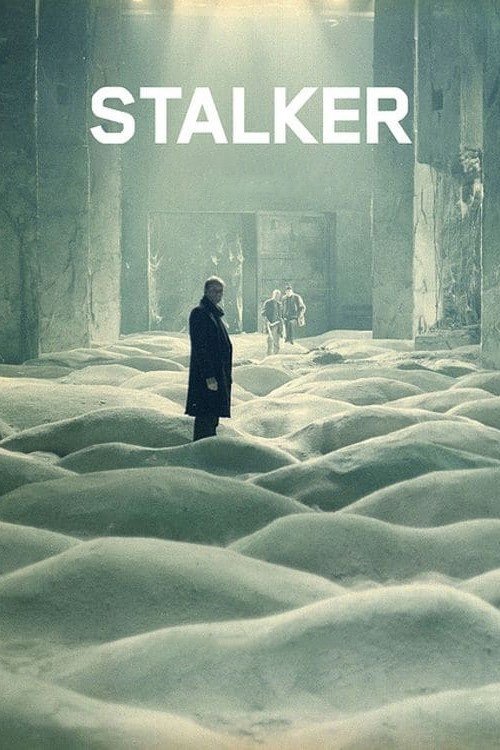
Stalker - Review
Stalker: A Journey into the Soul - A Comprehensive Review
Andrei Tarkovsky's Stalker, released in 1979, is not merely a science fiction film; it's a profound meditation on faith, desire, and the human condition. It's a cinematic poem, a visual symphony, and a philosophical treatise all rolled into one. This isn't a film you simply watch; it's a film you experience, one that burrows into your subconscious and lingers long after the credits have rolled. Prepare to be challenged, to be moved, and perhaps, to be transformed.
Plot: A Pilgrimage into the Unknown
The premise of Stalker is deceptively simple. In a dystopian near future, a mysterious, forbidden area known as the Zone exists. Rumored to be the site of an alien visitation, the Zone defies the laws of physics and holds within it a room where one's deepest desires are said to be granted. Our guide, the Stalker (Aleksandr Kaidanovsky), is a man who, for a fee, illegally leads people into this dangerous and unpredictable place. His clients are two contrasting figures: the Writer (Anatoli Solonitsyn), searching for inspiration, and the Professor (Nikolai Grinko), seeking scientific knowledge.
The journey into the Zone is arduous and fraught with peril. The Stalker meticulously navigates the ever-shifting landscape, warning his companions of invisible dangers and the need to follow specific, often illogical, paths. The film unfolds less as a traditional narrative and more as a pilgrimage, a spiritual quest into the depths of the characters' souls. The destination, the Room, becomes less important than the journey itself, the conversations, and the revelations that occur along the way.
Characters: Mirrors of the Human Psyche
The three central characters in Stalker are not mere individuals; they are archetypes, representing different facets of the human psyche.
- The Stalker (Aleksandr Kaidanovsky): The Stalker is a complex and enigmatic figure. He is a believer, a devotee of the Zone, who sees it as a source of hope and redemption. He is also a broken man, burdened by a past we only glimpse at, seeking solace and purpose in guiding others. He is fiercely protective of the Zone, even as he exploits it for a living. Kaidanovsky delivers a masterful performance, conveying the Stalker's vulnerability, desperation, and unwavering faith with subtle nuances.
- The Writer (Anatoli Solonitsyn): The Writer embodies the cynicism and disillusionment of the intellectual. He is a man searching for meaning and inspiration in a world he finds increasingly empty and meaningless. He is skeptical of the Zone's power, yet desperately hopes it can rekindle his creative spark. Solonitsyn portrays the Writer's inner turmoil with raw intensity, his performance a testament to the character's intellectual arrogance and underlying vulnerability.
- The Professor (Nikolai Grinko): The Professor represents the scientific pursuit of knowledge. He is driven by a desire to understand the Zone, to dissect it, and to uncover its secrets. However, his scientific detachment masks a deeper, more personal motive, one that ultimately challenges the very nature of his pursuit. Grinko's portrayal of the Professor is measured and controlled, hinting at the inner conflict that drives his character.
The relationships between these three characters are dynamic and volatile. They clash over their beliefs, their motivations, and their understanding of the Zone. Their interactions reveal their individual flaws and vulnerabilities, forcing them to confront their own inner demons.
Direction: Tarkovsky's Masterful Hand
Andrei Tarkovsky's direction in Stalker is nothing short of masterful. He creates a world that is both beautiful and unsettling, drawing the viewer into the Zone's mysterious atmosphere. His use of long takes, slow pacing, and meticulous composition creates a sense of realism and immersion.
Tarkovsky's deliberate pacing allows the viewer to contemplate the film's themes and to become fully absorbed in the characters' journey. The long takes, often lasting several minutes, force the viewer to pay attention to the subtle details of the scene, to observe the characters' expressions, and to feel the weight of their silence. This deliberate approach is a stark contrast to the fast-paced editing and action-oriented storytelling prevalent in mainstream cinema.
His attention to detail is evident in every frame, from the decaying industrial landscapes outside the Zone to the lush, overgrown vegetation within. The Zone itself is a character in the film, a living, breathing entity that responds to the characters' thoughts and emotions. Tarkovsky's vision of the Zone is not one of futuristic technology or alien landscapes, but rather a world that is both familiar and alien, beautiful and terrifying.
Cinematography: Visual Poetry
The cinematography in Stalker, primarily by Alexander Knyazhinsky, is breathtaking. The film is divided into two distinct visual styles: the drab, desaturated world outside the Zone and the vibrant, almost surreal world within. This contrast emphasizes the Zone's otherworldly nature and its power to transform those who enter it.
The use of color is particularly striking. The world outside the Zone is depicted in muted browns, grays, and greens, reflecting the bleakness and despair of the characters' lives. In contrast, the Zone is awash in vibrant colors, creating a sense of wonder and mystery. The lush vegetation, the shimmering water, and the strange, decaying structures all contribute to the Zone's unique and unsettling atmosphere.
The camera work is equally impressive. Knyazhinsky uses long, flowing shots to create a sense of movement and to draw the viewer deeper into the Zone. He also employs close-ups to capture the characters' emotions and to reveal their inner thoughts. The combination of color, composition, and camera work creates a visual masterpiece that is both beautiful and haunting.
Performances: Authenticity and Depth
The performances in Stalker are uniformly excellent. The actors embody their characters with a depth of emotion and authenticity that is rarely seen in cinema. As mentioned earlier, Aleksandr Kaidanovsky, Anatoli Solonitsyn, and Nikolai Grinko deliver powerful and nuanced performances that bring their characters to life. The supporting cast also contributes to the film's overall sense of realism.
The actors were given considerable freedom to interpret their roles, and their improvisations often made it into the final cut. This collaborative approach allowed the actors to fully inhabit their characters and to bring their own experiences and perspectives to the film. The result is a set of performances that are both believable and deeply moving.
Themes and Messages: Faith, Doubt, and the Human Condition
Stalker is a film rich in themes and messages. It explores the nature of faith, the power of desire, the search for meaning, and the complexities of the human condition. At its core, the film is a meditation on the struggle between faith and doubt, between hope and despair.
The Zone itself can be interpreted as a metaphor for the human soul, a place of hidden desires and unrealized potential. The Room represents the ultimate goal, the fulfillment of one's deepest wishes. However, the characters' hesitation to enter the Room suggests that they are afraid of confronting their true selves, of acknowledging their deepest desires. They fear that their wishes, once granted, will reveal their own inadequacies and imperfections.
The film also explores the limitations of science and reason. The Professor, a man of science, seeks to understand the Zone through empirical observation and analysis. However, he ultimately realizes that the Zone is beyond scientific explanation, that it operates on a different set of principles. This realization challenges the Professor's worldview and forces him to confront the limits of his own knowledge.
Ultimately, Stalker suggests that the true path to fulfillment lies not in achieving one's desires, but in the journey itself, in the process of self-discovery. The characters' experiences in the Zone force them to confront their own flaws and vulnerabilities, to question their beliefs, and to ultimately come to a deeper understanding of themselves.
Comparison to Other Films and Works
Stalker is often compared to other science fiction films that explore philosophical themes, such as 2001: A Space Odyssey and Solaris (also directed by Tarkovsky). However, Stalker is unique in its focus on the human element, its emphasis on character development, and its deliberate pacing.
Compared to Solaris, Stalker feels more grounded and less reliant on visual spectacle. While both films explore the relationship between humanity and the unknown, Stalker is more concerned with the inner lives of its characters and their struggles with faith and doubt. It also shares thematic similarities with Tarkovsky's other works, such as Andrei Rublev and Ivan's Childhood, which explore themes of faith, suffering, and the search for meaning in a world filled with chaos and uncertainty.
Positive Aspects
Stalker is a cinematic masterpiece that offers a profound and thought-provoking experience. Its strengths include:
- Profound Themes: The film explores complex and universal themes that resonate with audiences on a deep emotional level.
- Masterful Direction: Tarkovsky's direction is deliberate, meticulous, and visually stunning.
- Breathtaking Cinematography: The cinematography creates a world that is both beautiful and unsettling.
- Excellent Performances: The actors deliver powerful and nuanced performances that bring their characters to life.
- Atmospheric Sound Design: The sound design creates a sense of immersion and enhances the film's overall atmosphere.
Constructive Criticism
While Stalker is a remarkable film, it is not without its flaws. Some potential criticisms include:
- Slow Pacing: The film's deliberate pacing may not appeal to all viewers. Some may find it slow and uneventful.
- Ambiguous Narrative: The film's ambiguous narrative and lack of clear answers may frustrate some viewers.
- Demanding Viewing Experience: Stalker requires patience and attention, and it may not be suitable for casual viewing.
- Occasional Technical Imperfections: The film suffered from technical difficulties during production, which resulted in some noticeable imperfections in the final print (though some would argue these add to the film's mystique).
Conclusion
Stalker is a challenging, rewarding, and ultimately unforgettable film. It is a cinematic poem that explores the depths of the human soul and the mysteries of the universe. While its slow pacing and ambiguous narrative may not appeal to all viewers, those who are willing to engage with its themes and ideas will be richly rewarded. It's a film that stays with you long after you've seen it, prompting you to question your own beliefs and to reflect on the meaning of life.
Stalker is a testament to the power of cinema to explore complex philosophical themes and to create a truly transformative experience. It is a film that deserves to be seen and discussed for generations to come.