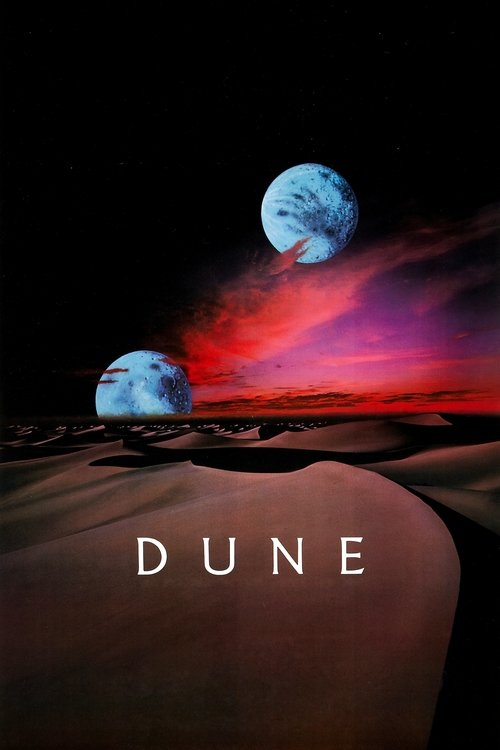
Dune - Review
A Spice-Fueled Odyssey Gone Astray: A Critical Look at David Lynch's "Dune" (1984)
The year is 1984. The promise: to bring Frank Herbert's sprawling, complex, and beloved science fiction epic, "Dune," to the big screen. The director: David Lynch, fresh off the success of "The Elephant Man" and "Eraserhead," a visionary known for his surreal and often unsettling style. The result? A film that, to this day, remains a source of heated debate among science fiction fans, a visually arresting but ultimately flawed adaptation that both captivates and frustrates in equal measure. Was it a noble attempt to grapple with an unfilmable novel? Or a misstep that ultimately betrayed the source material? Let's delve into the sands of Arrakis and dissect this ambitious, yet ultimately divisive, cinematic endeavor.
Plot: Condensing a Universe
The film attempts to cram the entirety of Herbert's first "Dune" novel into a relatively short runtime (for such an expansive story). In the year 10,191, the universe revolves around the spice Melange, a substance found only on the desert planet Arrakis. This spice extends life, enhances consciousness, and is crucial for interstellar travel, making Arrakis the most strategically important planet in the known universe. The story centers on Paul Atreides (Kyle MacLachlan), the son of Duke Leto Atreides (Jürgen Prochnow), who is tasked by the Emperor Shaddam IV (José Ferrer) to take control of Arrakis and its spice production, replacing the brutal and malevolent Harkonnen family, led by the Baron Vladimir Harkonnen (Kenneth McMillan). This, however, is a trap orchestrated by the Emperor and the Harkonnens to destroy the Atreides. Betrayal ensues, Duke Leto is killed, and Paul and his mother, Lady Jessica (Francesca Annis), a Bene Gesserit adept, escape into the desert. They find refuge among the Fremen, the native inhabitants of Arrakis, who have long awaited a messiah. Paul, through his Bene Gesserit training and his burgeoning prescience, begins to fulfill the Fremen prophecy, becoming Muad'Dib, their leader, and eventually challenging the Emperor for control of Arrakis and the spice.
While the film hits the major plot points, it suffers from severe condensation. Key elements of the story are rushed or glossed over, leaving viewers unfamiliar with the books struggling to understand the complex political intrigue, the nuances of the Bene Gesserit, or the significance of the spice. The internal monologues, delivered as voiceovers, feel clunky and expository, a desperate attempt to convey the characters' thoughts and motivations that are lost in the visual spectacle. The pacing is uneven, with some scenes feeling rushed while others linger unnecessarily. The ending, in particular, feels abrupt and unsatisfying, failing to capture the epic scale of Paul's transformation and victory.
Characters: Archetypes Lost in Translation
The film boasts an impressive cast, but many of the characters feel like caricatures rather than fully realized individuals. Kyle MacLachlan, in his film debut, delivers a decent performance as Paul Atreides, capturing his youthful naivete and his gradual transformation into a powerful leader. However, the film doesn't fully explore the internal struggles and moral complexities of Paul's journey, leaving him feeling somewhat underdeveloped. Francesca Annis shines as Lady Jessica, embodying her strength, intelligence, and unwavering devotion to her son. Her portrayal captures the essence of the Bene Gesserit training and her role as a key player in the unfolding events.
Kenneth McMillan's Baron Harkonnen is a grotesque and over-the-top villain, a caricature of evil that lacks the subtle menace and political cunning of the book version. Sting, as Feyd-Rautha Harkonnen, is memorable, but his performance is more style than substance. Jürgen Prochnow brings a quiet dignity to Duke Leto, but his character is given little screen time to develop. Max von Sydow as Dr. Kynes, the Imperial planetologist, provides a grounded and authoritative presence, but his role is significantly reduced compared to the book. The Fremen characters, while visually striking, are largely relegated to the background, with little exploration of their culture, beliefs, or individual personalities. The Emperor, portrayed by José Ferrer, is a disappointingly weak and unmemorable presence, failing to convey the power and authority that he wields in the universe.
Ultimately, the characters suffer from the film's rushed pacing and lack of depth. They are often reduced to archetypes, lacking the nuance and complexity that made them so compelling in the novel.
Direction: Lynch's Signature Style Meets Studio Interference
David Lynch's direction is arguably the most controversial aspect of the film. On one hand, his unique visual style, characterized by surreal imagery, dreamlike sequences, and unsettling sound design, is evident throughout the film. The film is visually stunning, with elaborate sets, costumes, and special effects that create a unique and otherworldly atmosphere. The Harkonnen homeworld, Giedi Prime, is a particularly memorable example of Lynch's visual flair, a nightmarish landscape of industrial decay and grotesque excess.
However, Lynch's signature style often clashes with the demands of adapting such a complex and plot-heavy novel. The film's exposition-heavy voiceovers, the rushed pacing, and the simplified characters all suggest studio interference and a desire to make the film more accessible to a wider audience. Lynch himself has disowned the film, citing creative differences and a lack of final cut control. It's clear that "Dune" is a compromised vision, a film that reflects both Lynch's artistic sensibilities and the constraints imposed upon him by the studio.
Some argue that Lynch was simply the wrong director for the project, that his surreal and often ambiguous style was ill-suited to the straightforward storytelling required to adapt Herbert's novel. Others maintain that he was the only director capable of capturing the otherworldly atmosphere and psychological depth of the "Dune" universe. Regardless of one's opinion, it's undeniable that Lynch's direction is a key factor in the film's divisive reception.
Cinematography: A Visual Feast
Despite the film's flaws, the cinematography, primarily handled by Freddie Francis, is undeniably impressive. The film's visuals are rich and detailed, creating a believable and immersive world. The vast desert landscapes of Arrakis are captured beautifully, conveying the planet's harshness and beauty. The interior sets, particularly those of the Harkonnen homeworld and the Atreides palace, are equally impressive, showcasing a blend of futuristic technology and gothic grandeur. The use of color is also striking, with the warm, earthy tones of Arrakis contrasting sharply with the cold, metallic colors of the Harkonnen world.
The special effects, while dated by today's standards, are still impressive for their time. The sandworms, in particular, are a highlight, appearing as truly massive and terrifying creatures. The film's visual style is a key element of its appeal, creating a unique and memorable cinematic experience.
Performances: A Mixed Bag
As mentioned earlier, the performances in "Dune" are a mixed bag. Kyle MacLachlan delivers a solid performance as Paul Atreides, but the character's lack of depth limits his ability to truly shine. Francesca Annis is excellent as Lady Jessica, conveying her strength and intelligence with grace and poise. Kenneth McMillan's Baron Harkonnen is memorable, but his over-the-top portrayal lacks the subtlety of the book character. Sting is entertaining as Feyd-Rautha, but his performance is more style than substance. Jürgen Prochnow brings a quiet dignity to Duke Leto, but his character is given little screen time to develop. The supporting cast is generally competent, but few of the performances are truly outstanding.
One of the biggest criticisms of the performances is that they often feel wooden or unnatural, perhaps due to the stilted dialogue and the rushed pacing. The actors are often forced to deliver exposition-heavy lines that feel unnatural and awkward. This, combined with the simplified characters, makes it difficult for the actors to fully connect with their roles and deliver truly memorable performances.
Themes and Messages: Echoes of Herbert's Vision
Despite its flaws, "Dune" manages to touch upon some of the key themes and messages of Herbert's novel. The film explores the dangers of unchecked power, the importance of environmentalism, and the complexities of religion and prophecy. The story of Paul Atreides is a cautionary tale about the seductive nature of power and the unintended consequences of messianic leadership. The film also highlights the importance of understanding and respecting different cultures, as exemplified by the Fremen and their deep connection to the desert planet.
However, the film's rushed pacing and simplified characters prevent it from fully exploring these themes in a meaningful way. The nuances of Herbert's philosophical and political ideas are often lost in the visual spectacle and the exposition-heavy dialogue. The film touches upon these themes, but it doesn't delve into them with the depth and complexity that they deserve.
Comparison to Other Films and Works
Compared to other science fiction films of the era, "Dune" stands out for its visual ambition and its attempt to tackle a complex and challenging source material. It shares some thematic similarities with films like "Star Wars," exploring themes of good versus evil, destiny, and the power of belief. However, "Dune" is a far more complex and politically nuanced story than "Star Wars," exploring themes of colonialism, environmentalism, and the dangers of unchecked power in a way that "Star Wars" does not.
Compared to David Lynch's other works, "Dune" feels like an outlier. While it shares some of his signature visual style, it lacks the psychological depth and surreal ambiguity of films like "Eraserhead" and "Mulholland Drive." It's clear that Lynch was working under significant constraints on "Dune," and the film doesn't fully reflect his artistic vision.
The 2021 adaptation of "Dune" directed by Denis Villeneuve offers a stark contrast. Villeneuve's version prioritizes world-building, character development, and faithfulness to the source material, resulting in a more cohesive and satisfying adaptation. While Lynch's "Dune" is visually striking, Villeneuve's version is more narratively compelling and thematically resonant.
Positive Aspects
- Visually stunning with impressive sets, costumes, and special effects.
- Memorable performances by Francesca Annis as Lady Jessica and Kenneth McMillan as Baron Harkonnen.
- Touches upon some of the key themes and messages of Herbert's novel.
- Ambitious attempt to adapt a complex and challenging source material.
- Unique and otherworldly atmosphere.
Constructive Criticism
- Rushed pacing and severe condensation of the plot.
- Simplified characters lacking depth and nuance.
- Exposition-heavy dialogue and clunky voiceovers.
- Uneven tone and a lack of narrative coherence.
- Studio interference that compromised Lynch's artistic vision.
- Unsatisfying ending.
- Fails to fully explore the complex themes and messages of the novel.
Conclusion
David Lynch's "Dune" is a visually arresting but ultimately flawed adaptation of Frank Herbert's classic science fiction novel. While the film boasts impressive sets, costumes, and special effects, it suffers from rushed pacing, simplified characters, and a lack of narrative coherence. Lynch's signature style clashes with the demands of adapting such a complex and plot-heavy story, resulting in a compromised vision that fails to fully capture the essence of the "Dune" universe. While it has its moments of brilliance and remains a fascinating artifact of 1980s science fiction cinema, it ultimately falls short of its potential and serves as a cautionary tale about the challenges of adapting beloved source material.
Rating: 5.5/10