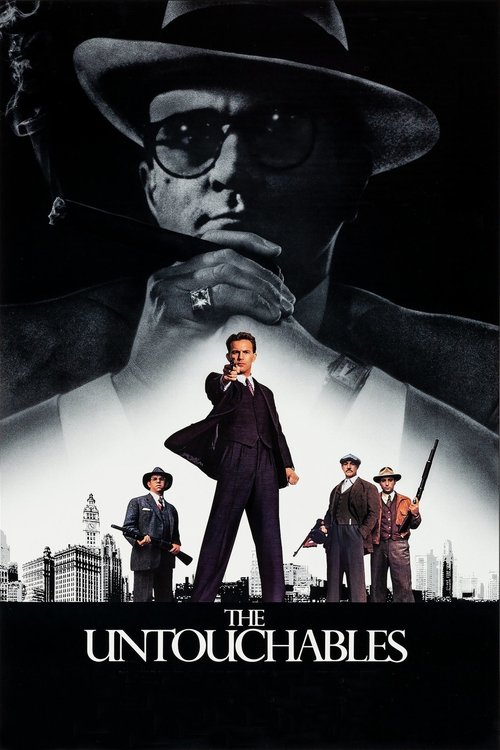
The Untouchables - Review
"The Untouchables": A Symphony of Style and Substance in the Windy City
Brian De Palma's The Untouchables, released in 1987, isn't just a gangster film; it's a visceral, operatic experience. A stylized and heightened depiction of Elliot Ness's crusade against Al Capone's Chicago empire during Prohibition, the film manages to be both a thrilling action piece and a meditation on morality, corruption, and the cost of justice. It's a film that lingers in the memory long after the credits roll, thanks to its stunning visuals, unforgettable performances, and a narrative that, while taking liberties with historical accuracy, grips you from start to finish. This review delves into the film's various facets, exploring its strengths and weaknesses, and ultimately assessing its lasting impact on the crime genre.
Plot: A David vs. Goliath Struggle in a City of Shadows
The film's plot is deceptively simple: idealistic Treasury agent Elliot Ness (Kevin Costner) arrives in Chicago determined to bring down Al Capone (Robert De Niro), whose bootlegging operations fuel the city's rampant violence and corruption. Initially, Ness's efforts are met with humiliating failure, highlighting the pervasive reach of Capone's influence. He quickly learns that honesty and integrity are not enough to combat an enemy who controls the police, the judiciary, and even the very fabric of society.
This initial setback forces Ness to re-evaluate his approach. He recruits a small, hand-picked team: Jim Malone (Sean Connery), a seasoned, street-smart Irish cop with a reputation for incorruptibility; George Stone (Andy Garcia), a sharp-shooting Italian-American police academy recruit; and Oscar Wallace (Charles Martin Smith), an accountant whose expertise is crucial for building a case against Capone based on tax evasion. Together, they become "The Untouchables," a symbol of unwavering dedication to justice in a city drowning in sin.
The narrative then unfolds as a series of increasingly daring raids and confrontations against Capone's operations. Each success comes at a cost, forcing Ness and his team to confront the moral compromises they must make to fight fire with fire. The stakes are constantly raised, culminating in a dramatic courtroom showdown where Ness finally corners Capone, not through brute force, but through meticulous investigation and a clever legal maneuver.
While the core plot is straightforward, De Palma imbues it with a sense of heightened drama and suspense. The pacing is expertly managed, alternating between tense action sequences and moments of quiet character development. The film takes liberties with historical fact, particularly in its portrayal of Ness's character and the events surrounding Capone's downfall. However, these artistic choices serve to amplify the film's thematic concerns and create a more compelling cinematic experience.
Characters: Icons of Good and Evil
The Untouchables boasts a cast of memorable characters, each contributing to the film's overall impact.
Elliot Ness (Kevin Costner)
Costner's portrayal of Elliot Ness is that of an initially naive and idealistic lawman who undergoes a significant transformation throughout the film. He begins as a clean-cut, by-the-book agent, but the harsh realities of Chicago corruption force him to embrace more ruthless tactics. While some critics have found Costner's performance to be somewhat wooden, his earnestness and unwavering determination make him a believable protagonist. His vulnerability, particularly in the face of violence and loss, adds depth to his character.
Jim Malone (Sean Connery)
Sean Connery delivers a career-defining performance as Jim Malone, the gruff, cynical Irish cop who becomes Ness's mentor and confidant. Malone is the film's moral compass, guiding Ness through the treacherous landscape of Chicago's underworld. Connery brings a gravitas and world-weariness to the role, making Malone both a formidable force and a deeply sympathetic figure. His famous line, "What are you prepared to do?" encapsulates the film's central theme of moral compromise. Connery won an Academy Award for Best Supporting Actor for his performance.
Al Capone (Robert De Niro)
Robert De Niro's portrayal of Al Capone is both chilling and charismatic. He doesn't simply play Capone as a one-dimensional villain; he embodies the man's cunning, brutality, and surprising moments of charm. De Niro's Capone is a larger-than-life figure, a symbol of the corruption and excess that defined the Prohibition era. His infamous baseball bat scene is a masterclass in controlled menace, demonstrating Capone's absolute power and willingness to use violence to maintain control.
George Stone (Andy Garcia)
Andy Garcia's George Stone provides a youthful energy and a sense of righteous anger to the team. Initially hesitant to use lethal force, Stone evolves into a skilled and dedicated member of the Untouchables, demonstrating his loyalty and commitment to justice. Garcia's performance is understated but effective, providing a crucial counterpoint to the more experienced characters of Ness and Malone.
Oscar Wallace (Charles Martin Smith)
Charles Martin Smith's Oscar Wallace is the brains of the operation, providing the crucial financial expertise needed to build a case against Capone. Wallace is a gentle and unassuming character, but his dedication and bravery prove essential to the Untouchables' success. His tragic fate serves as a stark reminder of the dangers faced by those who dared to challenge Capone's empire.
The supporting cast, including Billy Drago as Capone's ruthless enforcer Frank Nitti, also contribute to the film's rich tapestry of characters. Each character is meticulously crafted, adding depth and complexity to the film's narrative.
Direction: De Palma's Masterful Orchestration
Brian De Palma's direction is arguably the film's greatest strength. He brings a unique visual style and a masterful command of suspense to The Untouchables. De Palma is known for his meticulous attention to detail, his use of long takes, and his ability to create moments of intense dramatic tension.
His direction is heavily influenced by Alfred Hitchcock, and this is evident in the film's use of suspense, its carefully constructed set pieces, and its exploration of themes of guilt and paranoia. The famous Union Station shootout, inspired by the Odessa Steps sequence in Sergei Eisenstein's Battleship Potemkin, is a prime example of De Palma's skill in building tension and orchestrating visually stunning action sequences. The slow-motion, the dramatic music, and the focus on the innocent bystander caught in the crossfire create a scene of unparalleled intensity.
De Palma also utilizes split diopter shots, subjective camera angles, and other visual techniques to create a sense of unease and disorientation, reflecting the moral ambiguity of the characters' actions. His use of music, particularly Ennio Morricone's iconic score, is also crucial in creating the film's atmosphere of suspense and drama. De Palma's direction elevates The Untouchables from a simple gangster film to a visually arresting and emotionally resonant cinematic experience.
Cinematography: A Feast for the Eyes
Stephen H. Burum's cinematography is another key element of the film's success. He captures the gritty realism of 1930s Chicago while also imbuing the film with a stylized and visually striking aesthetic. The use of light and shadow is particularly effective, creating a chiaroscuro effect that emphasizes the moral darkness of the city. The film's color palette is rich and vibrant, adding to the sense of heightened drama.
Burum's camera work is fluid and dynamic, moving effortlessly between long, sweeping shots and close-ups that capture the actors' emotions. The use of slow motion is particularly effective in the action sequences, heightening the sense of drama and allowing the audience to appreciate the choreography of the violence. The overall visual style of the film is both beautiful and unsettling, perfectly capturing the duality of Chicago during the Prohibition era.
Performances: A Stellar Ensemble Cast
As mentioned previously, the performances in The Untouchables are uniformly excellent. Kevin Costner, Sean Connery, Robert De Niro, Andy Garcia, and Charles Martin Smith all deliver memorable performances that contribute to the film's overall impact. Connery's portrayal of Jim Malone is particularly noteworthy, earning him an Academy Award and cementing his status as a cinematic icon. De Niro's Al Capone is equally impressive, capturing the character's charisma and brutality with equal skill. The ensemble cast works seamlessly together, creating a believable and compelling group of characters. The chemistry between Costner and Connery is particularly strong, adding emotional depth to the film's narrative.
Themes and Messages: Morality, Corruption, and the Price of Justice
The Untouchables explores several important themes, including morality, corruption, and the price of justice. The film raises questions about the nature of good and evil, and the extent to which individuals are willing to compromise their principles to achieve their goals. Elliot Ness's journey is a testament to the challenges of maintaining integrity in a corrupt system. He is forced to confront the fact that sometimes, the only way to fight evil is to embrace tactics that are morally questionable.
The film also examines the corrosive effects of corruption on society. Capone's empire is built on bribery, intimidation, and violence, and his influence extends to every level of government and law enforcement. The Untouchables' struggle against Capone is a fight to restore order and justice to a city that has been consumed by corruption. The film suggests that true justice requires unwavering dedication and a willingness to sacrifice personal safety and well-being.
Ultimately, The Untouchables is a cautionary tale about the dangers of unchecked power and the importance of upholding moral principles, even in the face of overwhelming odds. It suggests that the fight against corruption is a never-ending battle, and that it requires constant vigilance and a willingness to stand up for what is right.
Comparison to Other Films and Works
The Untouchables can be compared to other classic gangster films, such as The Godfather, Scarface, and Once Upon a Time in America. However, De Palma's film stands apart due to its stylized visuals, its operatic tone, and its focus on the battle between good and evil. While The Godfather delves into the complexities of family and loyalty within the Mafia, and Scarface explores the rise and fall of a drug kingpin, The Untouchables is more concerned with the moral implications of fighting corruption.
In terms of De Palma's other works, The Untouchables shares some similarities with his earlier films, such as Carrie and Dressed to Kill, in its use of suspense, its stylized visuals, and its exploration of themes of violence and paranoia. However, The Untouchables is a more mature and ambitious film, showcasing De Palma's growth as a director. It also benefits from a stronger script and a more talented cast than some of his earlier works.
Sean Connery's performance as Jim Malone can be compared to his iconic role as James Bond, in that both characters possess a certain level of charisma, toughness, and moral ambiguity. However, Malone is a more complex and nuanced character than Bond, reflecting Connery's growth as an actor.
Positive Aspects
- Stunning visuals and cinematography
- Memorable performances from the entire cast
- Expert direction by Brian De Palma
- Iconic score by Ennio Morricone
- Gripping narrative and suspenseful action sequences
- Exploration of important themes related to morality and corruption
Constructive Criticism
- Historical inaccuracies in the portrayal of Elliot Ness and Al Capone
- Some may find Costner's performance to be somewhat wooden
- The film's stylized violence may not appeal to all viewers
- The plot, while engaging, is relatively straightforward
Conclusion
The Untouchables is a cinematic masterpiece that continues to captivate audiences decades after its release. Brian De Palma's masterful direction, Stephen H. Burum's stunning cinematography, and the stellar performances of the ensemble cast combine to create a truly unforgettable film. While the film takes liberties with historical accuracy and may not appeal to all viewers due to its stylized violence, its exploration of themes of morality, corruption, and the price of justice remains relevant and thought-provoking. The Untouchables is a must-see for fans of gangster films and a testament to the power of cinema to entertain and inspire.
Rating: 9.5/10