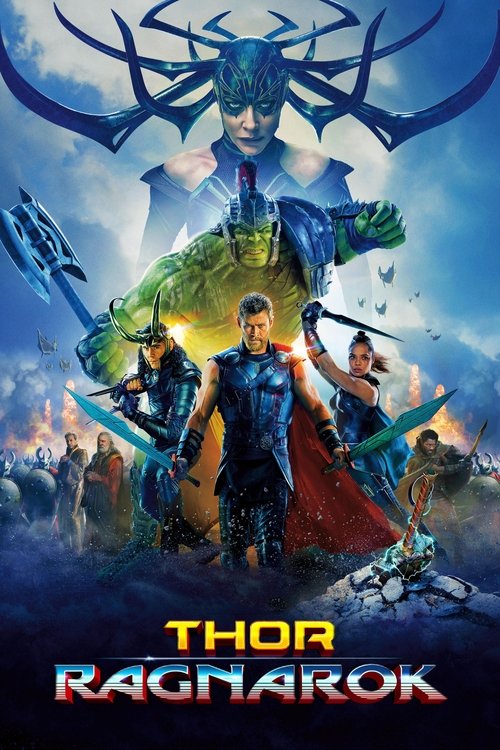
Thor: Ragnarok - Review
Thor: Ragnarok - A Hilariously Destructive Masterpiece
Forget everything you thought you knew about Thor. Forget the grim pronouncements, the Shakespearean drama, and the generally stoic demeanor. In 2017, Taika Waititi unleashed Thor: Ragnarok upon the world, a vibrant, hilarious, and surprisingly poignant entry into the Marvel Cinematic Universe that not only revitalized the character of Thor but also redefined what a superhero film could be. More than just a superhero slugfest, Ragnarok is a self-aware comedy with heart, wrapped in a visually stunning package of cosmic adventure. This review dives deep into the chaotic brilliance of Waititi's vision, exploring its plot, characters, themes, and everything that makes it a standout in the ever-expanding MCU.
Plot: From Sakaar's Arena to Asgard's Doom
A Cosmic Comedy of Errors
The film opens with Thor (Chris Hemsworth), imprisoned in the fiery realm of Muspelheim by the fire demon Surtur. He quickly dispatches Surtur, retrieving his crown, which Surtur claims is necessary to fulfill the prophecy of Ragnarok: the destruction of Asgard. Upon returning home, Thor discovers that Loki (Tom Hiddleston) has been impersonating Odin (Anthony Hopkins) for years, ruling with a feigned benevolence. Thor and Loki journey to Earth to find their father, eventually locating him in Norway. Odin reveals that he is dying and that his death will unleash Hela (Cate Blanchett), the Goddess of Death and their firstborn child, a figure so powerful and ruthless that Odin imprisoned her millennia ago.
Odin's death triggers Hela's return, and in a brief but brutal confrontation, she shatters Thor's hammer, Mjolnir, and forces Thor and Loki to flee through the Bifrost. Thor ends up on Sakaar, a garbage planet ruled by the eccentric Grandmaster (Jeff Goldblum), where he is forced to become a gladiator. He encounters Valkyrie (Tessa Thompson), a disillusioned Asgardian warrior haunted by her past, and is reunited with the Hulk (Mark Ruffalo), who has been stuck in his green form for two years after the events of Avengers: Age of Ultron. Loki, ever the opportunist, has already ingratiated himself with the Grandmaster.
The remainder of the film sees Thor, Hulk, Valkyrie, and eventually Loki, forming a ragtag team to escape Sakaar and return to Asgard to confront Hela. This involves a series of increasingly absurd and hilarious scenarios, including a gladiatorial contest between Thor and Hulk, a daring escape involving a stolen spaceship, and Valkyrie confronting her past trauma. Back in Asgard, Hela easily overpowers the Asgardian army and resurrects an army of the dead, wreaking havoc on the kingdom.
Ultimately, Thor realizes that he cannot defeat Hela through brute force. He embraces his destiny, unleashing his full potential as the God of Thunder, and, with Loki's help, instigates Ragnarok, destroying Asgard to defeat Hela. The surviving Asgardians, led by Thor, escape in a spaceship, setting course for Earth, unknowingly encountering Thanos's ship, as teased in the post-credits scene.
Plot Strengths and Weaknesses
The plot of Ragnarok is undoubtedly the film's greatest strength. It skillfully balances the weighty themes of destiny, responsibility, and loss with lighthearted humor and thrilling action sequences. The pacing is near-perfect, never allowing the audience to dwell too long on any one element. The film successfully juggles multiple storylines – Thor's journey of self-discovery, the Hulk's existential crisis, Valkyrie's redemption arc, and Hela's reign of terror – without feeling cluttered or disjointed.
However, the plot isn't without its minor flaws. While the humor is generally well-executed, some jokes occasionally fall flat or feel slightly out of place, disrupting the emotional flow of the narrative. The film's reliance on deus ex machina moments, such as Loki conveniently finding Surtur's crown or the ease with which they escape Sakaar, can feel somewhat contrived. Furthermore, the destruction of Asgard, while narratively necessary, feels rushed in the final act, leaving little time to fully process the loss of the Asgardian civilization. The fate of certain supporting characters during the destruction could have been handled with more care.
Characters: A Roster of Quirky Gods and Warriors
Thor: From Brooding Prince to Comedic King
Chris Hemsworth delivers his best performance as Thor in Ragnarok. He fully embraces the comedic potential of the character, showcasing impeccable timing and a willingness to poke fun at his own stoicism. This is a Thor who is not afraid to be vulnerable, to be confused, and to ultimately grow into a more confident and self-aware leader. His journey from a prince burdened by responsibility to a king embracing his destiny is both compelling and entertaining.
Loki: The God of Mischief, Still Up to His Old Tricks
Tom Hiddleston continues to shine as Loki, the God of Mischief. While his motivations remain ambiguous, he is undeniably charismatic and entertaining. Ragnarok provides Loki with moments of genuine growth, hinting at a potential redemption arc, while still allowing him to indulge in his trademark trickery and self-preservation. His complex relationship with Thor remains a highlight of the film.
Hela: A Villain Worthy of the Gods
Cate Blanchett is magnificent as Hela, the Goddess of Death. She is a formidable and terrifying villain, driven by a righteous anger at being denied her rightful place as heir to the Asgardian throne. Blanchett imbues Hela with a chilling presence and a sardonic wit, making her both compelling and utterly ruthless. She is not simply a generic evil overlord; she has a clear motive and a justified grievance, making her a more nuanced and memorable antagonist.
Valkyrie: A Warrior Redeemed
Tessa Thompson delivers a breakout performance as Valkyrie. She is a complex and compelling character, haunted by her past failures but determined to find redemption. Thompson portrays Valkyrie with a perfect blend of strength, vulnerability, and sardonic humor. Her interactions with Thor and Hulk are particularly entertaining, and her backstory adds depth and emotional resonance to the film.
Hulk: The Green Goliath Learns to Talk (and Feel)
Mark Ruffalo's Hulk is given a significant upgrade in Ragnarok. Having been stuck in his Hulk form for two years, he has developed a more nuanced personality and the ability to speak in full sentences. This allows for more comedic moments and explores the Hulk's internal struggles with his identity and his relationship with Bruce Banner. The dynamic between Thor and Hulk is a comedic goldmine, and Ruffalo's performance is both hilarious and surprisingly poignant.
The Grandmaster: A Delightfully Eccentric Ruler
Jeff Goldblum is perfectly cast as the Grandmaster. He embodies the character's quirky eccentricity and absolute power with effortless charm. The Grandmaster is a delightfully absurd figure, adding another layer of comedic absurdity to the Sakaar scenes. He is a highlight of the supporting cast.
Character Development: A Mixed Bag
While the main characters undergo significant development, some supporting characters are underdeveloped or underutilized. Characters like Skurge (Karl Urban), while initially intriguing, ultimately serve as plot devices rather than fully realized individuals. The Warriors Three, who were prominent in the previous Thor films, are unceremoniously dispatched early in the film, highlighting the shift in focus towards the core ensemble.
Direction and Cinematography: A Visual Feast
Taika Waititi's Vision: A Bold Departure
Taika Waititi's direction is the driving force behind Ragnarok's success. He injects the film with his signature brand of quirky humor, improvisational dialogue, and vibrant visual style. Waititi's approach is a stark contrast to the more serious and self-important tone of the previous Thor films, resulting in a film that is both entertaining and refreshing. He allows the actors to improvise and explore their characters, resulting in more natural and engaging performances. Waititi's direction is not just about making a funny movie; it's about creating a world that is both visually stunning and emotionally resonant.
Visual Style: A Neon-Drenched Spectacle
The cinematography, helmed by Javier Aguirresarobe, is visually stunning. The film is awash in vibrant colors, particularly neon hues, creating a unique and eye-catching aesthetic. The Sakaar scenes are particularly striking, with their otherworldly landscapes and bizarre architecture. The action sequences are dynamic and well-choreographed, making full use of the characters' powers and abilities. The visual effects are top-notch, seamlessly blending practical effects with CGI to create a believable and immersive world.
Soundtrack: An 80s Synth-Pop Extravaganza
Mark Mothersbaugh's soundtrack is a perfect complement to the film's visual style. The soundtrack is heavily influenced by 1980s synth-pop, adding to the film's overall sense of fun and nostalgia. The use of Led Zeppelin's "Immigrant Song" during key action sequences is particularly effective, enhancing the film's energy and excitement.
Constructive Criticism: Balancing Comedy with Gravitas
While Waititi's direction is largely successful, some critics argue that the film leans too heavily into comedy, sacrificing some of the emotional weight of the story. The destruction of Asgard, a pivotal moment in the Thor mythology, feels somewhat rushed and lacks the emotional impact it deserves. Balancing the comedic elements with the more serious themes of loss and sacrifice could have elevated the film to even greater heights.
Themes and Messages: More Than Just a Laugh Riot
Destiny vs. Free Will
Ragnarok explores the theme of destiny versus free will. Thor initially believes that he is destined to fulfill the prophecy of Ragnarok, but he ultimately chooses to defy fate and forge his own path. He learns that true strength lies not in blindly following tradition but in embracing change and making difficult choices.
Responsibility and Leadership
The film also examines the theme of responsibility and leadership. Thor is forced to confront his own shortcomings as a leader and to learn what it truly means to protect his people. He realizes that being a king is not just about wielding power but about making sacrifices and inspiring others.
Embracing Change and Letting Go of the Past
Ragnarok is a film about embracing change and letting go of the past. Thor must accept the loss of his hammer, his home, and his father in order to move forward and become the leader he is meant to be. Valkyrie must confront her past trauma in order to find redemption and purpose. The film suggests that clinging to the past can be destructive and that true growth comes from embracing the future.
The Corrupting Influence of Power
The film also touches on the corrupting influence of power. Hela's lust for power drives her to commit terrible acts, while Loki's ambition leads him to betray his own brother. The film suggests that power should be wielded responsibly and that unchecked ambition can lead to destruction.
Comparison to Other Films and Works
Contrast with Previous Thor Films
Ragnarok is a radical departure from the previous Thor films, which were generally more serious and Shakespearean in tone. While Thor (2011) was a decent origin story, and Thor: The Dark World (2013) was widely considered one of the weaker entries in the MCU, Ragnarok revitalized the character and breathed new life into the franchise. The film's humor, visual style, and character development are all a significant improvement over its predecessors.
Similarities to Guardians of the Galaxy
Ragnarok shares some similarities with Guardians of the Galaxy (2014), another MCU film that embraced a more comedic and irreverent tone. Both films feature a ragtag group of heroes, a quirky villain, and a soundtrack heavily influenced by 1980s music. However, Ragnarok is arguably even more self-aware and meta than Guardians of the Galaxy, pushing the boundaries of what a superhero film can be.
Taika Waititi's Previous Work
Ragnarok reflects Taika Waititi's signature style, which is evident in his previous films such as What We Do in the Shadows (2014) and Hunt for the Wilderpeople (2016). These films are characterized by their quirky humor, improvisational dialogue, and heartfelt characters. Waititi's unique voice and vision are what make Ragnarok such a special and memorable film.
Positive Aspects and Constructive Criticism
Positive Aspects
- Excellent performances from the entire cast, particularly Chris Hemsworth, Cate Blanchett, and Tessa Thompson.
- Taika Waititi's inspired direction, which injects the film with humor, energy, and visual flair.
- Stunning cinematography and visual effects.
- A catchy and memorable soundtrack.
- A well-paced and engaging plot that balances action, humor, and emotion.
- Strong character development for Thor, Hulk, and Valkyrie.
Constructive Criticism
- Some jokes occasionally fall flat or feel out of place.
- The destruction of Asgard feels rushed and lacks emotional impact.
- Some supporting characters are underdeveloped or underutilized.
- The film's reliance on deus ex machina moments can feel contrived.
- The heavy focus on comedy occasionally overshadows the more serious themes of the story.
Conclusion and Rating
Thor: Ragnarok is a triumph. It's a hilarious, visually stunning, and surprisingly poignant entry into the MCU that revitalized the character of Thor and redefined what a superhero film could be. While it's not without its minor flaws, its strengths far outweigh its weaknesses. Taika Waititi's vision is bold, imaginative, and utterly captivating. This is a film that will leave you laughing, cheering, and perhaps even shedding a tear or two. It's a must-see for any fan of the MCU and a testament to the power of taking risks and embracing change.
Rating: 9.5/10
```