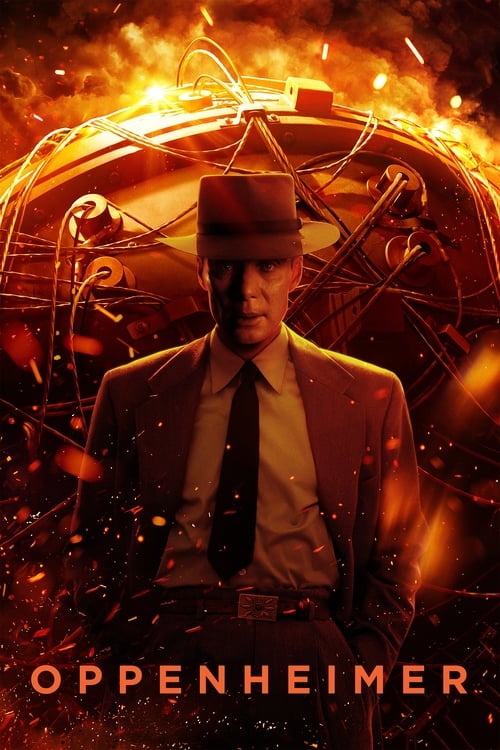
Oppenheimer - Review
Oppenheimer: A Nuclear Inferno of Genius and Guilt
Christopher Nolan’s Oppenheimer isn't just a biopic; it's a cinematic detonation. A sprawling, three-hour epic that grapples with the immense moral and existential weight of the atomic bomb, it plunges the audience headfirst into the complex mind of J. Robert Oppenheimer, the brilliant physicist who became known as the "father of the atomic bomb." This is not a comfortable history lesson; it's a visceral, unsettling journey into the heart of scientific ambition, political maneuvering, and the devastating consequences of unchecked power.
Plot: A Fractured Timeline of Creation and Condemnation
Oppenheimer unfolds in a non-linear fashion, a signature Nolan technique that initially might seem daunting but ultimately serves to mirror the fragmented psyche of its protagonist. The narrative is primarily structured around two timelines: "Fission," rendered in color, which focuses on Oppenheimer's development of the atomic bomb during World War II, and "Fusion," presented in stark black and white, which depicts the security hearing in 1954 that threatened to destroy his reputation and career. These timelines are interwoven with flashbacks to Oppenheimer's early academic life, his involvement with leftist politics, and his complex relationships with various individuals who shaped his trajectory.
The "Fission" timeline is a thrilling, almost breathless account of the Manhattan Project. Nolan masterfully conveys the urgency and intensity of the race against Nazi Germany to develop the atomic bomb. We see the meticulous planning, the scientific breakthroughs, the logistical challenges, and the sheer audacity of assembling a team of brilliant minds in a remote desert location – Los Alamos. The film doesn't shy away from the ethical implications, but it primarily focuses on the scientific and engineering marvel of the project, creating a sense of awe and wonder even as the audience knows the devastating outcome.
The "Fusion" timeline is a tense, claustrophobic courtroom drama. It exposes the political machinations and personal vendettas that fueled the campaign against Oppenheimer. Lewis Strauss, played with chilling precision by Robert Downey Jr., emerges as a key antagonist, his motivations shrouded in ambiguity. The hearing is not just about Oppenheimer's past associations with communists; it's about power, control, and the desire to silence a man who had become too powerful and too outspoken. This timeline is deliberately paced, allowing the tension to build slowly, creating a sense of dread and unease.
The film culminates in the Trinity test, a sequence that is both visually stunning and emotionally devastating. Nolan avoids showing a traditional explosion, opting instead for a more subjective and psychological approach. We see the reactions of the scientists, the blinding light, the deafening roar, and the realization that they have unleashed something truly terrifying upon the world. The aftermath of the Trinity test is depicted through haunting imagery and Oppenheimer's increasingly troubled conscience.
Characters: A Symphony of Complex Personalities
Oppenheimer is populated by a rich ensemble of characters, each with their own motivations, complexities, and secrets. The film excels at portraying these individuals not as caricatures but as fully realized human beings grappling with extraordinary circumstances.
J. Robert Oppenheimer (Cillian Murphy)
Cillian Murphy delivers a career-defining performance as J. Robert Oppenheimer. He captures the physicist's brilliance, arrogance, vulnerability, and profound sense of guilt with remarkable nuance. Murphy's eyes, in particular, are incredibly expressive, conveying a range of emotions from intellectual curiosity to deep-seated torment. He embodies the contradictions of Oppenheimer, a man who was both a visionary and a flawed human being.
Kitty Oppenheimer (Emily Blunt)
Emily Blunt delivers a powerful and understated performance as Kitty Oppenheimer, J. Robert's wife. She is a complex and often volatile character, struggling with alcoholism and her own intellectual frustrations. Blunt portrays Kitty as a strong and independent woman who is fiercely loyal to her husband, even when she disagrees with his choices. Her courtroom scenes are particularly compelling, showcasing her unwavering support and sharp intellect.
Lewis Strauss (Robert Downey Jr.)
Robert Downey Jr. delivers a nuanced and chilling performance as Lewis Strauss, the chairman of the Atomic Energy Commission. Strauss is a complex and enigmatic character, driven by ambition and a deep-seated insecurity. Downey Jr. masterfully portrays Strauss's subtle manipulations and his growing resentment towards Oppenheimer. His performance is a masterclass in understated villainy.
Leslie Groves (Matt Damon)
Matt Damon provides a solid and grounded performance as General Leslie Groves, the military officer in charge of the Manhattan Project. Groves is a pragmatist, focused on achieving the objective of building the atomic bomb as quickly as possible. Damon portrays Groves as a no-nonsense leader who is willing to make difficult decisions, even if they are morally questionable.
Other Notable Characters
The film also features strong supporting performances from Florence Pugh as Jean Tatlock, Oppenheimer's troubled lover; Josh Hartnett as Ernest Lawrence, a key scientist in the Manhattan Project; and Casey Affleck as Boris Pash, a ruthless intelligence officer.
Direction and Cinematography: A Masterclass in Visual Storytelling
Christopher Nolan's direction is masterful, showcasing his ability to handle complex narratives and large-scale productions. He creates a sense of tension and urgency throughout the film, drawing the audience into the world of Oppenheimer and the Manhattan Project. His use of non-linear storytelling, while potentially confusing for some, ultimately adds to the film's complexity and thematic depth.
The cinematography, by Hoyte van Hoytema, is breathtaking. The film is shot in a combination of IMAX and 70mm film, creating a visually immersive experience. The use of color and black and white is particularly effective, distinguishing between the "Fission" and "Fusion" timelines. The film's visual effects are also stunning, particularly the depiction of the Trinity test. However, Nolan avoids relying heavily on CGI, opting instead for practical effects whenever possible, which adds to the film's sense of realism.
The sound design is equally impressive, creating a sense of unease and tension through the use of ambient noise, music, and sound effects. The score, composed by Ludwig Göransson, is both haunting and powerful, perfectly complementing the film's themes and emotions.
Themes and Messages: The Moral Quagmire of Scientific Progress
Oppenheimer explores a number of complex themes, including the nature of scientific ambition, the moral responsibility of scientists, the dangers of political persecution, and the devastating consequences of war. The film raises profound questions about the role of science in society and the ethical implications of technological advancements.
The film highlights the tension between scientific curiosity and moral responsibility. Oppenheimer and his colleagues were driven by a desire to understand the universe and to push the boundaries of human knowledge. However, their work had devastating consequences, leading to the deaths of hundreds of thousands of people. The film asks whether scientists should be held accountable for the uses to which their discoveries are put.
Oppenheimer also explores the dangers of political persecution. The security hearing depicted in the film is a chilling reminder of the McCarthy era and the willingness of governments to suppress dissent in the name of national security. The film suggests that even the most brilliant and accomplished individuals are vulnerable to political attacks.
Ultimately, Oppenheimer is a cautionary tale about the dangers of unchecked power and the importance of moral responsibility. The film reminds us that even the most brilliant minds can be blinded by ambition and that the pursuit of knowledge must be tempered by a sense of ethical awareness.
Comparison to Other Films and Works
Oppenheimer can be compared to other films that explore the moral dilemmas of scientific progress, such as Fat Man and Little Boy (1989) and The Imitation Game (2014). However, Nolan's film is unique in its scope, ambition, and psychological depth.
In terms of Nolan's previous work, Oppenheimer shares thematic similarities with films like Inception (2010) and Interstellar (2014), which explore the complexities of the human mind and the nature of reality. However, Oppenheimer is arguably Nolan's most mature and complex film to date, grappling with real-world events and their profound consequences.
Cillian Murphy's performance as Oppenheimer can be compared to his previous collaborations with Nolan, such as his roles in the Dark Knight trilogy and Inception. However, his performance in Oppenheimer is on a different level, showcasing his range and depth as an actor.
Positive Aspects and Constructive Criticism
Oppenheimer is a cinematic masterpiece on many levels. The film's direction, cinematography, performances, and themes are all exceptional. Nolan has created a visually stunning and intellectually stimulating film that will stay with audiences long after they leave the theater.
However, the film is not without its flaws. The non-linear narrative can be confusing at times, and some viewers may find the film's length to be excessive. The film also focuses primarily on the male characters, with the female characters often relegated to supporting roles. While Emily Blunt delivers a strong performance as Kitty Oppenheimer, her character could have been given more depth and agency.
Furthermore, the film's depiction of the Japanese perspective is limited. While the film acknowledges the devastating impact of the atomic bombs on Hiroshima and Nagasaki, it does not fully explore the human cost of these events from the perspective of the victims. This is a significant omission, given the film's focus on the moral implications of the atomic bomb.
Finally, the film's score, while generally effective, can sometimes be overwhelming and distracting. The constant use of dramatic music can detract from the film's quieter and more introspective moments.
Conclusion and Rating
Despite its minor flaws, Oppenheimer is a monumental achievement in filmmaking. It's a complex, challenging, and ultimately rewarding cinematic experience that grapples with some of the most important questions of our time. Christopher Nolan has delivered a film that is both intellectually stimulating and emotionally resonant, showcasing his mastery of the craft. Cillian Murphy gives a career-defining performance, and the supporting cast is equally excellent.
Oppenheimer is a must-see for anyone interested in history, science, or the human condition. It's a film that will provoke thought, spark debate, and leave a lasting impression. It’s a masterpiece.
Rating: 9.5/10