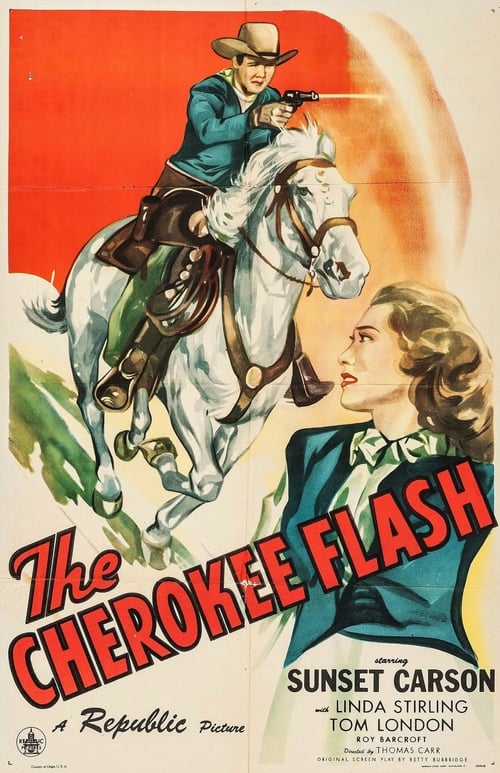
The Cherokee Flash - Review
The Cherokee Flash: A Rootin' Tootin' Western with a Side of Familiarity
The year is 1945. World War II is over, and audiences are seeking escapism and comfort. Enter "The Cherokee Flash," a B-Western offering a familiar tale of injustice, revenge, and frontier justice. While not reinventing the wheel, this film delivers a solid dose of Western thrills, even if it occasionally feels like a well-worn saddle. Let's delve into the dusty world of Jeff Carson and his son, Sunset, and see if this "Flash" still has some spark.
Plot: A Familiar Trail of Treachery
The plot of "The Cherokee Flash" is straightforward, adhering to many classic Western tropes. Jeff Carson, a rancher, finds himself the target of Lawyer Butler, a nefarious character who covets Carson's land. Butler, in a move that would make any villain proud, orchestrates a frame-up, pinning a bank robbery on Carson with the help of the corrupt Sheriff and his gang. The situation worsens when a witness who could exonerate Carson is murdered, and the blame is shifted to Carson's son, Sunset. Forced to flee, Sunset embarks on a mission to clear his father's name, expose the true culprits, and bring justice to the lawless town. The narrative relies heavily on coincidence and convenient plot devices, common in B-Westerns of the era, but it maintains a brisk pace, keeping the viewer engaged despite its predictability.
The story, while simple, suffers from a lack of originality. The "wrongfully accused" trope is a staple of the Western genre, and "The Cherokee Flash" offers little in the way of innovation. The motivations of Lawyer Butler are also somewhat weak; the film doesn't fully explore why Carson's land is so crucial to him, making his villainy feel more generic than nuanced. The ease with which Butler manipulates the Sheriff and other townspeople also strains credulity at times. However, the fast-paced action and the inherent satisfaction of seeing the good guys triumph over evil help to compensate for these shortcomings.
Characters: Archetypes with a Touch of Grit
The characters in "The Cherokee Flash" are largely archetypal, fulfilling specific roles within the Western narrative. Sunset Carson, played by himself, is the quintessential Western hero: brave, resourceful, and fiercely loyal to his family. He's a skilled rider, a crack shot, and possesses an unwavering moral compass. While Sunset Carson's acting range may be limited, he embodies the stoic heroism expected of a Western lead, making him a likable, if somewhat predictable, protagonist.
Lawyer Butler, the antagonist, is a classic Western villain: greedy, unscrupulous, and willing to stop at nothing to achieve his goals. He's portrayed with a sneering contempt that makes him easy to dislike, even if his motivations are somewhat underdeveloped. The Sheriff, a corrupt lawman in Butler's pocket, is another familiar figure, adding to the atmosphere of lawlessness and injustice that pervades the film. Jeff Carson, the wrongly accused father, serves as the catalyst for the plot, providing Sunset with the motivation to fight for justice. While he spends much of the film imprisoned, his presence looms large, reminding the audience of the stakes involved.
The supporting characters, including the townsfolk and members of Butler's gang, are less well-defined, serving primarily as background elements. However, they contribute to the overall atmosphere of the film, reinforcing the sense of a community under siege by corruption and greed. While the characters may lack depth and complexity, they effectively fulfill their roles within the narrative, contributing to the overall enjoyment of the film.
Direction: Competent but Uninspired
The direction of "The Cherokee Flash," helmed by Thomas Carr, is competent but lacks any distinctive flair. Carr, a prolific director of B-Westerns, understands the genre conventions and delivers a film that adheres to them faithfully. The pacing is brisk, the action sequences are well-staged, and the narrative unfolds in a clear and straightforward manner. However, there's little in the way of visual innovation or stylistic experimentation. The film relies heavily on established Western tropes, both in terms of its narrative and its visual presentation.
Carr's direction is functional rather than artistic, prioritizing efficiency and clarity over visual artistry. The film is shot in a straightforward manner, with little use of creative camera angles or elaborate set designs. The emphasis is on capturing the action and conveying the story in a clear and concise manner. While this approach may not result in a visually stunning film, it ensures that the narrative remains engaging and easy to follow.
Compared to the work of more celebrated Western directors like John Ford or Howard Hawks, Carr's direction in "The Cherokee Flash" is decidedly less ambitious. However, it's important to remember that B-Westerns were often produced on tight budgets and under strict time constraints. Carr's ability to deliver a competent and entertaining film under these conditions is a testament to his skill and experience.
Cinematography: Standard B-Western Fare
The cinematography of "The Cherokee Flash" is typical of B-Westerns of the era: functional and unpretentious. The film is shot in black and white, with a focus on capturing the action and conveying the story in a clear and straightforward manner. There's little in the way of elaborate lighting or creative camera angles. The emphasis is on practicality and efficiency, reflecting the limited budget and time constraints under which the film was produced.
The outdoor scenes, shot on location, provide some visual interest, showcasing the rugged beauty of the Western landscape. However, the cinematography rarely transcends the merely functional. The film relies heavily on standard shots and compositions, lacking the visual flair that would elevate it beyond the level of a typical B-Western. The interior scenes are similarly unremarkable, often feeling cramped and artificial.
While the cinematography may not be the film's strongest point, it serves its purpose adequately, providing a clear and unobtrusive visual backdrop for the story. The black and white photography contributes to the film's atmosphere of grit and realism, even if it lacks the visual artistry of more ambitious Westerns.
Performances: Sunset Carson Leads the Charge
The performances in "The Cherokee Flash" are generally competent, with Sunset Carson delivering a solid, if somewhat limited, performance as the heroic Sunset. Carson embodies the stoic, virtuous cowboy archetype, relying on his physical presence and riding skills to convey his character's strength and determination. While his acting range may be restricted, he effectively portrays the character's unwavering commitment to justice and his loyalty to his family.
The supporting cast, including the actors playing Lawyer Butler and the corrupt Sheriff, deliver serviceable performances, effectively portraying their characters' villainy and duplicity. However, none of the performances stand out as particularly memorable or nuanced. The actors fulfill their roles adequately, but they lack the opportunity to explore their characters in any depth.
Overall, the performances in "The Cherokee Flash" are consistent with the expectations of a B-Western. The actors deliver competent portrayals of their characters, but the film's limited budget and time constraints prevent them from delivering truly exceptional performances. Sunset Carson's presence as the lead, however, is undeniable and provides the film with its central appeal.
Themes and Messages: Justice and Family Loyalty
"The Cherokee Flash" explores several familiar themes commonly found in Westerns, including justice, family loyalty, and the struggle against corruption. The film champions the importance of upholding the law and fighting against those who abuse their power. Sunset's unwavering commitment to clearing his father's name and bringing the true culprits to justice underscores the film's message that even in a lawless land, the pursuit of justice is paramount.
The film also emphasizes the importance of family loyalty. Sunset's devotion to his father is the driving force behind his actions, motivating him to risk his life to expose the truth. The film suggests that family bonds are essential, providing strength and support in the face of adversity. The contrast between the Carson family's unwavering loyalty and the Butler gang's self-serving behavior highlights the film's moral message.
The film also touches upon the theme of corruption, depicting a town where the Sheriff and other officials are willing to betray their oaths for personal gain. This theme serves as a cautionary tale, reminding viewers of the dangers of unchecked power and the importance of holding those in authority accountable for their actions. While the film's exploration of these themes may be somewhat simplistic, it reflects the values and concerns of the era in which it was produced.
Comparison to Other Films
"The Cherokee Flash" is a product of its time, fitting squarely within the mold of B-Westerns that were popular in the 1940s. Films like "The Durango Kid" series starring Charles Starrett or the Roy Rogers films shared similar plot structures, character archetypes, and themes. Like those films, "The Cherokee Flash" prioritized action and adventure over nuanced character development or complex narratives. The focus was on providing audiences with a simple, entertaining story that celebrated traditional Western values.
Compared to more ambitious Westerns of the same era, such as John Ford's "My Darling Clementine" or Howard Hawks' "Red River," "The Cherokee Flash" is a much smaller-scale production. These films explored more complex themes and featured more nuanced character portrayals. However, "The Cherokee Flash" was not intended to compete with these films. It was designed to appeal to a different audience, one that was looking for a quick, entertaining dose of Western thrills.
Sunset Carson's own filmography is filled with similar Westerns. He carved out a niche for himself as a reliable, if not groundbreaking, Western star. Comparing "The Cherokee Flash" to other Sunset Carson films reveals a consistent formula: a strong, silent hero, a simple plot, plenty of action, and a happy ending. While these films may not be masterpieces of cinematic art, they provided audiences with a consistent and enjoyable experience.
Positive Aspects
"The Cherokee Flash" offers several positive aspects that contribute to its overall entertainment value. The film's brisk pacing keeps the viewer engaged, preventing the narrative from becoming bogged down in unnecessary details. The action sequences are well-staged and exciting, providing plenty of thrills for Western fans. Sunset Carson's presence as the lead is a definite plus, as he embodies the classic Western hero archetype. The film's simple, straightforward narrative is easy to follow, making it accessible to a wide audience. Finally, the film's celebration of traditional Western values, such as justice and family loyalty, provides a sense of comfort and reassurance.
Constructive Criticism
Despite its positive aspects, "The Cherokee Flash" also suffers from several weaknesses. The plot is predictable and lacks originality, relying heavily on familiar Western tropes. The characters are largely archetypal, lacking depth and complexity. The direction is competent but uninspired, lacking any distinctive visual flair. The cinematography is functional but unremarkable. The film's limited budget and time constraints are evident in its production values. Finally, the film's simplistic exploration of its themes may not appeal to viewers seeking a more nuanced or thought-provoking experience.
Conclusion
"The Cherokee Flash" is a quintessential B-Western, offering a familiar tale of justice and revenge in a lawless frontier. While it may not break any new ground in terms of plot, character development, or visual style, it delivers a solid dose of Western thrills, thanks to its brisk pacing, exciting action sequences, and Sunset Carson's charismatic presence. The film's predictable narrative and archetypal characters may not appeal to all viewers, but those seeking a simple, entertaining Western will likely find something to enjoy. "The Cherokee Flash" is a reminder of a bygone era of filmmaking, when Westerns were a staple of American cinema, providing audiences with a sense of escapism and adventure.
Rating: 6/10
While not a masterpiece, "The Cherokee Flash" is a perfectly serviceable B-Western that provides a decent dose of entertainment for fans of the genre. It's a solid example of the kind of film that was churned out during the Golden Age of Hollywood, offering a familiar story with a reliable hero and plenty of action.