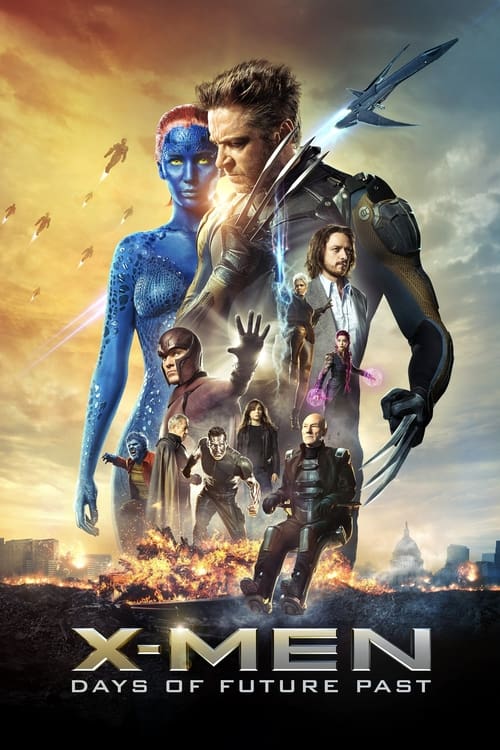
X-Men: Days of Future Past - Review
X-Men: Days of Future Past - A Time-Bending Triumph and a Mutant Masterpiece
Bryan Singer's return to the X-Men franchise with X-Men: Days of Future Past wasn't just a welcome homecoming; it was a seismic event that redefined the series and, arguably, the superhero genre itself. Released in 2014, this time-traveling epic seamlessly blended the original cast with their younger counterparts, creating a narrative tapestry rich in action, emotion, and thought-provoking themes. More than just a spectacle, it was a deeply human story about hope, regret, and the desperate fight for a future worth living. But does it hold up under scrutiny? Let's delve into the past to examine the future of this mutant marvel.
Plot: A Desperate Gambit Across Time
The film opens in a bleak, dystopian future. Mutants are hunted to near extinction by the Sentinels, advanced robotic killing machines designed to adapt to mutant powers. A small band of surviving X-Men, including Professor X (Patrick Stewart), Magneto (Ian McKellen), Storm (Halle Berry), and Wolverine (Hugh Jackman), are constantly on the run, using Kitty Pryde's (Ellen Page) ability to send their consciousness back in time to avoid impending Sentinel attacks. Realizing this is only a temporary solution, they hatch a desperate plan: send Wolverine's consciousness back to 1973 to prevent the event that triggered the Sentinel program – Mystique's (Jennifer Lawrence) capture after assassinating Bolivar Trask (Peter Dinklage), the Sentinels' creator.
Wolverine's mission is fraught with peril. He must find and convince the younger Professor X (James McAvoy) and Magneto (Michael Fassbender), estranged and at odds with each other, to work together. Professor X is a broken man, suppressing his powers with a serum that allows him to walk but disables his telepathy. Magneto is imprisoned deep beneath the Pentagon for his alleged involvement in the JFK assassination. The narrative skillfully intertwines the future storyline with the past, constantly raising the stakes and highlighting the devastating consequences of failure. The future X-Men are fighting a losing battle, buying Wolverine time, while in the past, he must overcome seemingly insurmountable obstacles to alter the course of history.
The plot is complex but remarkably well-executed. The time-travel mechanics are handled with a level of sophistication rarely seen in superhero films, and the narrative avoids many of the common pitfalls associated with the genre. The film cleverly uses the time travel element not just as a plot device, but also as a means of exploring the characters' past traumas and regrets, adding depth and emotional resonance to the action.
Characters: A Symphony of Mutant Personalities
Days of Future Past boasts an impressive ensemble cast, each character contributing significantly to the overall narrative. Let's examine some of the key players:
Wolverine (Hugh Jackman)
Hugh Jackman delivers arguably his best performance as Wolverine. He is the audience's anchor in this complex narrative, the bridge between two generations of X-Men. He carries the weight of the future on his shoulders, burdened by the knowledge of the apocalyptic consequences if he fails. His gruff exterior masks a deep-seated empathy and a fierce determination to protect those he cares about. The film allows him to showcase a vulnerability rarely seen in previous installments, making him a more compelling and relatable character.
Professor X (Patrick Stewart & James McAvoy)
The contrast between the older, wiser Professor X (Patrick Stewart) and his younger, broken counterpart (James McAvoy) is one of the film's greatest strengths. McAvoy's portrayal of a Charles Xavier grappling with depression, addiction, and the loss of his powers is both heartbreaking and inspiring. He captures the character's intellectual brilliance and inherent goodness, but also his deep-seated insecurities and self-doubt. Stewart's Professor X provides a beacon of hope, guiding Wolverine and reminding the younger Xavier of the potential for good that lies within him.
Magneto (Ian McKellen & Michael Fassbender)
Similarly, the dynamic between the older, hardened Magneto (Ian McKellen) and his younger, more radical self (Michael Fassbender) is fascinating. Fassbender continues to deliver a nuanced and compelling portrayal of a man driven by fear and a desire to protect his kind at any cost. His Magneto is not simply a villain; he is a complex character shaped by trauma and prejudice. McKellen's Magneto embodies the consequences of his past actions, a cautionary tale of the dangers of unchecked power and unwavering conviction.
Mystique (Jennifer Lawrence)
Jennifer Lawrence's Mystique is a pivotal character in the film. Her actions in 1973 are the catalyst for the dystopian future. She is portrayed as a conflicted individual, torn between her loyalty to her fellow mutants and her growing disillusionment with Professor X's pacifist approach. Lawrence brings a depth and vulnerability to the character, making her motivations understandable, even if her actions are ultimately destructive. The film explores the complexities of her relationship with both Professor X and Magneto, highlighting the divergent paths they have taken.
Bolivar Trask (Peter Dinklage)
Peter Dinklage delivers a chilling performance as Bolivar Trask, the brilliant but ruthless scientist obsessed with eradicating the mutant threat. He is not portrayed as a mustache-twirling villain, but as a man genuinely convinced that he is acting in the best interests of humanity. Dinklage imbues the character with a quiet intensity and a chilling pragmatism, making him a formidable adversary.
Quicksilver (Evan Peters)
While a smaller role, Evan Peters' Quicksilver steals every scene he's in. His powers are visually stunning, and his irreverent personality provides a much-needed dose of levity to the otherwise serious tone of the film. The "time in a bottle" sequence set to Jim Croce's "Time in a Bottle" is a highlight of the entire movie, showcasing the creative use of Quicksilver's abilities and the film's overall visual flair.
Direction: Singer's Triumphant Return
Bryan Singer's direction is masterful. He seamlessly blends the different timelines, characters, and storylines into a cohesive and engaging narrative. He understands the essence of the X-Men – their struggle for acceptance, their complex relationships, and their unwavering commitment to protecting those who fear and hate them. Singer's direction is both visually stunning and emotionally resonant, creating a film that is both a thrilling action spectacle and a deeply human story.
Singer's attention to detail is evident throughout the film. He pays homage to the source material while also taking creative liberties to enhance the narrative. He creates a believable and immersive world, both in the dystopian future and the turbulent 1970s. His ability to balance the large ensemble cast and give each character their moment to shine is a testament to his skill as a director.
Cinematography: A Visual Feast
The cinematography in Days of Future Past is breathtaking. Newton Thomas Sigel's work is visually stunning, creating a distinct look and feel for each timeline. The dystopian future is bleak and desolate, with muted colors and stark lighting, reflecting the grim reality of the mutant's struggle for survival. The 1970s are vibrant and chaotic, with saturated colors and dynamic camera movements, capturing the energy and uncertainty of the era.
The action sequences are expertly choreographed and visually impressive. The use of slow motion and visual effects is seamless and enhances the impact of the action. The Quicksilver scene is a prime example of the film's visual ingenuity, showcasing the creative use of the character's powers and the film's overall visual flair. The film's visual effects are groundbreaking, particularly in the depiction of the Sentinels and the mutant powers.
Performances: A Stellar Ensemble
The performances in Days of Future Past are universally strong. Hugh Jackman delivers a career-defining performance as Wolverine, embodying the character's strength, vulnerability, and unwavering determination. James McAvoy and Michael Fassbender continue to impress as the younger Professor X and Magneto, respectively, bringing depth and complexity to their roles. Jennifer Lawrence delivers a nuanced and compelling portrayal of Mystique, capturing the character's inner turmoil and her struggle for identity. The supporting cast, including Patrick Stewart, Ian McKellen, Halle Berry, Ellen Page, and Peter Dinklage, all deliver memorable performances.
The chemistry between the actors is palpable, particularly between McAvoy and Fassbender. Their on-screen dynamic is electric, capturing the complex and often tumultuous relationship between Professor X and Magneto. The actors bring a level of authenticity and emotional depth to their roles, making the characters feel real and relatable.
Themes and Messages: Hope Amidst Despair
Days of Future Past explores several important themes, including hope, regret, prejudice, and the importance of unity. The film highlights the devastating consequences of prejudice and the dangers of unchecked power. The Sentinels represent the ultimate manifestation of fear and hatred, a symbol of humanity's willingness to destroy what it doesn't understand.
The film also emphasizes the importance of hope and the power of redemption. Despite the bleakness of the future, the X-Men never give up fighting for a better tomorrow. Professor X's unwavering belief in the potential for good in all people serves as a beacon of hope in the darkness. The film suggests that even the most damaged individuals can find redemption and make a positive impact on the world.
Ultimately, Days of Future Past is a story about unity and the importance of working together to overcome adversity. The X-Men, despite their differences, must unite to save the future. The film suggests that by embracing diversity and working together, humanity can overcome even the most daunting challenges.
Comparison to Other Films and Works
Days of Future Past stands out among other superhero films for its complex plot, well-developed characters, and thought-provoking themes. It surpasses many of its contemporaries in terms of its emotional depth and its willingness to tackle difficult issues. The film also benefits from Bryan Singer's return to the franchise, as he brings a level of understanding and respect for the source material that was lacking in some of the previous installments.
Compared to previous X-Men films, Days of Future Past is a significant improvement in terms of both storytelling and visual effects. It effectively retcons some of the weaker aspects of the earlier films, creating a more cohesive and satisfying narrative. The film also sets a new standard for superhero action sequences, with its expertly choreographed and visually stunning set pieces.
The time-travel element invites comparisons to other films in the genre, such as Back to the Future and Terminator. However, Days of Future Past distinguishes itself by using time travel not just as a plot device, but also as a means of exploring the characters' past traumas and regrets. The film's focus on character development and emotional resonance sets it apart from many other time-travel movies.
Positive Aspects
- Compelling and complex plot
- Well-developed and relatable characters
- Masterful direction by Bryan Singer
- Breathtaking cinematography and visual effects
- Strong performances from the entire cast
- Thought-provoking themes and messages
- Seamless blending of timelines and characters
- Effective retconning of previous X-Men films
- The Quicksilver sequence is a standout moment
Constructive Criticism
- Some minor plot holes related to time travel mechanics
- The future storyline could have been more fully developed
- Certain characters, such as Storm, felt underutilized
- The film's ending, while satisfying, felt somewhat rushed
Conclusion
X-Men: Days of Future Past is a triumph of the superhero genre. It is a visually stunning, emotionally resonant, and intellectually stimulating film that will stay with you long after the credits roll. Bryan Singer's return to the franchise is a resounding success, and the film's ensemble cast delivers stellar performances. While not without its minor flaws, Days of Future Past is a must-see for fans of the X-Men and superhero movies in general. It is a testament to the power of storytelling and the enduring appeal of these iconic characters.
Rating: 9.5/10