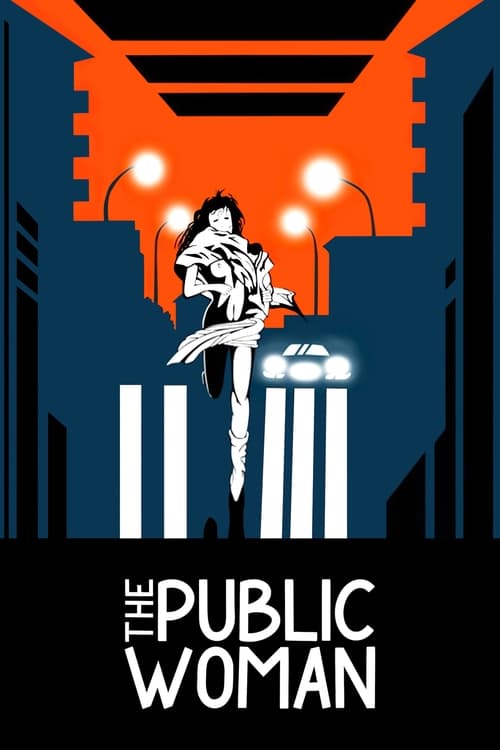
The Public Woman - Review
Andrzej Zulawski's "The Public Woman": A Descent into Madness and Artifice
Andrzej Zulawski, a name synonymous with cinematic extremity, delivers a potent, unsettling, and ultimately unforgettable experience with his 1984 film, "The Public Woman" (La Femme Publique). This is not a film for the faint of heart, nor is it a film easily digested. It's a challenging, demanding work of art that dives headfirst into the murky waters of identity, performance, political manipulation, and the destructive power of obsession. Prepare to be challenged, disturbed, and perhaps even mesmerized by Zulawski's unflinching vision.
Plot: A Tangled Web of Art, Politics, and Identity
The film centers on Ethel (Valérie Kaprisky), a young, relatively inexperienced actress who lands the role of Maria in a film adaptation of Dostoyevsky's "The Possessed." The director, Lucas (Francis Huster), a Czech émigré living in Paris, is a force of nature – a whirlwind of creative energy, demanding perfection, and seemingly intent on blurring the lines between reality and fiction. As Ethel immerses herself in the role, Lucas increasingly manipulates her, pushing her to embrace the character's madness and instability.
The narrative takes a sharp, unsettling turn when Ethel is thrust into a real-life scenario mirroring the political intrigue of the film she's acting in. Lucas, it turns out, is involved in a complex plot orchestrated by another Czech émigré, Milan (Lambert Wilson), who is emotionally unstable and haunted by the memory of his deceased wife. Lucas convinces Ethel to impersonate Milan's dead wife, a manipulative tactic designed to drive Milan to commit a political assassination.
The plot, while initially appearing straightforward, quickly unravels into a labyrinthine exploration of identity, performance, and the blurring of boundaries. The film within a film creates a constant sense of unease, as we are never quite sure where Ethel's performance ends and her true self begins. The political subplot, while somewhat underdeveloped, adds another layer of complexity, highlighting the ways in which individuals can be manipulated and exploited for political gain.
Characters: Lost Souls Trapped in a World of Deception
Ethel (Valérie Kaprisky): The central figure, Ethel, is a vulnerable and impressionable young woman who is easily swayed by Lucas's charisma and manipulative tactics. Kaprisky delivers a powerful performance, portraying Ethel's transformation from a naive actress to a woman consumed by the role she plays and the dangerous game she's drawn into. She embodies both the fragility and the strength of a woman struggling to maintain her identity in the face of overwhelming pressure.
Lucas (Francis Huster): Lucas is a complex and deeply flawed character. He is a brilliant director, driven by a desire to create art that is both challenging and provocative. However, he is also a manipulative and self-serving individual who is willing to exploit those around him to achieve his artistic vision. Huster's portrayal of Lucas is both captivating and repulsive, capturing the duality of a man who is both an artist and a monster.
Milan (Lambert Wilson): Milan is a tormented and emotionally unstable man haunted by the death of his wife. He is easily manipulated by Lucas, who uses Ethel to exploit his grief and drive him to commit a political assassination. Wilson delivers a heartbreaking performance, portraying Milan's vulnerability and desperation with remarkable depth and nuance.
The relationships between these characters are fraught with tension, manipulation, and betrayal. Lucas preys on Ethel's naiveté and Milan's grief, using them as pawns in his own twisted game. Ethel, in turn, is torn between her desire to please Lucas and her growing realization that she is being used. Milan, lost in his grief and manipulated by Lucas, becomes a tragic figure, a victim of both political intrigue and emotional exploitation.
Direction: Zulawski's Signature Style
Andrzej Zulawski's direction is the defining characteristic of "The Public Woman." He employs his signature style, characterized by frenetic camera movements, long takes, and intense performances, to create a sense of unease and disorientation. The camera often feels intrusive, as if it is invading the characters' personal space and exposing their innermost thoughts and emotions.
Zulawski's use of long takes allows the actors to fully inhabit their roles and explore the emotional complexities of their characters. These extended scenes can be both mesmerizing and unsettling, as they force the viewer to confront the raw, unfiltered emotions of the characters. The frenetic camera movements add to the sense of chaos and instability, reflecting the characters' inner turmoil and the chaotic world they inhabit.
His direction is not for everyone. It's demanding, often overwhelming, and deliberately confrontational. But it is also undeniably powerful and effective in conveying the film's themes of identity, manipulation, and the blurring of reality and fiction. Zulawski's directorial choices are not merely stylistic flourishes; they are integral to the film's meaning and impact.
Cinematography: A Visual Representation of Inner Turmoil
The cinematography, primarily handled by Dominique Chapuis, is crucial in establishing the film's unsettling atmosphere. The use of stark lighting, claustrophobic framing, and unconventional camera angles contributes to the sense of unease and disorientation. The camera often lingers on the characters' faces, capturing their raw emotions and exposing their vulnerabilities.
The film's color palette is often muted and desaturated, reflecting the bleakness and despair of the characters' lives. However, there are also moments of vibrant color, particularly in the film-within-a-film sequences, which serve to highlight the artificiality and theatricality of the characters' performances. The cinematography effectively contrasts the real world with the world of artifice, blurring the lines between the two.
The camerawork is often handheld, adding to the sense of immediacy and intimacy. This technique allows the viewer to feel as if they are right there in the room with the characters, witnessing their emotional breakdowns and their moments of vulnerability. The cinematography is not merely visually appealing; it is an essential tool in conveying the film's themes and creating its unsettling atmosphere.
Performances: Intense and Unflinching
The performances in "The Public Woman" are nothing short of extraordinary. Valérie Kaprisky delivers a tour-de-force performance as Ethel, capturing her vulnerability, her confusion, and her eventual descent into madness. Her performance is both captivating and disturbing, as she fully embodies the character's emotional turmoil and the blurring of her identity.
Francis Huster is equally impressive as Lucas, the manipulative and self-serving director. He portrays Lucas as a charismatic but ultimately destructive figure, driven by his artistic vision but willing to exploit those around him to achieve his goals. Huster's performance is both captivating and repulsive, capturing the duality of a man who is both an artist and a monster.
Lambert Wilson delivers a heartbreaking performance as Milan, the emotionally unstable man haunted by the death of his wife. He portrays Milan's vulnerability and desperation with remarkable depth and nuance, making him a tragic figure who is easily manipulated by Lucas. The supporting cast is also excellent, adding depth and complexity to the film's world.
The actors fully commit to their roles, delivering intense and unflinching performances that are both emotionally raw and psychologically complex. Their performances are essential to the film's success, as they bring the characters to life and make their struggles feel real and relatable, even in the most extreme circumstances.
Themes and Messages: Identity, Manipulation, and the Power of Art
"The Public Woman" explores several complex and thought-provoking themes, including identity, manipulation, and the power of art. The film questions the nature of identity, suggesting that it is not fixed or stable but rather fluid and malleable, shaped by external forces and internal desires. Ethel's struggle to maintain her identity in the face of Lucas's manipulation and the demands of her role highlights the fragility of the self and the ease with which it can be lost or distorted.
The film also examines the theme of manipulation, exploring the ways in which individuals can be exploited for personal or political gain. Lucas's manipulation of Ethel and Milan highlights the dangers of unchecked power and the importance of resisting those who seek to control and exploit others. The political subplot adds another layer to this theme, suggesting that individuals can also be manipulated by political forces and used as pawns in larger power struggles.
Finally, the film explores the power of art, suggesting that it can be both transformative and destructive. Lucas's obsession with his art leads him to exploit and manipulate those around him, ultimately causing them great harm. However, the film also suggests that art can be a powerful tool for self-discovery and expression, allowing individuals to explore their innermost thoughts and emotions. The film's ambiguous ending leaves the viewer to ponder the ultimate impact of art on the characters' lives.
Comparison to Other Films and Zulawski's Oeuvre
"The Public Woman" shares thematic similarities with other films that explore the blurring of reality and fiction, such as David Lynch's "Mulholland Drive" and Ingmar Bergman's "Persona." Like those films, "The Public Woman" challenges the viewer to question what is real and what is not, and to consider the ways in which our perceptions can be manipulated and distorted.
Within Zulawski's own filmography, "The Public Woman" can be seen as a companion piece to his earlier film, "Possession" (1981). Both films explore themes of madness, obsession, and the disintegration of relationships. However, "The Public Woman" is perhaps more grounded in reality than "Possession," which incorporates elements of horror and the supernatural.
Compared to "Possession," "The Public Woman" offers a more direct commentary on the world of filmmaking and the ways in which artists can exploit and manipulate those around them. While both films are challenging and disturbing, "The Public Woman" may be slightly more accessible to viewers unfamiliar with Zulawski's work, due to its more straightforward narrative and its less overtly surreal imagery.
Positive Aspects and Constructive Criticism
Positive Aspects:
- Powerful Performances: The performances of Valérie Kaprisky, Francis Huster, and Lambert Wilson are all exceptional.
- Zulawski's Vision: Zulawski's unique directorial style creates a truly unforgettable cinematic experience.
- Thought-Provoking Themes: The film explores complex and relevant themes of identity, manipulation, and the power of art.
- Unflinching Depiction of Madness: The film's portrayal of mental instability is both realistic and disturbing.
Constructive Criticism:
- Political Subplot: The political subplot could have been more fully developed to add greater depth to the narrative.
- Pacing: The film's pacing can be uneven at times, with some scenes feeling overly long and drawn out.
- Accessibility: Zulawski's directorial style is not for everyone, and some viewers may find the film too challenging or disturbing.
Conclusion
"The Public Woman" is a challenging, unsettling, and ultimately rewarding cinematic experience. Andrzej Zulawski's unflinching vision, combined with the powerful performances of the cast, creates a film that is both disturbing and thought-provoking. While the film may not be for everyone, those who are willing to embrace its challenges will find it to be a truly unforgettable work of art. It's a film that stays with you long after the credits roll, prompting reflection on the nature of identity, the dangers of manipulation, and the complex relationship between art and reality.
Rating: 8.5/10