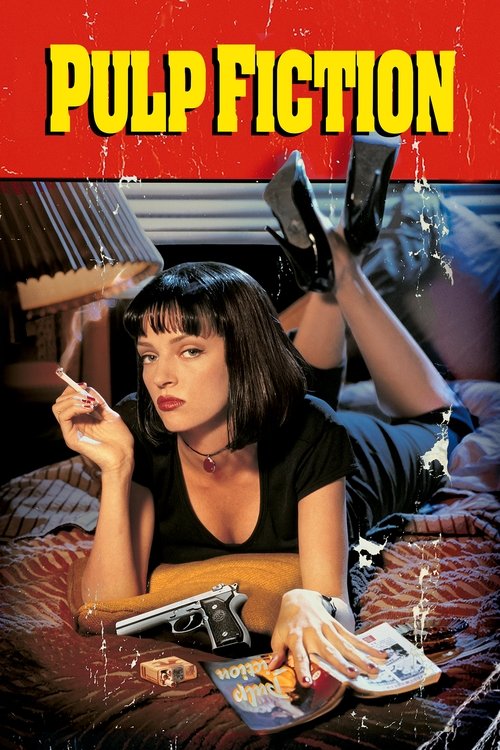
Pulp Fiction - Review
Pulp Fiction: A Timeless Masterpiece of Crime and Conversation
Quentin Tarantino's Pulp Fiction, released in 1994, isn't just a film; it's a cultural phenomenon. It's a cinematic Molotov cocktail, a potent mix of violence, wit, and pop culture references that exploded onto the screen and redefined independent filmmaking. Forget neatly packaged narratives and predictable tropes; Pulp Fiction is a nonlinear, hyper-stylized rollercoaster ride through the underbelly of Los Angeles, a world populated by hitmen who debate the merits of foot massages, boxers who throw fights, and gangsters who accidentally shoot people in the face. More than two decades later, its influence remains undeniable, its dialogue endlessly quotable, and its impact on cinema permanently etched in celluloid. But does its legacy hold up under scrutiny? Let's delve into the messy, brilliant world of Pulp Fiction and find out.
Plot: A Non-Linear Symphony of Violence and Vice
The genius of Pulp Fiction lies not just in what happens, but how it happens. Tarantino masterfully deconstructs a traditional narrative structure, presenting three interwoven stories in a deliberately jumbled order. This nonlinear approach creates a sense of disorientation and intrigue, forcing the audience to piece together the events and relationships themselves. We start with "The Diner Robbery," introducing Pumpkin (Tim Roth) and Honey Bunny (Amanda Plummer), two small-time robbers who decide to hold up a diner. This scene, initially appearing to be the film's climax, is actually its opening salvo, a shot of adrenaline directly to the viewer's veins.
Next, we're thrust into "Vincent Vega and Marsellus Wallace's Wife," where we meet Vincent Vega (John Travolta), a heroin-addicted hitman tasked with escorting Mia Wallace (Uma Thurman), the wife of his intimidating boss, Marsellus Wallace (Ving Rhames). This segment is arguably the film's most iconic, featuring a tense dinner scene, a twist contest, and a near-fatal overdose that showcases Tarantino's talent for balancing humor and suspense. The story then pivots to "The Gold Watch," focusing on Butch Coolidge (Bruce Willis), an aging boxer paid by Marsellus to throw a fight. Butch double-crosses Marsellus, leading to a thrilling chase and a bizarre encounter with a sadistic pawnshop owner and his gimp.
Finally, we return to "The Bonnie Situation," which directly follows the accidental shooting of Marvin (Phil LaMarr) in Vincent and Jules' (Samuel L. Jackson) car. This segment is a masterclass in comedic tension, as the duo enlists the help of Winston Wolfe (Harvey Keitel), a "cleaner" who expertly orchestrates the disposal of the body and the cleaning of the car. The film then circles back to the diner robbery, providing a satisfying sense of closure and completing the narrative loop.
While the nonlinear structure might seem confusing at first, it ultimately enhances the film's themes and adds to its overall impact. By fragmenting the narrative, Tarantino forces us to pay closer attention to the individual moments and characters, allowing us to appreciate the richness and complexity of his world-building.
Characters: A Rogues' Gallery of Memorable Personalities
Pulp Fiction is populated by a cast of unforgettable characters, each with their own quirks, motivations, and distinctive voices. Vincent Vega, played with a cool swagger by John Travolta, is a heroin-addicted hitman struggling with his own moral compass. His conversations with Jules Winnfield, his philosophical partner, are a highlight of the film, exploring everything from the meaning of foot massages to the nuances of European fast food.
Jules Winnfield, brought to life by Samuel L. Jackson in a career-defining performance, is a complex and compelling character. A cold-blooded killer with a penchant for quoting Ezekiel 25:17, Jules experiences a moment of profound epiphany after surviving a seemingly impossible shootout. This experience leads him to question his violent lifestyle and ultimately choose a path of redemption.
Mia Wallace, Uma Thurman's enigmatic and captivating character, is the quintessential femme fatale. She's a drug-addled socialite with a sharp wit and a mysterious allure. Her dance scene with Vincent is one of the film's most memorable moments, perfectly capturing the tension and chemistry between the two characters.
Butch Coolidge, played by Bruce Willis, is a washed-up boxer trying to escape his past. He's a man of few words, but his actions speak volumes. His desperate fight for survival in the pawnshop scene showcases his resilience and determination.
Marsellus Wallace, portrayed by Ving Rhames, is a powerful and intimidating gangster. While he doesn't have as much screen time as the other main characters, his presence looms large over the entire film. His humiliation and capture in the pawnshop scene is a shocking and unforgettable moment.
Even the supporting characters, like Winston Wolfe (Harvey Keitel), Pumpkin (Tim Roth), and Honey Bunny (Amanda Plummer), are memorable and well-developed. Each character contributes to the film's unique atmosphere and adds to its overall richness.
Direction and Cinematography: A Visual Feast
Tarantino's direction in Pulp Fiction is nothing short of masterful. He employs a variety of techniques, including long takes, close-ups, and unconventional camera angles, to create a visually dynamic and engaging experience. The film's pacing is impeccable, seamlessly blending moments of intense action with scenes of quiet conversation.
The cinematography, by Andrzej Sekuła, is equally impressive. The film is visually striking, with a vibrant color palette and a keen eye for detail. The use of light and shadow is particularly effective, creating a sense of mood and atmosphere. The camera work is fluid and dynamic, constantly moving and shifting to keep the viewer engaged.
Tarantino's use of music is also noteworthy. The soundtrack, a eclectic mix of surf rock, soul, and funk, perfectly complements the film's tone and adds to its overall coolness. The music is not just background noise; it's an integral part of the storytelling, enhancing the emotional impact of each scene.
Performances: A Career-Defining Ensemble
Pulp Fiction boasts an ensemble cast at the peak of their powers. John Travolta's performance as Vincent Vega revitalized his career, earning him an Academy Award nomination for Best Actor. Samuel L. Jackson's portrayal of Jules Winnfield is arguably his most iconic role, and he also received an Academy Award nomination for Best Supporting Actor. Uma Thurman's performance as Mia Wallace is equally memorable, earning her an Academy Award nomination for Best Supporting Actress.
Bruce Willis delivers a strong and nuanced performance as Butch Coolidge, showcasing his range as an actor. Ving Rhames is perfectly cast as the menacing Marsellus Wallace, and Harvey Keitel shines as the efficient and professional Winston Wolfe.
The supporting cast is equally impressive, with memorable performances from Tim Roth, Amanda Plummer, Christopher Walken, and Steve Buscemi. Each actor brings their A-game, contributing to the film's overall brilliance.
Themes and Messages: Beyond the Violence
Beneath the surface of violence and profanity, Pulp Fiction explores a number of complex and thought-provoking themes. One of the central themes is the nature of good and evil. The film challenges us to question our assumptions about morality and to consider the complexities of human behavior. Jules Winnfield's transformation is a prime example of this, as he grapples with his own violent past and seeks redemption.
Another important theme is the power of chance and circumstance. Many of the events in the film are driven by random occurrences, highlighting the unpredictable nature of life. The accidental shooting of Marvin, for example, is a pivotal moment that sets off a chain of events with far-reaching consequences.
The film also explores the theme of redemption. Jules' decision to abandon his life of crime is a powerful statement about the possibility of change and the importance of personal responsibility. Even Butch Coolidge, a man who has made many mistakes, ultimately chooses to do the right thing.
Pulp Fiction also satirizes and celebrates pop culture. The film is filled with references to movies, music, and television, reflecting Tarantino's deep knowledge and love of popular culture. These references are not just throwaway jokes; they're an integral part of the film's identity, adding to its overall coolness and appeal.
Comparison to Other Films and Works
Pulp Fiction is often compared to other crime films, such as Reservoir Dogs (also directed by Tarantino) and Goodfellas (directed by Martin Scorsese). Like these films, Pulp Fiction explores the lives of criminals and the violence they perpetrate. However, Pulp Fiction distinguishes itself through its nonlinear narrative, its hyper-stylized aesthetic, and its focus on dialogue and character development.
Reservoir Dogs, Tarantino's debut film, shares many of the same stylistic elements as Pulp Fiction, including its use of violence, its focus on dialogue, and its non-chronological storytelling. However, Reservoir Dogs is a much smaller and more contained film, focusing on a single heist gone wrong. Pulp Fiction, on the other hand, is a sprawling epic that encompasses multiple storylines and characters.
Goodfellas, Scorsese's masterpiece of the gangster genre, is a more realistic and grounded film than Pulp Fiction. While Goodfellas also explores the lives of criminals, it does so in a more documentary-like style, focusing on the rise and fall of Henry Hill. Pulp Fiction, on the other hand, is a more stylized and self-aware film, embracing its own artificiality.
Positive Aspects
Pulp Fiction is a film that excels on almost every level. Its nonlinear narrative is innovative and engaging, its characters are unforgettable, its direction and cinematography are masterful, and its performances are outstanding. The film's dialogue is sharp, witty, and endlessly quotable. Its soundtrack is iconic and perfectly complements the film's tone. The film's themes are complex and thought-provoking, exploring the nature of good and evil, the power of chance, and the possibility of redemption. Pulp Fiction is a film that stays with you long after the credits have rolled.
Constructive Criticism
While Pulp Fiction is undoubtedly a masterpiece, it's not without its flaws. Some critics have argued that the film's violence is gratuitous and excessive. Others have criticized its use of racial slurs and stereotypes. While these criticisms are valid, they should be viewed in the context of the film's overall themes and its satirical intent. Tarantino is not necessarily endorsing the violence or the language depicted in the film; rather, he is using them to explore the darker aspects of human nature and to challenge our assumptions about morality.
Another potential criticism is the film's length. At nearly three hours, Pulp Fiction can feel a bit long for some viewers. However, the film's pacing is generally excellent, and each scene is essential to the overall narrative. The length allows Tarantino to fully develop his characters and to explore his themes in depth.
Conclusion
Pulp Fiction is a landmark film that redefined independent cinema and continues to influence filmmakers to this day. Its innovative narrative structure, its unforgettable characters, its masterful direction, and its outstanding performances make it a truly unique and unforgettable cinematic experience. While it's not without its flaws, its strengths far outweigh its weaknesses. Pulp Fiction is a must-see for any serious film enthusiast.
Rating: 10/10