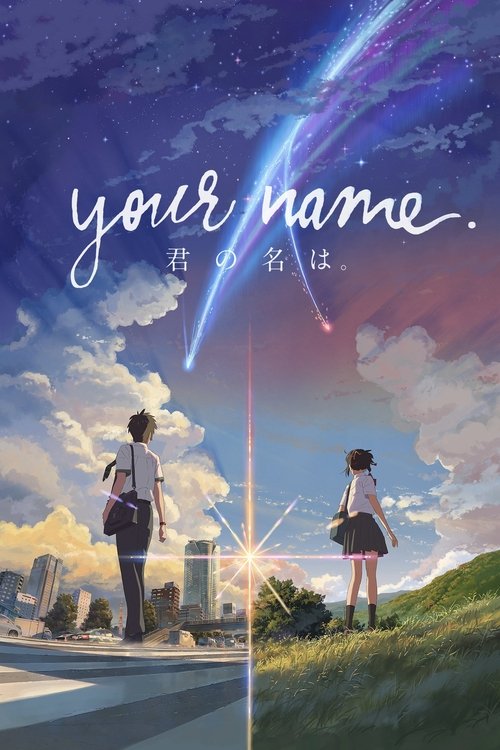
Your Name. - Review
A Celestial Dance of Fate: A Review of Makoto Shinkai's "Your Name."
In a cinematic landscape often dominated by superhero sagas and predictable blockbusters, Makoto Shinkai's Your Name. (Kimi no Na wa.) arrived in 2016 like a comet streaking across the night sky. It wasn't just a box office success; it was a cultural phenomenon, captivating audiences worldwide with its breathtaking animation, emotionally resonant story, and profound exploration of connection, memory, and destiny. More than just a body-swap comedy or a teenage romance, Your Name. is a meticulously crafted masterpiece that lingers in the mind long after the credits roll, prompting reflection on the invisible threads that bind us together. But does this film truly deserve the overwhelming praise it has received, or is its success a product of perfect timing and clever marketing? Let's delve into the heart of this celestial dance and unravel the magic of Your Name.
Plot: A Tapestry of Time and Connection
The narrative premise of Your Name. is deceptively simple: Mitsuha Miyamizu, a high school girl living in the rural town of Itomori, yearns for a life beyond her small-town existence. Taki Tachibana, a high school boy in bustling Tokyo, juggles his studies with a part-time job and dreams of becoming an architect. One day, they inexplicably begin to switch bodies in their sleep. These body swaps are initially chaotic and comedic, leading to hilarious misunderstandings and social faux pas. However, as the swaps become more frequent, Mitsuha and Taki begin to communicate, leaving notes and establishing rules to navigate each other's lives. They form a unique bond, becoming essential to each other's well-being and happiness.
The first act of the film is a delightful exploration of this body-swap dynamic. We witness the humor of Mitsuha, a traditional girl, navigating the fast-paced, modern world of Tokyo as Taki, and vice versa. Shinkai masterfully utilizes visual gags and situational comedy to establish the characters and their contrasting environments. However, Your Name. is far more than just a lighthearted comedy. As the narrative progresses, a sense of mystery and impending doom begins to permeate the story. The body swaps abruptly cease, leaving Taki with a lingering sense of unease and a determination to find Mitsuha. His search leads him to Itomori, where he discovers a devastating truth: the town was destroyed three years prior by a fragment of a comet, and Mitsuha was among the casualties.
This plot twist completely recontextualizes the entire story, transforming it from a charming body-swap romance into a desperate race against time. Taki, refusing to accept Mitsuha's fate, embarks on a quest to reconnect with her across time and space. He learns about the Miyamizu family's ancestral rituals and uses the sacred kuchikamizake (fermented rice wine) to attempt to enter Mitsuha's body once more, hoping to warn her and the townspeople of the impending disaster. The film's climax is a thrilling and emotionally charged sequence where Taki and Mitsuha, briefly reunited, must convince the townspeople to evacuate before the comet strikes. They face skepticism, disbelief, and the limitations of their own memories, which are rapidly fading. The ending, while bittersweet, offers a glimmer of hope, suggesting that their connection transcends time and space, leading them to a destined reunion.
One minor criticism of the plot lies in its reliance on exposition to explain the complex time-travel mechanics and the Miyamizu family's history. While necessary for understanding the narrative, these exposition dumps can sometimes feel clunky and disrupt the film's otherwise smooth pacing. Additionally, the initial comedic tone of the body-swap sequences might feel jarring to some viewers when contrasted with the film's later, more serious themes.
Characters: Hearts Aching Across Time
Mitsuha and Taki are not just plot devices; they are fully realized characters with distinct personalities, desires, and flaws. Mitsuha is a spirited and independent girl, frustrated by the constraints of her rural life and yearning for a taste of the excitement and freedom of Tokyo. Her longing for something more makes her incredibly relatable. Taki, on the other hand, is a hardworking and ambitious young man, focused on his future but also carrying a quiet loneliness. His determination to find Mitsuha, even after learning of her death, showcases his unwavering loyalty and deep-seated empathy.
The supporting characters, while not as central to the plot, are equally well-developed and contribute significantly to the film's emotional depth. Mitsuha's grandmother, Hitoha Miyamizu, serves as a wise and enigmatic figure, connecting the story to the ancient traditions and beliefs of the Miyamizu family. Her teachings about musubi (the flow of time and the connections between people) provide a crucial framework for understanding the film's themes. Mitsuha's friends, Tesshi and Sayaka, offer unwavering support and loyalty, even when they don't fully understand what's happening. Similarly, Taki's friends, Tsukasa and Okudera-senpai, provide comedic relief and a sense of normalcy in his increasingly bizarre life.
However, the film primarily focuses on the emotional journey of Mitsuha and Taki. Their initial confusion and amusement at the body swaps gradually evolve into a deep sense of connection and longing. They learn to rely on each other, offering support and guidance through difficult situations. Their relationship transcends physical presence, demonstrating the power of shared experiences and the enduring nature of human connection. The voice acting performances (both Japanese and English dubs) are exceptional, capturing the nuances of the characters' emotions and personalities. Ryunosuke Kamiki (Taki) and Mone Kamishiraishi (Mitsuha) deliver particularly compelling performances, conveying the characters' vulnerability, determination, and ultimately, their unwavering hope.
Direction: A Masterclass in Visual Storytelling
Makoto Shinkai's direction is arguably the film's greatest strength. He masterfully weaves together elements of fantasy, romance, and disaster to create a visually stunning and emotionally resonant experience. Shinkai's attention to detail is evident in every frame, from the meticulously rendered backgrounds of Itomori and Tokyo to the subtle expressions on the characters' faces. He utilizes light and color to create mood and atmosphere, enhancing the emotional impact of key scenes. For example, the vibrant sunsets over Itomori evoke a sense of nostalgia and longing, while the stark contrast between the bustling streets of Tokyo and the serene landscapes of the countryside highlights the differences between Mitsuha and Taki's lives.
Shinkai's use of montage is particularly effective in conveying the passage of time and the evolving relationship between Mitsuha and Taki. These montages are not just a collection of pretty images; they are carefully constructed sequences that tell a story in themselves, capturing the essence of their daily lives and the growing bond between them. The film's pacing is expertly controlled, allowing moments of quiet reflection to balance the more action-packed sequences. Shinkai also employs visual metaphors and symbolism to enrich the narrative. The recurring motif of the red thread, for instance, represents the invisible connections that bind people together, while the comet symbolizes both destruction and the potential for renewal.
Shinkai's direction elevates Your Name. beyond a simple anime film, transforming it into a cinematic experience that is both visually breathtaking and emotionally profound. He demonstrates a masterful understanding of visual storytelling, using every element of the filmmaking process to enhance the narrative and create a truly unforgettable experience.
Cinematography: Painting with Light and Emotion
The cinematography of Your Name. is nothing short of breathtaking. The film is a visual feast, showcasing the beauty of both the natural world and the urban landscape. The meticulously detailed backgrounds are rendered with stunning clarity and depth, creating a sense of immersion that draws the viewer into the story. The use of color is particularly striking, with vibrant hues that evoke a range of emotions, from the warmth of nostalgia to the coldness of despair. The lighting is equally impressive, creating dramatic shadows and highlights that enhance the mood and atmosphere of each scene.
The film's visual style is heavily influenced by Shinkai's signature aesthetic, characterized by its photorealistic detail and its use of lens flare and bokeh effects. These techniques create a sense of ethereal beauty, adding a dreamlike quality to the film. The camera angles and movements are carefully chosen to emphasize the emotional impact of each scene. Close-ups are used to capture the characters' expressions and emotions, while wide shots are used to showcase the grandeur of the landscapes and the scale of the disaster. The film's visual effects are seamlessly integrated into the animation, creating a sense of realism that enhances the overall experience.
The cinematography of Your Name. is not just visually stunning; it is also deeply symbolic, reflecting the film's themes of connection, memory, and destiny. The recurring motif of the sky, for instance, represents the vastness of time and space, as well as the interconnectedness of all things. The comet, with its fiery trail, symbolizes both destruction and the potential for renewal. The film's visual language is rich and nuanced, inviting the viewer to interpret the story on multiple levels.
Performances: Voices that Resonate
As mentioned earlier, the voice acting performances in Your Name. are exceptional, both in the original Japanese and the English dub. Ryunosuke Kamiki and Mone Kamishiraishi deliver particularly compelling performances as Taki and Mitsuha, capturing the characters' vulnerability, determination, and ultimately, their unwavering hope. Their voices are perfectly suited to the characters, conveying their emotions with authenticity and nuance. The supporting voice cast is equally strong, bringing depth and personality to their respective roles.
The success of the voice acting lies not only in the technical skill of the actors but also in their ability to connect with the characters on an emotional level. They imbue their performances with a sense of genuine empathy, making the characters feel relatable and believable. The English dub, directed by Michael Sinterniklaas, is particularly noteworthy for its high quality and its faithful adherence to the original Japanese script. The voice actors, including Michael Sinterniklaas as Taki and Stephanie Sheh as Mitsuha, deliver nuanced and emotionally resonant performances that capture the essence of the characters.
The performances in Your Name. are not just about delivering lines; they are about bringing the characters to life, making them feel real and relatable. The voice actors succeed in this regard, creating a cast of characters that viewers can connect with on a deep and emotional level.
Themes and Messages: Unraveling the Threads of Destiny
Your Name. is a film rich in themes and messages, exploring profound concepts such as connection, memory, destiny, and the power of hope. At its core, the film is a celebration of human connection, demonstrating the enduring power of relationships that transcend time and space. Mitsuha and Taki's bond is not just a romantic one; it is a connection that is forged through shared experiences, mutual support, and a deep understanding of each other's hearts. The film suggests that even in the face of overwhelming odds, human connection can provide strength, resilience, and ultimately, hope.
The theme of memory is also central to the film. Mitsuha and Taki struggle to retain their memories of each other, highlighting the fragility of human memory and the importance of cherishing the moments we have. The film suggests that even though memories may fade, the emotions and experiences associated with them can linger, shaping our identities and guiding our actions. The concept of musubi, the flow of time and the connections between people, provides a framework for understanding the film's exploration of memory and destiny. The film suggests that everything is connected, and that even seemingly random events can have profound consequences.
Ultimately, Your Name. is a film about hope. Despite the devastation and loss that they experience, Mitsuha and Taki never give up on their quest to find each other and to save the town of Itomori. Their unwavering belief in the power of connection and the possibility of a better future is ultimately what allows them to overcome the obstacles they face. The film offers a message of hope and resilience, suggesting that even in the darkest of times, there is always reason to believe in the possibility of a brighter tomorrow.
Comparisons: Echoes of the Past, Visions of the Future
Your Name. has drawn comparisons to other body-swap comedies, such as Freaky Friday and The Lake House, but Shinkai's film transcends the limitations of the genre by incorporating elements of fantasy, disaster, and profound emotional depth. While sharing the basic premise of two individuals swapping bodies, Your Name. delves into deeper thematic territory, exploring the nature of time, memory, and destiny in a way that few other films have attempted.
In terms of Shinkai's previous work, Your Name. represents a significant evolution in his storytelling style. While his earlier films, such as 5 Centimeters Per Second and The Garden of Words, were characterized by their melancholic tone and their focus on the bittersweet nature of unrequited love, Your Name. offers a more optimistic and hopeful perspective. The film also features a more complex and engaging narrative structure, incorporating elements of time travel and disaster to create a thrilling and emotionally resonant experience.
Some critics have compared Your Name. to Hayao Miyazaki's films, particularly Spirited Away, due to its themes of environmentalism and its use of Japanese folklore. However, Shinkai's film has a distinct style and sensibility that sets it apart from Miyazaki's work. While Miyazaki's films often feature fantastical creatures and whimsical adventures, Your Name. is grounded in a more realistic setting, exploring the everyday lives and emotions of its characters.
Ultimately, Your Name. stands on its own as a unique and unforgettable cinematic experience. It draws inspiration from various sources, but it ultimately transcends its influences to create something truly original and profound.
Constructive Criticism: A Few Minor Flaws
While Your Name. is undoubtedly a masterpiece, it is not without its minor flaws. As mentioned earlier, the film's reliance on exposition can sometimes feel clunky and disrupt the pacing. The explanation of the time-travel mechanics and the Miyamizu family's history could have been integrated more seamlessly into the narrative. Additionally, the initial comedic tone of the body-swap sequences might feel jarring to some viewers when contrasted with the film's later, more serious themes. A more gradual shift in tone might have made the transition feel smoother.
Furthermore, some critics have argued that the film's ending is somewhat ambiguous and unsatisfying. While the final scene offers a glimmer of hope, it leaves many questions unanswered. The fate of Itomori, the long-term impact of the comet strike, and the details of Mitsuha and Taki's relationship are all left unresolved. While ambiguity can be a powerful tool in storytelling, some viewers may find the lack of closure frustrating.
Finally, the film's popularity and critical acclaim have led to some backlash, with some critics accusing it of being overly sentimental and manipulative. While it is true that Your Name. is an emotionally charged film, its emotional impact is earned through its compelling characters, its stunning visuals, and its profound themes. The film's emotional resonance is not simply a result of manipulation; it is a reflection of the genuine human connection that lies at the heart of the story.
Conclusion: A Timeless Masterpiece
Despite its minor flaws, Your Name. remains a cinematic triumph. Makoto Shinkai has crafted a visually stunning, emotionally resonant, and profoundly moving film that transcends the limitations of the animation genre. The film's exploration of connection, memory, destiny, and the power of hope is both timeless and universal, resonating with audiences of all ages and backgrounds. The voice acting performances are exceptional, the cinematography is breathtaking, and the direction is masterful. Your Name. is a film that will stay with you long after the credits roll, prompting reflection on the invisible threads that bind us together and the enduring power of human connection. It is a testament to the power of storytelling and a reminder that even in the face of overwhelming odds, there is always reason to hope.
Rating: 9.5/10