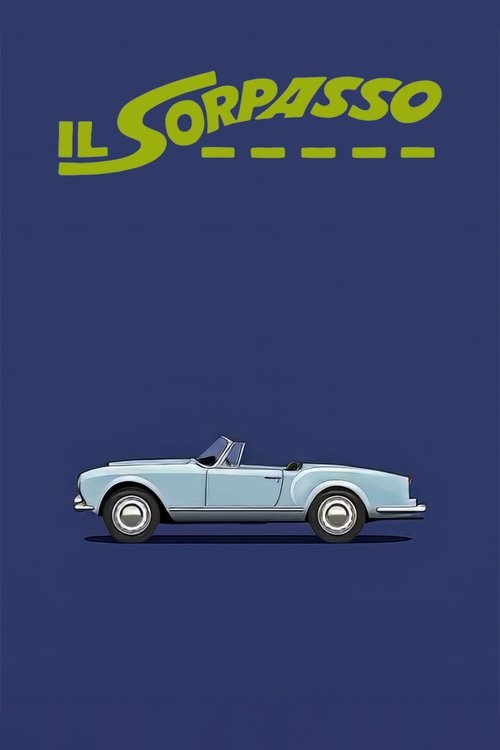
Il Sorpasso - Review
Il Sorpasso: A Timeless Italian Road Trip of Life, Loss, and Reckless Abandon
Dino Risi's Il Sorpasso, released in 1962, isn't just a film; it's a sun-drenched, exhaust-fume-filled journey into the heart of post-war Italy, a land grappling with newfound freedoms and the lingering echoes of a more traditional past. More than a simple road movie, it's a poignant exploration of friendship, responsibility, and the intoxicating allure of living in the moment, even when that moment is hurtling towards a potentially devastating collision. This isn't just a film to watch; it's a film to experience, to feel the heat of the Italian summer, the rumble of the Lancia Aurelia, and the unsettling weight of Bruno's reckless charm.
Plot: A Chance Encounter, a Chaotic Journey
The film opens on a deserted Rome street on Ferragosto, the traditional Italian summer holiday. Roberto Mariani (Jean-Louis Trintignant), a shy and conscientious law student, is holed up in his apartment, diligently studying while the rest of the city is celebrating. His quiet routine is shattered by the arrival of Bruno Cortona (Vittorio Gassman), a boisterous, middle-aged man driving a flashy Lancia Aurelia Spider. Bruno, a man of impulsive actions and questionable employment, is looking for a phone to call a friend. He convinces the hesitant Roberto to join him for a quick drink, a decision that irrevocably alters the course of Roberto's summer.
What begins as a brief detour quickly transforms into an extended road trip through the Italian countryside. Bruno, with his devil-may-care attitude and relentless energy, drags Roberto out of his shell, exposing him to a world of fast cars, beautiful women, and carefree abandon. They encounter various characters along the way: a gas station attendant, a group of American tourists, Bruno's ex-wife and daughter, and a young woman on the beach who briefly captures Roberto's attention. Each encounter reveals a different facet of Italian society and contributes to the growing tension between the two protagonists.
As the journey progresses, Roberto begins to question Bruno's recklessness and the consequences of his actions. He observes Bruno's strained relationship with his daughter, Lili, and witnesses his casual disregard for the rules of the road and the feelings of others. The carefree facade begins to crack, revealing a deeper insecurity and a desperate attempt to recapture a lost youth. The film culminates in a tragic accident, a direct consequence of Bruno's reckless driving, forcing Roberto to confront the harsh realities of life and the devastating impact of unchecked irresponsibility.
Characters: Contrasting Personalities, Compelling Dynamics
The success of Il Sorpasso hinges on the contrasting personalities of its two central characters and the dynamic that develops between them.
Bruno Cortona (Vittorio Gassman)
Bruno is the embodiment of the Italian "vitellone," a charismatic but ultimately aimless man who lives for the moment. He's loud, impulsive, and often inconsiderate, yet he possesses a undeniable charm that draws people to him. Gassman's performance is nothing short of iconic, capturing Bruno's swagger, his vulnerability, and his underlying desperation. He's a man clinging to a youthful image, desperately trying to outrun the inevitable march of time. Bruno's recklessness isn't simply a character flaw; it's a symptom of his fear of aging and his inability to confront the realities of his life. Gassman masterfully portrays this inner turmoil beneath the surface of Bruno's flamboyant exterior.
Roberto Mariani (Jean-Louis Trintignant)
Roberto is Bruno's polar opposite: quiet, reserved, and conscientious. He represents the traditional values of hard work and responsibility. Trintignant's portrayal of Roberto is subtle and nuanced, capturing his initial reluctance and gradual transformation as he's exposed to Bruno's world. He's initially drawn to Bruno's carefree spirit, seeing it as a welcome escape from his own stifling routine. However, as the journey progresses, he becomes increasingly aware of Bruno's flaws and the potential consequences of his actions. Roberto's character arc is one of awakening, as he learns to assert himself and make his own choices, even if it means confronting the charismatic Bruno.
The relationship between Bruno and Roberto is the heart of the film. Bruno acts as a catalyst, pulling Roberto out of his shell and exposing him to new experiences. Roberto, in turn, serves as a moral compass, subtly challenging Bruno's behavior and forcing him to confront his own shortcomings. Their friendship is ultimately a fragile one, built on a foundation of contrasting values and a shared desire for something more than their current lives. The film skillfully portrays the complexities of this relationship, highlighting both the positive and negative influences they have on each other.
Direction and Cinematography: Capturing the Essence of Italy
Dino Risi's direction is masterful, creating a film that is both visually stunning and emotionally resonant. He expertly captures the beauty of the Italian countryside, contrasting it with the frenetic energy of Bruno's driving and the underlying anxieties of the characters. The pacing of the film is deliberate, allowing the audience to fully immerse themselves in the journey and to observe the subtle nuances of the characters' interactions.
The cinematography, by Alfio Contini, is equally impressive. The use of black and white film adds a timeless quality to the film, while also emphasizing the stark contrasts between light and shadow, reflecting the contrasting personalities of Bruno and Roberto. The camera work is dynamic, capturing the speed and excitement of the road while also lingering on moments of quiet reflection. The scenes of the Italian countryside are particularly breathtaking, showcasing the beauty and diversity of the landscape.
Risi's use of music is also noteworthy. The film's soundtrack, featuring classic Italian songs, perfectly complements the mood and atmosphere of the film. The music adds a layer of nostalgia and reflects the changing social landscape of Italy in the early 1960s. The sound design is also effective, capturing the sounds of the road, the engine of the Lancia Aurelia, and the bustling atmosphere of the Italian towns and cities.
Themes and Messages: A Reflection on Italian Society
Il Sorpasso is more than just a road movie; it's a social commentary on the changing values of Italian society in the early 1960s. The film explores themes of:
* The Generation Gap: The contrasting personalities of Bruno and Roberto represent the growing divide between the older generation, clinging to traditional values, and the younger generation, embracing new freedoms and opportunities. Bruno's reckless behavior can be seen as a rejection of the constraints of the past, while Roberto's cautiousness reflects a desire for stability and security. * The Allure of Freedom: The open road represents the promise of freedom and escape, a chance to break free from the constraints of everyday life. Bruno embodies this desire for freedom, living impulsively and without regard for the consequences. However, the film also suggests that true freedom comes with responsibility and that unchecked recklessness can lead to devastating consequences. * The Search for Identity: Both Bruno and Roberto are searching for their place in the world. Bruno is trying to recapture his youth, while Roberto is trying to define his own identity. Their journey together forces them to confront their own insecurities and to make choices that will shape their future. * The Dangers of Materialism: The film subtly critiques the growing materialism of Italian society. Bruno's flashy car and his pursuit of pleasure are symbolic of this materialistic trend. The film suggests that true happiness cannot be found in material possessions but rather in meaningful relationships and a sense of purpose. * The Illusion of Happiness: Bruno's outward exuberance masks a deep-seated unhappiness. He's constantly seeking pleasure and excitement, but he's unable to find lasting satisfaction. The film suggests that true happiness comes from within and that it cannot be achieved through superficial pursuits.Comparisons: Echoes of the Past, Seeds of the Future
Il Sorpasso shares similarities with other road movies, such as Easy Rider (1969) and Thelma & Louise (1991), in its exploration of freedom, rebellion, and the search for identity. However, Il Sorpasso is unique in its Italian context and its focus on the specific social and cultural changes occurring in Italy at the time.
In terms of Dino Risi's other works, Il Sorpasso can be seen as a precursor to his later comedies, such as Profumo di donna (1974), which also explore themes of aging, masculinity, and the complexities of human relationships. Vittorio Gassman's performance in Il Sorpasso is often compared to his roles in other Italian comedies, such as I soliti ignoti (1958), where he also played a charismatic but ultimately flawed character.
Jean-Louis Trintignant's role in Il Sorpasso is a departure from his earlier, more romantic roles in French cinema. His performance in this film showcases his versatility as an actor and his ability to portray complex and nuanced characters.
Positive Aspects: A Masterpiece of Italian Cinema
Il Sorpasso is a masterpiece of Italian cinema for several reasons:
* Compelling Characters: Bruno and Roberto are unforgettable characters, brought to life by Gassman and Trintignant's exceptional performances. * Masterful Direction: Dino Risi's direction is flawless, creating a film that is both visually stunning and emotionally resonant. * Thought-Provoking Themes: The film explores complex themes of freedom, responsibility, and the changing values of Italian society. * Timeless Quality: Il Sorpasso remains relevant and engaging even today, its themes and characters resonating with audiences across generations. * Iconic Status: The film has achieved iconic status in Italian cinema, influencing countless other films and filmmakers.Constructive Criticism: Minor Imperfections in a Near-Perfect Film
While Il Sorpasso is a near-perfect film, there are a few minor criticisms that can be made:
* Pacing: Some viewers may find the pacing of the film to be slow at times, particularly in the middle section. * Ending: The ending, while tragic and impactful, may feel somewhat abrupt to some viewers. A slightly more developed aftermath could have added more weight. * Subtlety: While the film's social commentary is insightful, some viewers may find it to be too subtle, particularly in the early scenes.However, these criticisms are minor and do not detract significantly from the overall quality of the film.
Conclusion: A Timeless Classic Worth Revisiting
Il Sorpasso is a timeless classic of Italian cinema, a film that continues to resonate with audiences decades after its release. Dino Risi's masterful direction, Vittorio Gassman and Jean-Louis Trintignant's unforgettable performances, and the film's thought-provoking themes make it a must-see for any film enthusiast. This is more than just a road movie; it's a profound exploration of life, loss, and the reckless pursuit of happiness. It's a film that stays with you long after the credits roll, prompting reflection on your own values and choices.