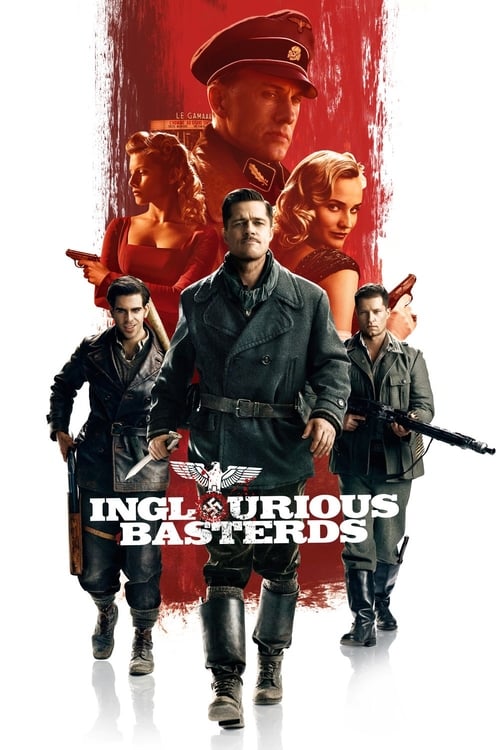
Inglourious Basterds - Review
Inglourious Basterds: A Tarantino Masterpiece of Revenge and Revisionist History
Quentin Tarantino's Inglourious Basterds isn't just a war film; it's a cinematic Molotov cocktail hurled at historical convention. Released in 2009, this audacious, genre-bending epic reimagines World War II through the lens of Tarantino's signature wit, violence, and unforgettable dialogue. More than a simple action flick, it's a provocative exploration of revenge, identity, and the power of cinema itself. Prepare to be both thrilled and challenged as we delve into the intricate layers of this modern classic.
Plot: A Twisted Tale of Two Missions
The film weaves together two seemingly disparate storylines that ultimately converge in a spectacular and violent finale. The first follows the exploits of "The Basterds," a group of Jewish-American soldiers handpicked by the ruthless Lieutenant Aldo Raine (Brad Pitt) to instill fear into the hearts of the Nazi regime. Their mission: to scalp and kill as many Nazis as possible, leaving a trail of terror and propaganda in their wake. Raine's brutal methods and the Basterds' unwavering commitment to their task create a compelling and morally ambiguous narrative. He instructs his men to get him 100 Nazi scalps, and he expects them to do it. The Basterds are not heroes in the traditional sense; they are instruments of vengeance, driven by a primal need for retribution. Meanwhile, in Paris, Shosanna Dreyfus (Mélanie Laurent), a young Jewish woman who narrowly escaped a Nazi massacre, operates a cinema under an assumed identity. When a propaganda film starring the German war hero Fredrick Zoller (Daniel Brühl) premieres at her theater, she sees an opportunity for revenge. Her plan is to burn the theater down with the entire Nazi elite inside. The two plots begin to intertwine when the Basterds, seeking to assassinate Hitler and his high command, learn about the premiere and devise their own plan to infiltrate the event. The film masterfully builds tension as the characters' paths converge, creating a powder keg of suspense that explodes in a breathtaking climax.
Characters: A Gallery of Unforgettable Personalities
Tarantino excels at crafting memorable characters, and Inglourious Basterds is no exception. Each character, from the protagonists to the supporting players, is richly drawn and imbued with unique quirks and motivations.
Lieutenant Aldo Raine (Brad Pitt):
Pitt delivers a career-defining performance as the charismatic and utterly ruthless Aldo Raine. His Southern drawl, his unwavering determination, and his penchant for branding Nazis with a swastika carved into their foreheads make him an instantly iconic figure. Raine is a man driven by a singular purpose: to inflict as much pain and suffering on the enemy as possible. He's not concerned with morality or the rules of war; he's simply focused on achieving his objective, no matter the cost.
Shosanna Dreyfus/Emmanuelle Mimieux (Mélanie Laurent):
Laurent delivers a powerful and nuanced performance as Shosanna, a woman haunted by the past and determined to exact revenge. Her transformation from a terrified survivor to a calculating and resourceful avenger is compelling and emotionally resonant. She embodies the resilience and strength of the Jewish people in the face of unimaginable horror.
Colonel Hans Landa (Christoph Waltz):
Waltz's portrayal of Colonel Hans Landa, the "Jew Hunter," is nothing short of masterful. He is charming, intelligent, and utterly terrifying. Landa is a brilliant detective, capable of uncovering the truth with seemingly effortless ease. However, his charm is a facade, masking a cold and calculating mind. He is a master manipulator, using his intelligence and charisma to achieve his goals, regardless of the consequences. Waltz's performance earned him an Academy Award for Best Supporting Actor, and rightfully so. He steals every scene he's in.
Sergeant Hugo Stiglitz (Til Schweiger):
Stiglitz, a former German soldier who defected and began killing Nazi officers, is a silent and deadly force within the Basterds. His reputation precedes him, and his presence adds a palpable sense of danger to the group.
Private First Class Donny Donowitz/The Bear Jew (Eli Roth):
Roth's portrayal of Donny Donowitz, nicknamed "The Bear Jew," is both terrifying and darkly humorous. His signature weapon – a baseball bat – becomes a symbol of Jewish vengeance, as he brutally beats Nazis to death. He is a figure of pure, unadulterated rage.
Fredrick Zoller (Daniel Brühl):
Brühl portrays Zoller, a German war hero turned actor, with a mix of arrogance and vulnerability. He is both a symbol of Nazi propaganda and a flawed human being, adding complexity to the character.
Direction and Cinematography: Tarantino's Signature Style
Tarantino's direction is as bold and distinctive as ever in Inglourious Basterds. He employs his signature techniques, including extended dialogue scenes, non-linear storytelling, and sudden bursts of violence, to create a uniquely engaging and unsettling cinematic experience. His meticulous attention to detail, from the period costumes to the carefully chosen soundtrack, immerses the viewer in the world of Nazi-occupied Europe. The cinematography, by Robert Richardson, is equally impressive. The film is visually stunning, with striking compositions, dramatic lighting, and a keen eye for detail. Richardson's use of color and shadow enhances the film's atmosphere, creating a sense of tension and unease. The camera work is dynamic and fluid, often moving in unexpected ways to capture the action and emotions of the characters. The close-ups are particularly effective, allowing the audience to connect with the characters on a deeper level.
Performances: A Stellar Ensemble Cast
Inglourious Basterds boasts a truly exceptional ensemble cast, with each actor delivering a memorable performance. Brad Pitt is excellent as Aldo Raine, bringing a mix of charisma and menace to the role. Mélanie Laurent is captivating as Shosanna, portraying her character's strength and vulnerability with equal skill. Daniel Brühl is compelling as Fredrick Zoller, adding depth and complexity to what could have been a one-dimensional villain. However, it is Christoph Waltz who truly shines in the film. His portrayal of Hans Landa is a masterclass in acting, earning him widespread critical acclaim and numerous awards. He brings a unique blend of charm, intelligence, and menace to the role, creating a character that is both fascinating and terrifying. The supporting cast is equally strong, with memorable performances from Eli Roth, Til Schweiger, Michael Fassbender, and Diane Kruger.
Themes and Messages: Revenge, Identity, and the Power of Cinema
Inglourious Basterds explores a range of complex themes and messages, including revenge, identity, and the power of cinema. The film is, at its core, a story about revenge. The Basterds are driven by a desire to avenge the atrocities committed by the Nazis, while Shosanna seeks to avenge the murder of her family. Tarantino presents revenge as a primal and often brutal force, but also as a form of justice in a world where traditional justice seems impossible. The film also explores the theme of identity. The Basterds, as Jewish-American soldiers, are fighting for their identity and their right to exist. Shosanna, hiding her Jewish identity, must confront her past and reclaim her heritage. The film suggests that identity is not fixed but rather fluid and shaped by experience. Perhaps the most intriguing theme of Inglourious Basterds is the power of cinema. Shosanna uses her cinema as a weapon of revenge, while the Nazis use cinema as a tool of propaganda. The film suggests that cinema can be both a powerful force for good and a dangerous weapon of manipulation. Tarantino, as a filmmaker, is acutely aware of the power of his medium, and he uses it to challenge our perceptions of history and morality.
Comparison to Other Films and Director's Previous Work
Inglourious Basterds shares some thematic similarities with other revenge films, such as Kill Bill, also directed by Tarantino. Both films feature protagonists who are driven by a desire for vengeance and who are willing to use extreme violence to achieve their goals. However, Inglourious Basterds is a more complex and nuanced film than Kill Bill, exploring deeper themes of identity, history, and the power of cinema. In terms of historical revisionism, Inglourious Basterds can be compared to films like The Producers (1967) which uses satire to mock the Nazi regime, albeit in a comedic fashion. However, Tarantino's approach is more audacious and provocative, rewriting history in a way that is both shocking and cathartic. Compared to Tarantino's other works, Inglourious Basterds is perhaps his most ambitious and mature film. It showcases his signature style – the witty dialogue, the graphic violence, the eclectic soundtrack – but it also demonstrates a deeper understanding of history and human nature. The film is a culmination of Tarantino's cinematic obsessions, blending genres, styles, and influences to create a truly unique and unforgettable experience.
Positive Aspects: A Cinematic Triumph
Inglourious Basterds is a triumph on many levels. The film is brilliantly directed, beautifully shot, and impeccably acted. The script is sharp, witty, and full of memorable lines. The characters are complex, compelling, and utterly unforgettable. The film's themes are thought-provoking and relevant. But perhaps the most impressive aspect of Inglourious Basterds is its sheer audacity. Tarantino dares to rewrite history, to challenge our perceptions of good and evil, and to push the boundaries of cinematic storytelling. He succeeds in creating a film that is both entertaining and intellectually stimulating, a rare feat in modern cinema.
Constructive Criticism: Minor Flaws in a Masterpiece
While Inglourious Basterds is undoubtedly a masterpiece, it is not without its flaws. Some critics have argued that the film is too long and that some of the dialogue scenes are overly indulgent. Others have criticized the film's historical inaccuracies and its glorification of violence. While these criticisms have some merit, they ultimately pale in comparison to the film's many strengths. The extended dialogue scenes, while occasionally lengthy, are essential to the film's character development and thematic exploration. The historical inaccuracies, while present, are intentional and serve to underscore the film's revisionist nature. The violence, while graphic, is not gratuitous but rather serves to highlight the brutality of war and the consequences of hatred. One could also argue that the ending, while satisfying on a visceral level, is somewhat simplistic and undermines the film's more complex themes. The assassination of Hitler and the Nazi high command, while a crowd-pleasing moment, feels somewhat like a Hollywood fantasy, at odds with the film's more nuanced exploration of history and morality. The final scene with Aldo Raine marking Landa also feels a little tacked on, though it does reinforce the themes of revenge and justice.
Conclusion: A Bold and Unforgettable Cinematic Experience
Inglourious Basterds is a bold, audacious, and unforgettable cinematic experience. It's a film that challenges, provokes, and entertains in equal measure. Tarantino's masterful direction, the stellar performances, and the thought-provoking themes make it a must-see for any serious film enthusiast. While it's not without its minor flaws, its strengths far outweigh its weaknesses. It's a film that stays with you long after the credits roll, prompting reflection and debate. It's a testament to the power of cinema and the enduring legacy of Quentin Tarantino.