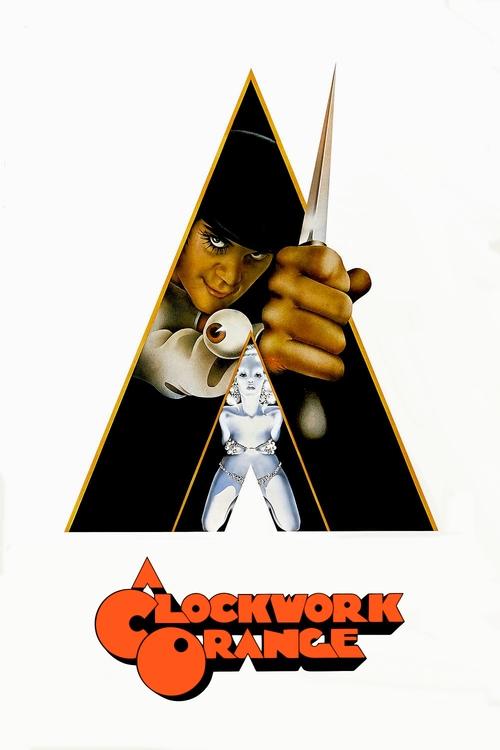
A Clockwork Orange - Review
A Clockwork Orange: A Symphony of Violence and Free Will
Stanley Kubrick's A Clockwork Orange, released in 1971, is not merely a film; it's a visceral experience. A provocative, disturbing, and darkly comedic exploration of free will, morality, and the nature of good and evil, it remains as relevant and unsettling today as it was upon its initial release. This isn't a movie you watch passively; it's a film that claws its way into your subconscious, forcing you to confront uncomfortable truths about society and yourself. Prepare to be challenged, disturbed, and ultimately, captivated.
Plot: A Descent into Madness and a Twisted Redemption
The film plunges us headfirst into the world of Alex DeLarge (Malcolm McDowell), a charismatic but utterly depraved young man living in a dystopian Britain. Alex, along with his "droogs" Pete, Georgie, and Dim, spends his nights engaging in acts of "ultra-violence": brutal beatings, robberies, and sexual assaults. These acts are depicted with a stylized, almost operatic quality, set to a soundtrack that jarringly juxtaposes classical music (particularly Beethoven) with the graphic violence on screen.
The first act establishes Alex's reign of terror. He's a hedonist, driven by primal urges and a love for Beethoven. He enjoys the power he wields over his droogs and the victims he terrorizes. However, his reign is cut short when his droogs, tired of his domineering leadership, betray him during a home invasion, leading to his arrest and imprisonment for murder.
Desperate to escape prison, Alex volunteers for the "Ludovico Technique," an experimental aversion therapy program designed to "cure" him of his violent tendencies. This forms the film's second act. Through forced exposure to violent imagery while heavily medicated, Alex is conditioned to associate violence with nausea and pain. The Ludovico Technique effectively removes his ability to choose between good and evil, rendering him a passive, albeit outwardly reformed, individual.
The final act explores the consequences of Alex's "cure." Released back into society, he finds himself vulnerable and defenseless. He's rejected by his parents, attacked by former victims, and manipulated by political forces. The "cure" has not made him a better person; it has merely stripped him of his free will, leaving him a puppet of the state. The film ends with Alex, after being subjected to further psychological manipulation, seemingly reverting to his old self, suggesting that forced conformity is ultimately unsustainable and perhaps even more dangerous than the original problem.
Characters: Villains, Victims, and the Gray Areas In Between
A Clockwork Orange boasts a cast of memorable, albeit often disturbing, characters. However, it's essential to understand they are not simply good or evil; they exist within a complex moral landscape.
- Alex DeLarge (Malcolm McDowell): Alex is the film's central figure and anti-hero. McDowell delivers a mesmerizing performance, portraying Alex with a chilling charisma and unsettling charm. He's a monster, but also a strangely compelling figure. His love for Beethoven adds a layer of complexity to his character, suggesting a capacity for beauty and appreciation that is tragically twisted by his violent nature. While his actions are reprehensible, the film also forces us to question the morality of the state's attempt to control him through the Ludovico Technique.
- The Droogs (Pete, Georgie, Dim): Alex's droogs are essentially extensions of his own violent impulses. They lack the intelligence and charisma of Alex, making them easily manipulated and ultimately, treacherous. Their betrayal of Alex highlights the inherent instability of power dynamics within a group driven by violence.
- The Writer (Patrick Magee): The writer, whose home is invaded by Alex and his droogs, represents the vulnerability of the individual in the face of societal breakdown. He's a symbol of intellectualism and artistic expression, both of which are threatened by Alex's mindless violence. Later, he becomes a political pawn, using Alex's suffering to advance his own agenda.
- Dr. Brodsky and Dr. Branom: These doctors represent the cold, detached rationality of the scientific establishment. They are willing to sacrifice individual autonomy in the name of societal order, believing that the ends justify the means. Their unwavering belief in the Ludovico Technique blinds them to its potential consequences.
- The Minister of the Interior: The Minister represents the cynical pragmatism of the political establishment. He sees Alex as a tool to be used for political gain, exploiting his suffering to bolster his own image and silence his critics. He's a master of manipulation, willing to sacrifice individual rights for the sake of political expediency.
Direction and Cinematography: A Visual Masterpiece
Stanley Kubrick's direction is nothing short of masterful. He creates a visually arresting and unsettling world, using a combination of stylized violence, striking set design, and innovative camera techniques.
- Set Design: The film's sets are deliberately artificial and exaggerated, creating a sense of unease and alienation. The Korova Milkbar, with its milk-dispensing statues and surreal atmosphere, is a prime example. The use of bright colors and geometric shapes further contributes to the film's unsettling aesthetic.
- Camera Techniques: Kubrick employs a variety of camera techniques to enhance the film's impact. Wide-angle lenses distort perspective, creating a sense of claustrophobia and disorientation. Slow-motion sequences emphasize the brutality of the violence, while fast-motion sequences add a touch of dark humor. The use of subjective camera angles puts the viewer directly into Alex's perspective, forcing us to confront his actions from his point of view.
- Music: The film's soundtrack is a brilliant and unsettling blend of classical music and electronic scores. The juxtaposition of Beethoven's Ninth Symphony with scenes of ultra-violence is particularly jarring, highlighting the inherent contradictions within Alex's character. The use of synthesized music adds to the film's futuristic and dystopian atmosphere.
The cinematography, by John Alcott, is equally impressive. The use of natural lighting creates a sense of realism, while the carefully composed shots enhance the film's visual impact. The film's color palette is dominated by bright, saturated colors, which contribute to its unsettling and surreal atmosphere.
Performances: McDowell's Tour de Force
Malcolm McDowell's performance as Alex DeLarge is the heart and soul of A Clockwork Orange. He delivers a tour-de-force performance, capturing the character's charisma, depravity, and vulnerability with equal skill. His ability to switch seamlessly between charming sociopath and helpless victim is truly remarkable.
The supporting cast is also excellent. Patrick Magee is chillingly effective as the writer, while Michael Bates and Warren Clarke deliver memorable performances as the doctors. The droogs, played by James Marcus, Aubrey Morris, and Paul Farrell, are suitably menacing and unhinged.
Themes and Messages: Free Will, Morality, and the State
A Clockwork Orange explores a number of complex and challenging themes.
- Free Will vs. Determinism: The film's central theme is the conflict between free will and determinism. Is it better to allow individuals to choose between good and evil, even if they choose evil, or is it justifiable to strip them of their free will in order to ensure societal order? The Ludovico Technique represents the ultimate form of determinism, attempting to control behavior through conditioning.
- The Nature of Good and Evil: The film challenges our conventional notions of good and evil. Alex is undeniably evil, but the state's attempt to "cure" him raises questions about the nature of morality. Is it possible to force someone to be good, or does true goodness require genuine choice?
- The Role of the State: A Clockwork Orange is highly critical of the state's power to control and manipulate individuals. The film suggests that the state can be just as dangerous as the criminals it seeks to control, particularly when it resorts to unethical and inhumane methods.
- The Dangers of Conformity: The film warns against the dangers of forced conformity. When individuals are stripped of their free will and forced to conform to societal norms, they become puppets of the state, devoid of individuality and critical thinking.
- The Power of Art: Beethoven's music plays a significant role in the film, representing the power of art to inspire and uplift. However, the film also suggests that art can be twisted and used for nefarious purposes, as when Alex's love for Beethoven is exploited during the Ludovico Technique.
Comparison to Other Films and Works
A Clockwork Orange can be compared to other dystopian films that explore similar themes of social control and individual freedom. Films like Nineteen Eighty-Four (1984) and Brazil (1985) also depict societies where the state exerts absolute control over its citizens.
In terms of Kubrick's own filmography, A Clockwork Orange shares some similarities with Dr. Strangelove (1964) in its use of dark humor and its critique of political power. Both films are satirical and provocative, challenging viewers to question the status quo.
Malcolm McDowell's performance in A Clockwork Orange can be compared to his performance in other films, such as If.... (1968), where he also plays a rebellious and anti-establishment character. However, Alex DeLarge is a much more complex and morally ambiguous character than Mick Travis in If....
Positive Aspects
- Malcolm McDowell's Performance: McDowell's portrayal of Alex is iconic and unforgettable.
- Kubrick's Direction: Kubrick's masterful direction creates a visually stunning and unsettling film.
- The Film's Themes: The film's exploration of free will, morality, and the role of the state is thought-provoking and relevant.
- The Soundtrack: The film's soundtrack is a brilliant and unsettling blend of classical music and electronic scores.
- The Film's Impact: A Clockwork Orange is a film that stays with you long after you've seen it, prompting reflection and discussion.
Constructive Criticism
- The Violence: The film's graphic violence can be disturbing and off-putting to some viewers. While the violence is stylized, it is still quite intense.
- The Pacing: The film's pacing can be uneven at times. Some scenes feel rushed, while others feel overly drawn out.
- The Ending: The film's ending is somewhat ambiguous and may leave some viewers feeling unsatisfied.
Conclusion
A Clockwork Orange is a challenging, disturbing, and ultimately brilliant film. Stanley Kubrick's masterful direction, Malcolm McDowell's unforgettable performance, and the film's thought-provoking themes make it a cinematic masterpiece. While the film's violence may be off-putting to some, it is an essential part of its exploration of free will, morality, and the nature of good and evil. A Clockwork Orange is not a film for the faint of heart, but it is a film that will stay with you long after you've seen it, prompting reflection and discussion. It's a cinematic experience that demands to be wrestled with, debated, and ultimately, appreciated for its audacity and its enduring relevance.