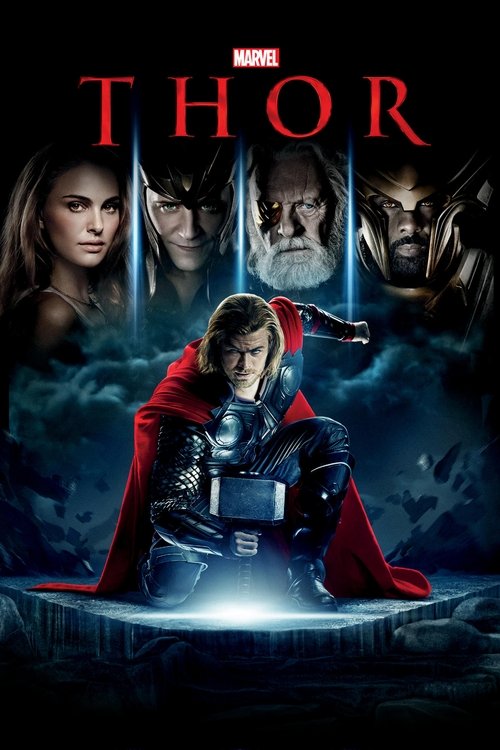
Thor - Review
Thor: A God Among Us, For Better and For Worse
Before the cosmic adventures, the ragtag Guardians, and the universe-threatening snaps, there was Thor. Released in 2011, Kenneth Branagh's Thor wasn't just another superhero origin story; it was a bold attempt to blend Shakespearean drama with comic book spectacle. It introduced audiences to a god stripped of his power, banished to Earth, and forced to confront his arrogance to become the hero Asgard needed. But does this early entry in the Marvel Cinematic Universe (MCU) still hold up, or has it been overshadowed by its more ambitious successors? Let's delve into the realms of Asgard and Earth to find out.
Plot: From Divine Arrogance to Earthly Humility
The story begins in Asgard, a realm of advanced beings perceived by humans as gods. Thor, the crown prince, brash and eager for battle, is about to inherit the throne from his wise father, Odin. However, during Thor's coronation, the Frost Giants, ancient enemies of Asgard, attempt to steal back their source of power, the Casket of Ancient Winters. Fuelled by pride and a thirst for glory, Thor disobeys Odin's orders and leads a retaliatory assault on Jotunheim, the Frost Giants' frozen realm. This act of aggression reignites a long-dormant war and infuriates Odin.
As punishment for his recklessness, Odin strips Thor of his power, banishes him to Earth, and sends his mighty hammer, Mjolnir, with him, enchanted so that only the worthy can wield it. Thor lands in Puente Antiguo, New Mexico, where he is discovered by astrophysicist Jane Foster, her mentor Erik Selvig, and Jane's intern Darcy Lewis. Initially, Thor is confused and desperate to return to Asgard, believing his banishment to be a temporary setback. He quickly learns that his actions have had serious consequences, and Asgard is vulnerable to his adopted brother, Loki, who is revealed to be a Frost Giant and is secretly plotting to seize the throne.
While on Earth, Thor begins to experience humility and empathy, largely due to his interactions with Jane. He is drawn to her intelligence and her passion for understanding the cosmos. He also learns to appreciate the value of human life and the fragility of Earth. His attempts to retrieve Mjolnir prove futile as he is deemed unworthy. This forces him to confront his past mistakes and the true meaning of leadership.
Meanwhile, Loki manipulates events to make it appear as though the Frost Giants are responsible for Odin's weakened state (he falls into Odinsleep, a deep slumber to regain his strength). He then sends the Destroyer, an Asgardian automaton, to Earth to eliminate Thor and anyone who poses a threat to his plans. In a climactic battle, Thor sacrifices himself to save Jane and the people of Puente Antiguo. This selfless act proves his worthiness, and Mjolnir returns to him, restoring his powers. He defeats the Destroyer and returns to Asgard to confront Loki.
The film culminates in a battle on the Bifrost Bridge, the rainbow bridge connecting Asgard to other realms. Thor defeats Loki, preventing him from destroying Jotunheim. He also chooses to destroy the Bifrost Bridge to prevent further conflict and protect Earth, effectively cutting himself off from Jane and his home. The film ends with Odin lamenting the loss of his sons and Jane continuing her research, searching for a way to reunite with Thor, who gazes longingly at the stars.
Characters: Gods, Mortals, and Ambiguous Intentions
Thor (Chris Hemsworth): Hemsworth's portrayal of Thor is arguably the film's greatest strength. He perfectly captures the character's initial arrogance and naivety, as well as his eventual growth into a compassionate and selfless hero. He convincingly portrays the fish-out-of-water scenario, blending comedic moments with genuine emotional vulnerability. His physical presence is undeniable, making him a believable warrior god.
Jane Foster (Natalie Portman): Portman brings a grounded intelligence to the role of Jane Foster. She is a brilliant astrophysicist with a genuine curiosity about the universe. Her relationship with Thor is initially based on scientific interest, but it quickly evolves into a genuine connection. While some criticize her character as being underdeveloped, Portman's performance adds a layer of credibility to the fantastical elements of the story.
Loki (Tom Hiddleston): Hiddleston's Loki is a complex and compelling villain. He is not simply evil for the sake of it; his actions are driven by a deep-seated sense of inferiority and a desire for recognition. Hiddleston's portrayal is nuanced and charismatic, making Loki a sympathetic and ultimately tragic figure. He steals every scene he's in, and his performance laid the groundwork for his future popularity in the MCU.
Odin (Anthony Hopkins): Hopkins brings gravitas and authority to the role of Odin, the Allfather. He embodies the wisdom and power of the Asgardian ruler, but also reveals the burden of leadership and the difficult choices he has had to make. His performance adds a layer of Shakespearean tragedy to the film.
Erik Selvig (Stellan Skarsgård): Skarsgård provides a steady and reliable presence as Erik Selvig, Jane's mentor. He is a voice of reason and a source of support for Jane, and he quickly becomes a friend to Thor. His later possession by Loki in The Avengers adds a layer of intrigue to his character.
Darcy Lewis (Kat Dennings): Dennings provides comic relief as Darcy Lewis, Jane's intern. Her sarcastic wit and unconventional approach to science offer a refreshing contrast to the more serious characters. While her character is primarily there for comedic purposes, Dennings delivers her lines with impeccable timing and charm.
The Warriors Three (Ray Stevenson as Volstagg, Tadanobu Asano as Hogun, and Josh Dallas as Fandral): The Warriors Three are Thor's loyal friends and fellow warriors. While they don't have a significant amount of screen time, they provide valuable support to Thor and add to the sense of camaraderie in Asgard. Their individual personalities are somewhat underdeveloped, but they are still a welcome addition to the cast.
Direction and Cinematography: A Blend of Worlds
Kenneth Branagh's direction is a key element in the film's success. Known for his Shakespearean adaptations, Branagh brings a sense of dramatic weight and theatricality to the story. He expertly balances the fantastical elements of Asgard with the more grounded reality of Earth. His experience with ensemble casts is also evident in the way he manages the diverse group of characters.
The cinematography, by Haris Zambarloukos, is visually striking. Asgard is depicted as a gleaming, futuristic city, while Jotunheim is a desolate, icy wasteland. The contrast between these two realms is visually compelling. The Earth scenes are shot with a more naturalistic style, emphasizing the ordinariness of human life. The action sequences are well-choreographed and visually engaging, although they are not as elaborate or groundbreaking as those in later MCU films.
The visual effects are generally well-executed, particularly the depiction of Asgard and the Bifrost Bridge. The Destroyer is also a visually impressive creation. However, some of the CGI, particularly in the Jotunheim scenes, looks somewhat dated by today's standards.
Themes and Messages: Worthiness, Humility, and Sacrifice
Thor explores several important themes, including:
Worthiness: The film's central theme is the concept of worthiness. Thor's journey is about learning what it truly means to be worthy of wielding Mjolnir and leading Asgard. He initially believes that power and strength are the most important qualities, but he eventually realizes that humility, compassion, and selflessness are equally essential.
Humility: Thor's banishment to Earth forces him to confront his arrogance and learn humility. He is stripped of his power and forced to rely on others. He learns to appreciate the value of human life and the importance of empathy. This transformation is crucial to his development as a hero.
Sacrifice: Thor's willingness to sacrifice himself to save Jane and the people of Puente Antiguo is the ultimate demonstration of his worthiness. He puts the needs of others before his own, proving that he has truly learned the lessons of humility and compassion.
Family and Responsibility: The film also explores the complex dynamics of family and the burden of responsibility. Odin struggles to balance his love for his sons with his duty to protect Asgard. Loki's actions are driven by his feelings of abandonment and his desire for recognition. Thor ultimately accepts his responsibility as a leader and chooses to do what is best for his people, even if it means sacrificing his own happiness.
Science vs. Magic: The film presents an interesting juxtaposition between science and magic. Jane Foster represents the scientific perspective, seeking to understand the universe through empirical observation. Thor represents the magical perspective, believing in the power of gods and ancient forces. The film suggests that both perspectives have value and that they can coexist.
Comparisons: Shakespearean Echoes and Superhero Tropes
Thor is often compared to Shakespearean tragedies, particularly Hamlet and King Lear. The themes of betrayal, ambition, and family conflict are reminiscent of Shakespeare's works. Kenneth Branagh's direction also emphasizes the dramatic and theatrical aspects of the story.
In terms of other superhero films, Thor shares some similarities with Superman (1978), in that it features a powerful being from another world who is sent to Earth and learns to use his powers for good. However, Thor is more focused on character development and the internal struggles of its protagonist.
Compared to later MCU films, Thor feels somewhat smaller in scale and scope. It is more focused on the personal journey of Thor and the conflict between Asgard and Jotunheim, whereas later films deal with cosmic threats and the fate of the universe. However, Thor laid the groundwork for the larger MCU and introduced several key characters and concepts.
Compared to other films directed by Kenneth Branagh, Thor is a departure from his usual fare of Shakespearean adaptations and historical dramas. However, his experience with ensemble casts and his ability to bring dramatic weight to fantastical stories served him well in directing Thor.
Positive Aspects: Hemsworth's Performance and Branagh's Direction
The film's greatest strength is Chris Hemsworth's performance as Thor. He perfectly embodies the character's transformation from arrogant prince to humble hero. Tom Hiddleston's Loki is also a standout performance, adding depth and complexity to the villain role.
Kenneth Branagh's direction is another significant asset. He brings a sense of dramatic weight and theatricality to the story, elevating it above a typical superhero origin story. The visual effects are generally well-executed, particularly the depiction of Asgard and the Bifrost Bridge.
The film's themes of worthiness, humility, and sacrifice are well-developed and resonate with audiences. The supporting cast, including Natalie Portman, Anthony Hopkins, and Stellan Skarsgård, provide solid performances.
Constructive Criticism: Dated CGI and Underdeveloped Characters
One of the film's main weaknesses is its dated CGI. Some of the visual effects, particularly in the Jotunheim scenes, look somewhat unconvincing by today's standards. The action sequences, while well-choreographed, are not as elaborate or groundbreaking as those in later MCU films.
Some of the supporting characters, particularly Jane Foster and the Warriors Three, are somewhat underdeveloped. Their motivations and backstories are not fully explored, which makes it difficult to fully invest in their stories. The romantic relationship between Thor and Jane feels somewhat rushed and unconvincing.
The film's pacing is uneven at times. The first act, which focuses on Asgard and Jotunheim, feels somewhat rushed, while the second act, which focuses on Thor's experiences on Earth, feels somewhat slow. The film could have benefited from a more balanced pacing.
Conclusion: A Solid Foundation for a Godly Franchise
Thor is a solid and entertaining superhero origin story that successfully blends Shakespearean drama with comic book spectacle. While it has some weaknesses, such as its dated CGI and underdeveloped characters, its strengths, including Chris Hemsworth's performance, Kenneth Branagh's direction, and its compelling themes, outweigh its flaws. It laid a strong foundation for the Thor franchise and the larger MCU. While it might not be the most groundbreaking or visually stunning MCU film, it remains a worthwhile entry that deserves recognition for its contributions to the superhero genre.
Rating: 7.5/10