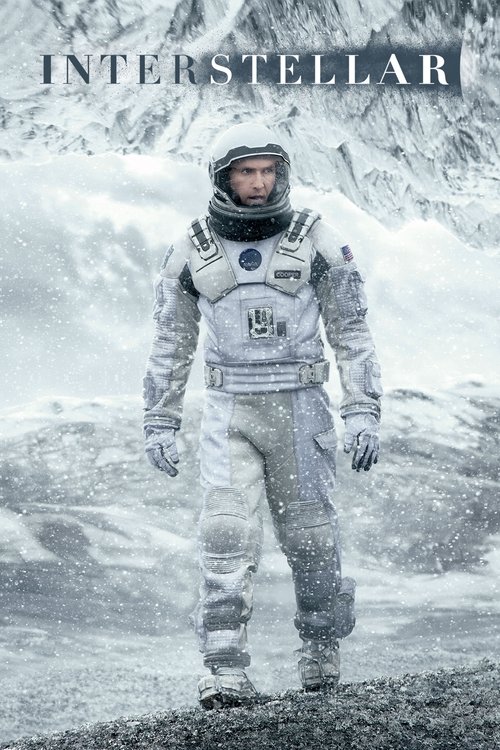
Interstellar - Review
Interstellar: A Breathtaking Voyage Through Space, Time, and Emotion
Christopher Nolan's Interstellar, released in 2014, isn't just a science fiction film; it's an epic poem painted on the canvas of the cosmos. It's a sprawling, ambitious, and deeply emotional journey that grapples with humanity's survival, the power of love, and the very fabric of space-time. While it occasionally stumbles under the weight of its own ambition, the film's sheer scale, stunning visuals, and powerful performances make it a cinematic experience that lingers long after the credits roll.
Plot: A Race Against Time and Extinction
The film plunges us into a near-future Earth ravaged by blight, where dust storms are a constant threat and agriculture is failing. Cooper (Matthew McConaughey), a former NASA pilot turned farmer, struggles to provide for his children, Murph (Mackenzie Foy as a child, Jessica Chastain as an adult, and Ellen Burstyn as an elderly woman) and Tom (Timothée Chalamet as a teenager, Casey Affleck as an adult). Discovering a hidden message in gravitational anomalies, Cooper and Murph stumble upon a secret NASA facility led by Professor Brand (Michael Caine). Brand reveals a desperate plan: to send a team through a wormhole near Saturn, placed there by unknown beings, to explore potentially habitable planets and secure humanity's future.
Cooper, torn between his love for his children and the responsibility to save humanity, ultimately joins the mission. The crew, including Brand's daughter Amelia (Anne Hathaway), Doyle (Wes Bentley), Romilly (David Gyasi), and the iconic robot TARS (voiced by Bill Irwin), embarks on a perilous journey through the wormhole. They face immense challenges, including time dilation due to relativity, treacherous alien landscapes, and agonizing moral dilemmas. The film expertly interweaves the space exploration narrative with the emotional core of Cooper's relationship with Murph, creating a powerful and resonant story.
Characters: Driven by Love, Hope, and Desperation
Interstellar boasts a cast of compelling characters, each grappling with their own motivations and fears. Cooper is the quintessential reluctant hero, a man driven by a deep love for his children and a sense of duty to humanity. McConaughey delivers a nuanced and powerful performance, portraying Cooper's internal conflict with raw emotion. His connection with Murph is the emotional bedrock of the film, and their separation is a constant source of tension and heartbreak.
Murph is arguably the most important character in the film. She represents the future of humanity and becomes increasingly driven to solve the gravity equation that could save the remaining people on Earth. The performances of Mackenzie Foy, Jessica Chastain, and Ellen Burstyn as Murph at different ages are all exceptional, capturing her intelligence, determination, and the emotional scars left by her father's departure.
Amelia Brand is a complex and idealistic scientist, driven by both a scientific curiosity and a deep-seated belief in the power of love. Hathaway's performance is nuanced and heartfelt, particularly in her controversial defense of love as a measurable and powerful force in the universe. Professor Brand is a paternal figure, harboring a dark secret that ultimately shapes the trajectory of the mission. Michael Caine delivers a typically strong performance, adding gravitas and moral ambiguity to the role.
TARS, the sardonic and adaptable robot, provides much-needed comic relief and becomes an integral part of the team. His dry wit and unwavering loyalty make him a fan favorite. Romilly and Doyle, while less developed than the other characters, contribute to the overall sense of realism and danger that permeates the mission.
Direction and Cinematography: A Visual Masterpiece
Christopher Nolan's direction is masterful, seamlessly blending grand-scale space exploration with intimate human drama. He expertly builds suspense and creates a sense of awe and wonder, immersing the audience in the vastness and mystery of the cosmos. Nolan's commitment to practical effects, whenever possible, adds to the film's sense of realism and visceral impact.
The cinematography, by Hoyte van Hoytema, is nothing short of breathtaking. The film's visuals are stunning, from the sweeping shots of the dying Earth to the awe-inspiring depictions of the wormhole and the alien planets. The use of IMAX cameras further enhances the immersive experience, making the audience feel as though they are truly traveling through space. The stark beauty of the frozen planet and the terrifying scale of the Gargantua black hole are particularly memorable.
The sound design is also crucial to the film's impact. Hans Zimmer's score is both epic and deeply emotional, perfectly complementing the visuals and enhancing the emotional weight of the story. The use of silence is also effective, creating a sense of isolation and unease in the vastness of space.
Themes and Messages: Love, Sacrifice, and the Survival of Humanity
Interstellar explores a multitude of complex themes, including the power of love, the importance of sacrifice, the survival of humanity, and the nature of time and space. The film argues that love is not just a sentimental emotion but a fundamental force that can transcend time and space. Cooper's love for his children drives him to embark on the mission and ultimately leads to the salvation of humanity.
Sacrifice is another key theme. Cooper sacrifices his time with his children, potentially never seeing them again, in order to save them and future generations. Professor Brand sacrifices his integrity by withholding crucial information about the mission's chances of success. These sacrifices highlight the difficult choices that must be made in the face of existential threats.
The film also delves into the nature of time and space, exploring the concepts of relativity, time dilation, and the possibility of manipulating gravity. While some of the scientific concepts are highly speculative, they add a layer of intellectual depth to the film and encourage viewers to contemplate the mysteries of the universe.
Ultimately, Interstellar is a film about hope. Despite the bleakness of the situation and the immense challenges faced by the characters, the film maintains a sense of optimism about humanity's ability to overcome adversity and find a way to survive.
Comparison to Other Films and Works
Interstellar draws inspiration from a variety of sources, including Stanley Kubrick's 2001: A Space Odyssey, Andrei Tarkovsky's Solaris, and Carl Sagan's novel Contact. Like these films, Interstellar explores the philosophical and existential implications of space travel. However, Interstellar is more emotionally driven than 2001 and less abstract than Solaris. It strikes a balance between scientific speculation and human drama.
Compared to Nolan's previous works, Interstellar is his most ambitious and emotionally resonant film to date. While films like Inception and The Dark Knight trilogy are known for their intricate plots and visual spectacle, Interstellar delves deeper into the human heart and explores themes of love, loss, and redemption. It shares Nolan's signature non-linear storytelling and his fascination with time, but it also represents a significant step forward in his development as a filmmaker.
McConaughey's performance can be compared to his work in Dallas Buyers Club and True Detective, showcasing his ability to portray complex and flawed characters with depth and authenticity. Hathaway's role as Amelia Brand is reminiscent of her performance in Les Misérables, demonstrating her range and emotional vulnerability.
Positive Aspects: A Cinematic Triumph
Interstellar is a visual and auditory masterpiece. The cinematography is stunning, the score is haunting, and the special effects are seamless. The film's immersive quality is undeniable, drawing the audience into the vastness and mystery of space.
The performances are uniformly excellent, with McConaughey, Chastain, and Hathaway delivering particularly strong performances. The characters are well-developed and relatable, and their emotional journeys resonate deeply.
The film's exploration of complex themes, such as love, sacrifice, and the survival of humanity, adds a layer of intellectual depth to the story. Interstellar is not just a science fiction film; it's a philosophical meditation on the human condition.
The film's ambition is commendable. Nolan dared to create a sprawling, epic film that grapples with big ideas and challenges the audience to think about their place in the universe.
Constructive Criticism: Moments of Weakness
While Interstellar is a remarkable achievement, it is not without its flaws. Some critics have argued that the film's science is overly speculative and that certain plot points are contrived. The explanation of the tesseract, in particular, can feel confusing and convoluted.
The film's pacing can be uneven. The first act, set on Earth, feels slow and deliberate, while the second and third acts, set in space, are more action-packed. This uneven pacing can make the film feel longer than it actually is.
Some viewers may find the film's emotional manipulation to be excessive. The constant emphasis on love and loss can feel heavy-handed at times.
While the performances are generally excellent, some of the supporting characters are underdeveloped. Romilly and Doyle, in particular, feel like afterthoughts.
The ending, while emotionally satisfying, can feel somewhat abrupt and convenient. The deus ex machina element of the unknown beings providing the wormhole can also be seen as a narrative shortcut.
Conclusion: A Must-See Cinematic Experience
Despite its flaws, Interstellar remains a breathtaking and unforgettable cinematic experience. Its stunning visuals, powerful performances, and thought-provoking themes make it a film that stays with you long after you've seen it. While it may not be perfect, its ambition and emotional depth are undeniable. It is a film that demands to be seen on the biggest screen possible, with the best sound system available. Interstellar is a testament to the power of cinema to transport us to other worlds and to explore the deepest questions of the human heart. It is a film that will be debated and discussed for years to come.