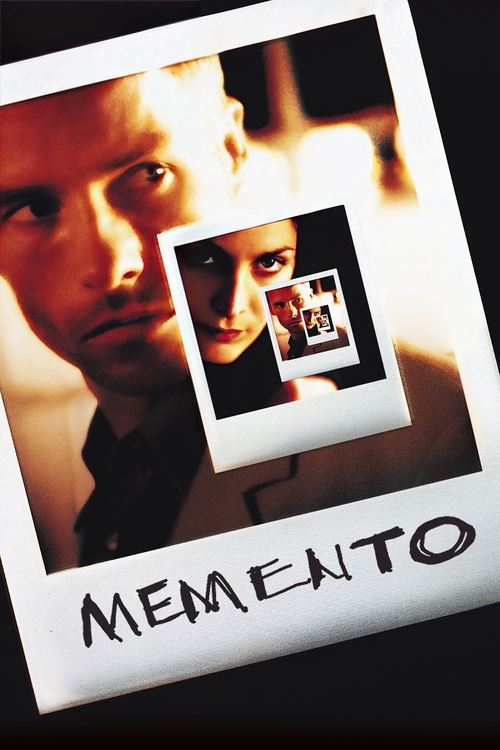
Memento - Review
A Mind Unraveling: A Deep Dive into Christopher Nolan's "Memento"
Christopher Nolan's "Memento," released in 2000, isn't just a film; it's a puzzle box. It's a disorienting, intellectually stimulating experience that demands active participation from the viewer. It's a film that lingers in the mind long after the credits roll, prompting endless discussions and repeated viewings. More than two decades later, it remains a landmark achievement in narrative experimentation and a testament to the power of independent filmmaking. But is its brilliance flawless? Let's delve into the fragmented world of Leonard Shelby and dissect the intricate mechanics of this modern classic.
Plot: A Chronological Conundrum
The most immediately striking aspect of "Memento" is its non-linear narrative. The film unfolds in two distinct timelines: a color sequence presented in reverse chronological order, and a black-and-white sequence presented in chronological order. The color sequences depict Leonard Shelby (Guy Pearce), a man suffering from anterograde amnesia – the inability to form new memories – as he hunts for the man who raped and murdered his wife. Each scene begins where the previous one ended, creating a disorienting sense of immediacy and forcing the audience to experience the world through Leonard's fragmented perspective. The black-and-white sequences, on the other hand, offer glimpses into Leonard's past, gradually revealing the events that led to his condition. These sequences, seemingly straightforward, eventually converge with the color sequences, culminating in a shocking and ambiguous climax that challenges our understanding of the entire film.
This unconventional structure isn't merely a stylistic flourish. It's integral to the film's themes and its exploration of memory, identity, and truth. By presenting the story in reverse, Nolan forces the audience to rely on Leonard's unreliable methods of investigation: Polaroid photos, tattoos, and hastily scribbled notes. We, like Leonard, are constantly piecing together fragments of information, unsure of their accuracy or context. This creates a sense of unease and uncertainty, mirroring Leonard's own disorientation and vulnerability.
However, the complexity of the narrative also presents a challenge. While the reverse chronology is undeniably innovative, it can occasionally feel convoluted and demanding. Some viewers may find it difficult to keep track of the various characters and plot threads, especially during the initial viewing. The film requires close attention and a willingness to actively engage with its fragmented structure. This isn't a passive viewing experience; it's an intellectual exercise.
Characters: Lost in the Labyrinth of Memory
Leonard Shelby: The protagonist of "Memento" is a deeply flawed and ultimately tragic figure. His amnesia makes him vulnerable to manipulation, and his reliance on unreliable methods of investigation makes him susceptible to error. Guy Pearce delivers a career-defining performance as Leonard, perfectly capturing his frustration, confusion, and desperate determination. He embodies the character's vulnerability while simultaneously conveying a sense of underlying strength and resolve. Leonard is driven by a singular purpose: revenge. But is his quest based on truth, or is it a construct of his own fractured mind? This ambiguity is central to the film's exploration of identity and the subjective nature of reality.
Natalie: Carrie-Anne Moss delivers a compelling performance as Natalie, a bartender who seems to offer Leonard assistance, but whose motives remain shrouded in mystery. She is manipulative and opportunistic, using Leonard's condition to her advantage. Yet, there are moments when she seems genuinely sympathetic to his plight. Is she a friend, a foe, or something in between? Natalie represents the inherent danger of Leonard's situation: he is surrounded by people who may be exploiting him for their own gain.
Teddy: Joe Pantoliano is unsettlingly effective as Teddy, a police officer who claims to be helping Leonard find his wife's killer. Teddy is a complex and ambiguous character whose true intentions remain unclear until the film's climax. He offers Leonard information and assistance, but his motives are always suspect. Is he a trustworthy ally, or is he manipulating Leonard for his own purposes? Teddy embodies the film's exploration of trust and the difficulty of discerning truth in a world of deception.
While the performances are uniformly excellent, some critics argue that the supporting characters, particularly Natalie and Teddy, are somewhat underdeveloped. Their motivations are often unclear, and their backstories are only hinted at. This ambiguity contributes to the film's overall sense of unease, but it also prevents the audience from fully connecting with these characters on an emotional level.
Direction and Cinematography: A Masterclass in Visual Storytelling
Christopher Nolan's direction in "Memento" is nothing short of masterful. He expertly uses the non-linear narrative structure to create a disorienting and immersive experience for the viewer. He employs a variety of techniques, including close-ups, subjective camera angles, and jarring cuts, to convey Leonard's fragmented perspective. The film's pacing is deliberately uneven, mirroring the unpredictable nature of Leonard's memory loss.
The cinematography, by Wally Pfister, is equally impressive. The film's stark black-and-white sequences create a sense of stark reality, while the vibrant color sequences heighten the sense of disorientation and unreality. The use of light and shadow is particularly effective, creating a sense of tension and unease. The film's visual style is both striking and subtle, perfectly complementing the complex narrative and thematic content.
Nolan's use of sound design is also noteworthy. The film's score, composed by David Julyan, is haunting and atmospheric, perfectly capturing the film's mood of dread and uncertainty. The use of silence is equally effective, creating moments of intense tension and suspense. The sound design is meticulously crafted to enhance the viewer's emotional experience.
One minor criticism could be directed at the pacing in the middle section of the film. At times, the constant shifting between timelines can feel slightly repetitive, potentially losing some of the initial momentum. However, this is a minor quibble in an otherwise brilliantly directed film.
Performances: Pearce Shines in a Career-Defining Role
As mentioned previously, Guy Pearce delivers a tour-de-force performance as Leonard Shelby. He embodies the character's vulnerability, frustration, and unwavering determination with remarkable skill. His performance is both physically and emotionally demanding, and he rises to the challenge with aplomb. Pearce's performance is the anchor of the film, grounding the complex narrative and making Leonard a relatable and sympathetic character, despite his flaws.
Carrie-Anne Moss and Joe Pantoliano provide excellent supporting performances as Natalie and Teddy, respectively. They both bring a sense of ambiguity and intrigue to their roles, keeping the audience guessing about their true intentions. Their performances are nuanced and subtle, adding layers of complexity to the film's already intricate narrative.
The supporting cast is also strong, with notable performances from Mark Boone Junior as Burt, and Stephen Tobolowsky as Sammy Jankis. These actors contribute to the film's overall sense of realism and authenticity.
Themes and Messages: Memory, Identity, and the Search for Truth
"Memento" explores a number of profound themes, including memory, identity, and the search for truth. The film challenges our assumptions about the nature of memory and its role in shaping our identities. Leonard's amnesia raises fundamental questions about what it means to be human and how we define ourselves in the absence of a coherent past.
The film also explores the subjective nature of truth. Leonard's reliance on unreliable methods of investigation raises questions about the accuracy of his memories and the validity of his conclusions. The film suggests that truth is not an objective reality, but rather a construct of our own perceptions and beliefs. This theme is particularly relevant in today's world, where we are constantly bombarded with conflicting information and competing narratives.
Furthermore, "Memento" delves into the dangerous nature of self-deception. Leonard, in his quest for revenge, may be constructing a narrative that suits his own needs, blinding himself to the truth. The film suggests that the pursuit of revenge can be a destructive force, leading to further suffering and ultimately perpetuating a cycle of violence.
The film also subtly touches upon the ethical implications of manipulating individuals with cognitive impairments. Natalie and Teddy exploit Leonard's condition for their own personal gain, highlighting the vulnerability of individuals with memory disorders and the importance of protecting their rights.
Comparison to Other Films and Works
"Memento" shares thematic similarities with other films that explore memory loss and identity, such as "Eternal Sunshine of the Spotless Mind" (2004) and "The Machinist" (2004). However, "Memento" distinguishes itself through its innovative narrative structure and its focus on the subjective nature of truth.
In terms of narrative experimentation, "Memento" can be compared to films like "Pulp Fiction" (1994) and "Reservoir Dogs" (1992), which also employ non-linear storytelling techniques. However, "Memento" takes this approach to a new level, creating a truly disorienting and immersive experience for the viewer.
Looking at Nolan's later works, we can see the seeds of his signature style in "Memento." His fascination with complex narratives, unreliable narrators, and the exploration of subjective reality is evident in films like "Inception" (2010), "Interstellar" (2014), and "Tenet" (2020). "Memento" serves as a crucial stepping stone in Nolan's development as a filmmaker, showcasing his early mastery of visual storytelling and his willingness to take risks.
Positive Aspects
- Innovative and groundbreaking narrative structure
- Superb performances, particularly by Guy Pearce
- Masterful direction and cinematography
- Thought-provoking themes and messages
- A truly unique and unforgettable cinematic experience
Constructive Criticism
- The non-linear narrative can be challenging and demanding
- Supporting characters could be more fully developed
- Pacing can feel slightly uneven in the middle section
Conclusion
"Memento" is a challenging, rewarding, and ultimately unforgettable film. It's a testament to Christopher Nolan's visionary filmmaking and his ability to push the boundaries of cinematic storytelling. While its non-linear narrative may not be for everyone, those who are willing to embrace its complexity will be richly rewarded. "Memento" is a film that demands to be seen, discussed, and re-watched. It's a modern classic that continues to resonate with audiences more than two decades after its release. It's a film that stays with you, like a faded Polaroid, constantly reminding you of the fragility of memory and the elusive nature of truth.
Rating: 9.5/10