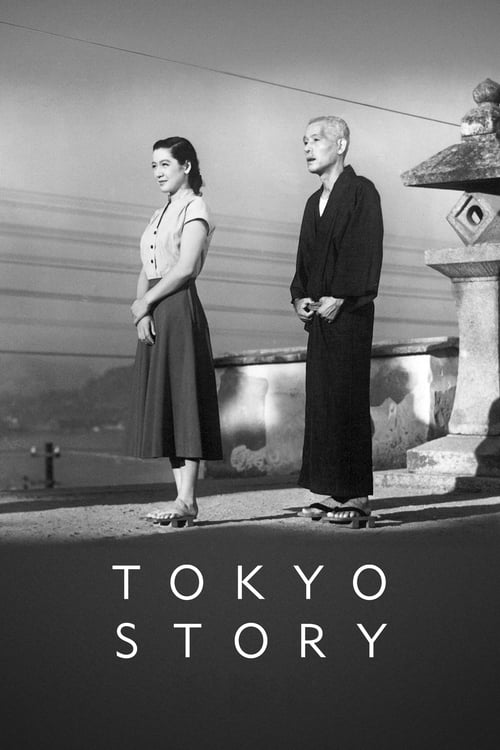
Tokyo Story - Review
A Quiet Earthquake: A Review of Yasujiro Ozu's "Tokyo Story"
Yasujiro Ozu's "Tokyo Story" isn't just a film; it's an experience. Released in 1953, it's a poignant, understated masterpiece that explores the universal themes of family, aging, and the inevitable distance that grows between generations. It's a film that creeps up on you, its emotional power building gradually, almost imperceptibly, until it leaves you profoundly moved and contemplating the delicate threads that bind us together. While seemingly simple in its narrative, "Tokyo Story" is a deeply complex and resonant work of art, a testament to Ozu's masterful direction and his ability to capture the quiet beauty and sorrow of everyday life. Forget explosions and grand pronouncements; "Tokyo Story" finds its drama in the unspoken, in the subtle shifts in body language, and in the spaces between words. It's a film that demands patience and rewards it with a profound understanding of the human condition.
Plot: A Journey of Disconnection
The plot of "Tokyo Story" is deceptively simple. An elderly couple, Shukishi and Tomi Hirayama, journey from their small seaside village of Onomichi to Tokyo to visit their grown children. Their son, Koichi, is a doctor, and their daughter, Shige, runs a beauty salon. They anticipate a joyous reunion, a chance to reconnect with their family and experience the bustling metropolis. However, they soon discover that their children are too preoccupied with their own lives to give them the attention and care they crave. Koichi is busy with his medical practice, and Shige is more concerned with her business and social life. They are politely, but undeniably, a burden.
Feeling neglected and unwanted, Shukishi and Tomi are eventually sent to a resort town, Atami, for a few days, ostensibly to relax and enjoy themselves. However, the noisy and overcrowded resort proves to be even more disappointing. They return to Tokyo, only to find that their children are still unable to truly connect with them. The burden of their presence is palpable.
The only person who genuinely seems to care for them is Noriko, their widowed daughter-in-law, the wife of their deceased son. She takes time off work to show them around Tokyo, offering them kindness and companionship. Noriko's selfless devotion provides a stark contrast to the indifference of Shukishi and Tomi's own children.
Tragedy strikes when Tomi suddenly falls ill. Shukishi and their children rush to her bedside, but she passes away shortly after. In the aftermath of her death, the family gathers, but even in grief, the underlying tensions and disconnect remain. The film concludes with Shukishi returning to Onomichi, alone and reflecting on the impermanence of life and the changing dynamics of family.
Characters: Portraits of Generational Divide
Ozu's characters are not simply plot devices; they are fully realized individuals with their own hopes, fears, and flaws. Their interactions and relationships form the heart of the film.
Shukishi Hirayama (Chishu Ryu)
Shukishi, played with quiet dignity by Chishu Ryu, is the patriarch of the family. He is a stoic and reserved man, deeply rooted in tradition. He struggles to understand the modern world and the changing values of his children. He masks his disappointment with a gentle acceptance, but his sadness is palpable. Ryu's performance is understated yet deeply moving, conveying a lifetime of experience and a quiet resignation to the realities of aging.
Tomi Hirayama (Chieko Higashiyama)
Tomi, portrayed by Chieko Higashiyama, is the heart of the family. She is warm, compassionate, and deeply concerned about her children's well-being. She is more perceptive than Shukishi, noticing the subtle signs of neglect and the widening gap between them and their children. Higashiyama's performance is both tender and heartbreaking, capturing the essence of a loving mother who longs for connection but is ultimately met with indifference.
Koichi Hirayama (So Yamamura)
Koichi, the elder son, is a successful doctor, but he is also burdened by his responsibilities. He is polite and dutiful, but he lacks the time and inclination to truly connect with his parents. He represents the generation that is focused on career and material success, often at the expense of family relationships. He's not necessarily malicious, but rather caught up in the demands of modern life, illustrating a common struggle.
Shige Kaneko (Haruko Sugimura)
Shige, the daughter, is a hairdresser who is more concerned with her own comfort and social status than with her parents' needs. She is somewhat selfish and insensitive, viewing her parents as an inconvenience. Sugimura's portrayal is nuanced, hinting at a deeper insecurity and a desire for validation that may contribute to her self-centered behavior.
Noriko (Setsuko Hara)
Noriko, the widowed daughter-in-law, is the most compassionate and selfless character in the film. Despite the fact that her husband (Shukishi and Tomi's son) has been dead for eight years, she continues to treat her in-laws with kindness and respect. She represents the enduring power of love and the importance of human connection. Setsuko Hara's performance is luminous, radiating warmth and empathy. She offers a glimmer of hope amidst the prevailing sense of disappointment and disconnection.
Direction: The Master of Minimalism
Yasujiro Ozu's direction is characterized by its minimalist style and its focus on capturing the nuances of human relationships. He employs a distinctive visual language that is both simple and profound.
Low Camera Angles
Ozu famously used low camera angles, often placing the camera just a few feet above the ground. This perspective creates a sense of intimacy and allows the viewer to feel as if they are sitting in the room with the characters. It also elevates the characters, giving them a sense of dignity and importance, even in their most ordinary moments.
Tatami Shots
Many of Ozu's shots are framed from the perspective of someone sitting on a tatami mat, a traditional Japanese flooring. This reinforces the feeling of intimacy and creates a sense of cultural authenticity. The tatami shot becomes a visual motif, grounding the film in its Japanese context.
Pillow Shots
Ozu frequently uses "pillow shots" – brief, static images of landscapes, objects, or empty spaces – to transition between scenes or to create a sense of atmosphere. These shots are often seemingly unrelated to the narrative, but they serve to create a sense of rhythm and to allow the viewer to pause and reflect on what they have just seen. They contribute to the film's overall contemplative mood.
Static Camera
Ozu rarely uses camera movement, preferring to keep the camera static and allowing the actors to move within the frame. This creates a sense of stillness and allows the viewer to focus on the characters' expressions and gestures. The lack of camera movement also emphasizes the deliberate and measured pace of the film.
Cinematography: A Palette of Subtle Beauty
The cinematography of "Tokyo Story," by Yuharu Atsuta, is understated yet beautiful. The film is shot in black and white, which enhances its timeless quality and allows the viewer to focus on the essential elements of the story. The lighting is soft and natural, creating a sense of realism and intimacy.
Atsuta's use of composition is masterful. He carefully frames each shot to create a sense of balance and harmony. He often uses geometric shapes and patterns to create a sense of order and stability. The film's visual aesthetic is both simple and elegant, reflecting Ozu's minimalist style.
The use of black and white also contributes to the film's emotional impact. It strips away the distractions of color, allowing the viewer to focus on the characters' faces and their emotional states. The contrast between light and shadow creates a sense of depth and texture, adding to the film's visual richness.
Performances: Nuance and Restraint
The performances in "Tokyo Story" are uniformly excellent. The actors embody their characters with nuance and restraint, conveying a wide range of emotions through subtle gestures and expressions. There are no histrionics or melodramatic outbursts; instead, the actors rely on their ability to communicate complex emotions with minimal dialogue.
Chishu Ryu and Chieko Higashiyama are particularly outstanding as Shukishi and Tomi. They portray the elderly couple with a quiet dignity and a deep sense of love and longing. Setsuko Hara is equally impressive as Noriko, radiating warmth and compassion. The supporting cast also delivers strong performances, bringing depth and complexity to their respective roles.
Ozu was known for working with the same actors repeatedly, creating a sense of familiarity and trust. This allowed him to elicit nuanced and authentic performances from his cast. The actors understood Ozu's style and were able to embody his characters with a deep sense of understanding.
Themes and Messages: The Impermanence of Life
"Tokyo Story" explores a number of profound themes, including the generational gap, the changing nature of family relationships, the impact of modernization on traditional values, and the inevitability of aging and death.
The Generational Gap
The film highlights the growing distance between the older and younger generations. Shukishi and Tomi struggle to understand the modern world and the values of their children, who are more focused on career and material success. This generational divide is a universal theme that resonates across cultures and time periods.
The Changing Nature of Family
The film depicts the breakdown of traditional family structures in post-war Japan. The children are no longer as connected to their parents as they once were, and they are less willing to sacrifice their own needs for the sake of their family. This reflects a broader shift in societal values, as individualism and materialism become more prevalent.
The Impact of Modernization
The film also explores the impact of modernization on traditional Japanese culture. The bustling city of Tokyo represents the modern world, with its fast-paced lifestyle and its emphasis on material wealth. In contrast, the rural village of Onomichi represents the traditional values of family, community, and connection to nature. The film suggests that modernization has come at a cost, eroding the bonds of family and community.
Aging and Death
The film confronts the inevitability of aging and death with unflinching honesty. Shukishi and Tomi are both aware of their mortality, and they are concerned about the future of their family after they are gone. Tomi's sudden death serves as a stark reminder of the impermanence of life and the importance of cherishing the moments we have with our loved ones.
Comparison to Other Films and Works
Ozu's style is unique and instantly recognizable. His films often explore similar themes, such as family relationships, the changing nature of Japanese society, and the passage of time. "Late Spring" (1949) and "Equinox Flower" (1958) are two other notable Ozu films that share similar themes and stylistic elements with "Tokyo Story."
Compared to "Late Spring," which focuses on the relationship between a father and daughter, "Tokyo Story" broadens the scope to encompass the entire family. While "Late Spring" explores the daughter's reluctance to marry and leave her father, "Tokyo Story" examines the challenges faced by elderly parents who are struggling to connect with their grown children.
Compared to other filmmakers who have explored similar themes, such as Ingmar Bergman or Akira Kurosawa, Ozu's style is more understated and minimalist. Bergman's films are often more psychologically intense and visually dramatic, while Kurosawa's films are often more action-oriented and epic in scope. Ozu's films are more focused on capturing the quiet beauty and sorrow of everyday life.
Positive Aspects
- Profound Emotional Impact: "Tokyo Story" is a deeply moving film that stays with you long after the credits have rolled.
- Masterful Direction: Ozu's minimalist style is both beautiful and effective.
- Excellent Performances: The actors deliver nuanced and authentic performances.
- Timeless Themes: The film explores universal themes that resonate across cultures and time periods.
- Subtle Storytelling: The film's power lies in its subtlety and its ability to convey complex emotions with minimal dialogue.
Constructive Criticism
- Slow Pace: Some viewers may find the film's pace to be too slow. The deliberate and measured rhythm may not appeal to those who are accustomed to more fast-paced narratives.
- Understated Style: Ozu's minimalist style may not appeal to all viewers. Some may find it to be too simple or too uneventful.
- Cultural Specificity: While the themes are universal, the film is deeply rooted in Japanese culture. Some viewers may find it difficult to fully appreciate the cultural nuances and subtleties.
- Lack of Resolution: The film's ending is somewhat ambiguous and open-ended. Some viewers may prefer a more definitive resolution.
Conclusion
"Tokyo Story" is a masterpiece of understated cinema. It's a film that demands patience and rewards it with a profound understanding of the human condition. While its slow pace and minimalist style may not appeal to all viewers, those who are willing to embrace its quiet beauty will find it to be a deeply moving and thought-provoking experience. It's a film that lingers in the mind long after the credits have rolled, prompting reflection on the importance of family, the inevitability of aging, and the enduring power of human connection. It's a testament to Ozu's genius and a reminder of the beauty that can be found in the ordinary.
Rating: 9.5/10