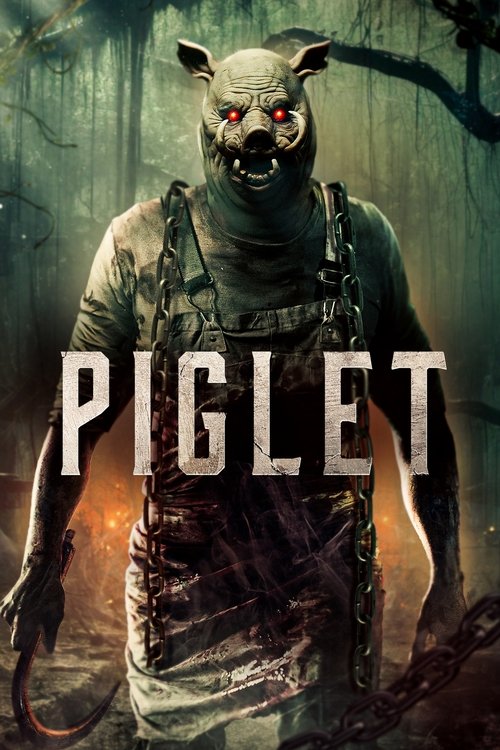
Piglet - Review
Piglet: A Harrowing Descent into Monstrous Origins and Personal Trauma
The horror genre, often dismissed as simple jump scares and gore, at its best, delves into the darkest corners of the human psyche, exploring our deepest fears and anxieties. "Piglet," released on May 29th, 2025, attempts to do just that, presenting a gruesome tale of survival against a monstrous antagonist while simultaneously confronting themes of guilt, trauma, and the consequences of unchecked scientific ambition. Does it succeed? Mostly. While the film occasionally stumbles under the weight of its own ambition, it ultimately delivers a visceral and thought-provoking experience that lingers long after the credits roll. Prepare to be disturbed, both by the blood and the implications.
Plot: A Birthday Bash Turns Bloody
The film opens with a familiar trope: a group of college friends embarking on a camping trip to celebrate Kate's 21st birthday. There's Kate (played with compelling vulnerability by Anya Taylor-Joy), the birthday girl haunted by a past tragedy; Liam (Dev Patel), her supportive but slightly overbearing best friend; Chloe (Jenna Ortega), the cynical and sarcastic voice of reason; and Mark (Noah Jupe), the eager and somewhat naive newcomer. The initial scenes are filled with the expected camaraderie and lighthearted banter, establishing the dynamics between the characters and hinting at underlying tensions. However, the festive atmosphere is shattered when Mark wanders off and becomes the first victim of Piglet, a monstrous human-pig hybrid lurking in the woods.
From here, the plot shifts into a desperate fight for survival. The remaining friends, reeling from the shock and grief of Mark's death, must navigate the treacherous terrain while being relentlessly hunted by Piglet. As they struggle to stay alive, they stumble upon an abandoned research facility, uncovering the horrifying origins of their tormentor. Piglet, it turns out, is the result of unethical genetic experiments conducted by a disgraced scientist seeking to push the boundaries of human-animal hybridization. This revelation adds a layer of social commentary to the narrative, questioning the morality of scientific pursuits without ethical oversight. The discovery also reveals a connection between Kate's past and the creation of Piglet, forcing her to confront a long-buried trauma that holds the key to defeating the monster.
While the core premise of a group of friends hunted by a monster is hardly groundbreaking, "Piglet" distinguishes itself through its exploration of the monster's origins and its connection to the protagonist's personal history. The plot, however, suffers from occasional pacing issues. The middle act, focused on the group's attempts to outrun Piglet, sometimes feels repetitive and lacks the narrative momentum of the opening and closing acts. Furthermore, certain plot conveniences, such as the ease with which the friends discover the research facility, strain credibility. Despite these flaws, the overall narrative is engaging and suspenseful, culminating in a satisfying, albeit brutal, climax.
Characters: Trauma, Guilt, and the Fight for Redemption
The strength of "Piglet" lies not only in its creature design and gore, but also in its relatively well-developed characters. Anya Taylor-Joy delivers a standout performance as Kate, portraying her as a complex and multi-layered character grappling with immense guilt and trauma. Her vulnerability is palpable, yet she also possesses a quiet strength that allows her to become the group's de facto leader. Her transformation from a traumatized victim to a determined survivor is one of the film's most compelling aspects.
Dev Patel provides solid support as Liam, Kate's loyal friend who struggles to balance his concern for her well-being with his own fears. His character serves as a grounding force, offering moments of levity and emotional support amidst the chaos. Jenna Ortega, as Chloe, embodies the cynical voice of reason, questioning the group's decisions and providing a dose of dark humor. While her character initially comes across as somewhat unlikeable, her pragmatic approach ultimately proves valuable in their fight for survival. Noah Jupe, as Mark, unfortunately, has limited screen time, but he effectively portrays the character's naiveté and enthusiasm, making his death all the more impactful.
Even Piglet himself, while a monstrous creation, is given a degree of depth. Through flashbacks and glimpses into his creation, the film hints at the tragic circumstances that led to his existence. He is not simply a mindless killing machine, but a victim of scientific hubris, trapped in a monstrous form and driven by primal instincts. This adds a layer of moral complexity to the narrative, forcing the audience to question the true nature of monstrosity.
However, some characters feel underdeveloped. The scientist responsible for Piglet's creation is portrayed as a stereotypical mad scientist, lacking the nuance that could have made him a more compelling antagonist. Additionally, the motivations of some of the supporting characters are not always clear, hindering their impact on the overall narrative. Despite these shortcomings, the core group of friends is well-developed and relatable, making their struggle for survival all the more engaging.
Direction: A Masterclass in Suspense and Atmosphere
Director Elias Roth (no relation to Eli Roth, despite the shared penchant for gore) demonstrates a keen understanding of the horror genre, expertly crafting a suspenseful and atmospheric experience. He masterfully utilizes the natural environment, transforming the seemingly idyllic forest into a terrifying labyrinth. The use of shadows, fog, and sound design creates a constant sense of unease, keeping the audience on edge throughout the film. Roth also employs effective jump scares sparingly, relying more on building tension and dread than on cheap thrills.
The action sequences are well-choreographed and visceral, showcasing the brutal reality of the group's fight for survival. Roth doesn't shy away from the gore, but he also avoids gratuitous violence, using it to emphasize the horror of the situation and the devastating impact of Piglet's attacks. The film's pacing is generally well-managed, with moments of intense action interspersed with quieter scenes that allow the characters to breathe and reflect on their situation. However, as mentioned earlier, the middle act suffers from occasional pacing issues, with some scenes feeling repetitive and drawn out.
Roth's direction is particularly effective in portraying the psychological toll of the events on the characters. He uses close-up shots to capture their fear, desperation, and resilience, allowing the audience to connect with them on a deeper level. The film also explores the themes of guilt and trauma through visual cues and symbolic imagery, adding layers of meaning to the narrative. Overall, Roth's direction is a major strength of "Piglet," elevating it above typical slasher fare and transforming it into a more nuanced and thought-provoking horror experience.
Cinematography: Painting a Picture of Dread
The cinematography, helmed by veteran horror cinematographer Beatrice Schneider, is nothing short of stunning. Schneider's use of light and shadow is masterful, creating a visually striking and unsettling atmosphere. The forest setting is rendered in both breathtaking beauty and terrifying darkness, emphasizing the duality of nature as both a source of life and a potential threat. The camera work is dynamic and engaging, effectively capturing the intensity of the action sequences and the emotional nuances of the characters' performances.
Schneider's use of color is also noteworthy. The film's palette is dominated by muted greens, browns, and grays, creating a sense of bleakness and despair. However, splashes of vibrant red, representing blood and violence, punctuate the otherwise muted tones, creating a jarring and unsettling effect. The use of slow-motion is employed sparingly but effectively, enhancing the impact of key moments and allowing the audience to fully appreciate the film's visual details.
The camera angles are also carefully chosen to create a sense of unease and disorientation. Low-angle shots are used to emphasize Piglet's imposing size and menacing presence, while high-angle shots are used to convey the characters' vulnerability and helplessness. The use of handheld camera work during the action sequences adds a sense of realism and immediacy, immersing the audience in the chaos of the situation. Overall, the cinematography is a key element in creating the film's unsettling and unforgettable atmosphere.
Performances: Anya Taylor-Joy Shines
As mentioned earlier, Anya Taylor-Joy delivers a tour-de-force performance as Kate. She embodies the character's vulnerability, strength, and resilience with remarkable skill. Her nuanced portrayal captures the character's internal struggles and her determination to overcome her past. Taylor-Joy's performance is the emotional heart of the film, anchoring the narrative and drawing the audience into Kate's journey.
Dev Patel provides solid support as Liam, portraying him as a caring and supportive friend who struggles to cope with the escalating horror. Patel effectively conveys Liam's fear and desperation, while also showcasing his loyalty and unwavering commitment to Kate. Jenna Ortega delivers a memorable performance as Chloe, injecting the film with a dose of dark humor and cynicism. Ortega's portrayal is both entertaining and believable, making Chloe a compelling and relatable character.
Noah Jupe, despite his limited screen time, makes a lasting impression as Mark. His portrayal of the character's naiveté and enthusiasm makes his death all the more tragic. The supporting cast is generally strong, although some characters are less developed than others. Overall, the performances in "Piglet" are a major strength of the film, adding depth and emotional resonance to the narrative.
Themes and Messages: The Monsters We Create
"Piglet" explores several complex themes, most notably the consequences of unchecked scientific ambition. The film questions the morality of genetic experimentation and the potential for scientific advancements to be used for nefarious purposes. The creation of Piglet serves as a cautionary tale, highlighting the dangers of playing God and the unforeseen consequences of tampering with nature.
The film also delves into the themes of guilt, trauma, and redemption. Kate's past trauma haunts her throughout the film, shaping her actions and influencing her relationships. She must confront her guilt and overcome her fears in order to survive and ultimately defeat Piglet. The film suggests that even in the face of unimaginable horror, redemption is possible, and that confronting one's past is essential for healing and growth.
Another important theme is the nature of monstrosity. The film challenges the traditional notion of monsters as inherently evil beings, suggesting that they are often the product of human actions. Piglet, while a terrifying creature, is also a victim of scientific hubris, trapped in a monstrous form and driven by primal instincts. The film asks the audience to consider the circumstances that led to Piglet's creation and to question who the real monsters are: the creature itself or the scientists who created it?
Comparison to Similar Films
"Piglet" draws inspiration from a variety of horror films, including "The Texas Chain Saw Massacre," "The Hills Have Eyes," and "Splice." Like "The Texas Chain Saw Massacre," "Piglet" features a group of young people terrorized by a monstrous killer in a remote location. Like "The Hills Have Eyes," it explores the theme of human monstrosity and the potential for violence to erupt in unexpected places. And like "Splice," it grapples with the ethical implications of genetic experimentation and the creation of hybrid creatures.
However, "Piglet" also distinguishes itself from these films in several ways. Unlike "The Texas Chain Saw Massacre," "Piglet" provides a more detailed explanation of the monster's origins and motivations. Unlike "The Hills Have Eyes," it focuses on the psychological impact of the violence on the characters. And unlike "Splice," it avoids the melodramatic elements and focuses on the visceral horror of the situation.
In terms of Elias Roth's previous work, "Piglet" represents a significant step forward. While his earlier films, such as "Cabin Fever 3: Viral" and "Hemlock Grove," were often criticized for their reliance on gratuitous gore and underdeveloped characters, "Piglet" demonstrates a greater maturity and sophistication. The film's characters are more complex, the themes are more nuanced, and the horror is more effective because it is grounded in character and emotion.
Positive Aspects
- Strong performances, particularly from Anya Taylor-Joy.
- Suspenseful and atmospheric direction.
- Stunning cinematography.
- Thought-provoking themes and messages.
- Effective creature design and gore.
Constructive Criticism
- Occasional pacing issues in the middle act.
- Some underdeveloped characters.
- Certain plot conveniences that strain credibility.
- The scientist responsible for Piglet's creation could have been more nuanced.
Conclusion
"Piglet" is a harrowing and thought-provoking horror film that explores the dark side of scientific ambition and the enduring power of trauma. While it suffers from occasional pacing issues and some underdeveloped characters, its strengths far outweigh its weaknesses. Anya Taylor-Joy delivers a standout performance, the direction is suspenseful and atmospheric, and the cinematography is stunning. The film's themes and messages resonate long after the credits roll, prompting viewers to question the nature of monstrosity and the consequences of our actions. "Piglet" is a must-see for fans of the horror genre who are looking for a film that is both terrifying and intellectually stimulating. It is a film that stays with you, not just for the gore, but for the questions it raises about humanity, science, and the monsters we create.
Rating: 8.5/10