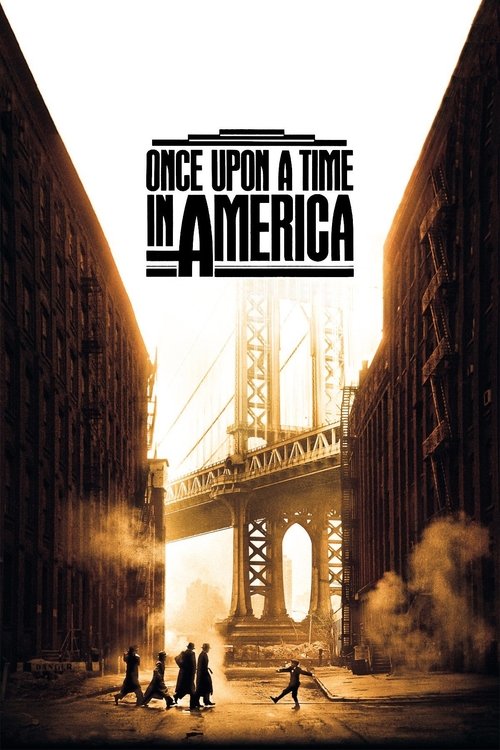
Once Upon a Time in America - Review
Once Upon a Time in America: A Haunting Requiem for Lost Innocence
Sergio Leone's sprawling epic, Once Upon a Time in America, released in 1984, isn't just a gangster film; it's a deeply melancholic meditation on memory, regret, and the corrosive power of time. More than just a tale of Jewish immigrants rising through the ranks of organized crime during the Prohibition era, it's a cinematic poem that lingers long after the credits roll, leaving a profound sense of loss and a haunting question: can the past ever truly be escaped?
Plot: A Non-Linear Labyrinth of Memory
The film's narrative structure is deliberately fractured, mirroring the fragmented nature of memory itself. We are introduced to David "Noodles" Aaronson (Robert De Niro) in 1968, a broken, haunted man returning to New York after a self-imposed exile of over three decades. A mysterious message, "You have been away too long," draws him back to the Lower East Side, forcing him to confront the ghosts of his past and the betrayals that shattered his life.
From this starting point, the film unfolds in a non-linear fashion, weaving together three distinct timelines: Noodles' childhood in the 1920s, his rise to power during Prohibition, and his desolate return in 1968. The transitions between these periods are often abrupt and dreamlike, triggered by sensory cues – a melody, a scent, a familiar face – blurring the lines between reality and recollection. This unconventional structure demands patience from the viewer, but it ultimately serves to deepen the film's emotional impact, immersing us in Noodles' subjective experience of loss and regret.
The childhood sequences are particularly evocative, portraying the formative years of Noodles and his gang – Max (James Woods), Patsy (James Hayden), and Cockeye (William Forsythe) – as they navigate the harsh realities of poverty and anti-Semitism. They engage in petty crimes, dreaming of a better life, their youthful camaraderie tinged with an undercurrent of violence. This period establishes the deep bond between Noodles and Max, a relationship that will ultimately define their destinies.
The Prohibition era sees the gang's ambitions grow, as they become involved in bootlegging, robbery, and murder. Noodles, torn between his loyalty to his friends and his growing affection for Deborah (Jennifer Connelly as a child, Elizabeth McGovern as an adult), finds himself increasingly entangled in a web of violence and betrayal. The film doesn't glorify their criminal activities; instead, it portrays them as a desperate attempt to escape their circumstances, a path that ultimately leads to destruction.
The 1968 timeline sees Noodles piecing together the events that led to his exile, uncovering a conspiracy that implicates his closest friends and forces him to confront the consequences of his past actions. This final act is a slow, deliberate unraveling of secrets, culminating in a devastating revelation that challenges Noodles' understanding of everything he thought he knew.
Characters: Flawed Individuals Haunted by the Past
Once Upon a Time in America is populated by complex, morally ambiguous characters, each driven by their own desires and haunted by their own demons. Noodles is the film's emotional center, a character defined by his loyalty, his love for Deborah, and his ultimately tragic flaw – his inability to trust. De Niro delivers a nuanced and powerful performance, capturing the character's vulnerability, his rage, and his profound sense of regret.
Max, Noodles' closest friend and partner in crime, is a charismatic but ultimately ruthless figure. James Woods delivers a tour-de-force performance, portraying Max as a man consumed by ambition, willing to betray anyone – even his closest friend – to achieve his goals. Max's motivations are complex and ultimately ambiguous, leaving the audience to question whether his actions were driven by greed, a twisted sense of loyalty, or something else entirely.
Deborah, the object of Noodles' affection, is a symbol of both beauty and unattainable desire. She represents a life beyond the confines of the Lower East Side, a world of art, culture, and refinement that Noodles can never fully access. Elizabeth McGovern's portrayal of Deborah is both alluring and heartbreaking, capturing the character's intelligence, her ambition, and her ultimately tragic fate. The younger Deborah, played by Jennifer Connelly, is equally captivating, embodying the innocence and dreams of a young girl growing up in a harsh environment.
The supporting characters, including Patsy, Cockeye, and Fat Moe (Larry Rapp), are equally well-drawn, each contributing to the film's rich tapestry of characters and emotions. They represent the diverse and often contradictory forces that shaped Noodles' life and the world he inhabited.
Direction: Leone's Masterful Visual Storytelling
Sergio Leone's direction is nothing short of masterful, imbuing every frame with a sense of epic grandeur and profound emotional depth. He employs his signature techniques – extreme close-ups, wide-angle shots, and long, deliberate takes – to create a visually stunning and emotionally resonant experience. The film's pacing is deliberate, allowing the story to unfold slowly and deliberately, drawing the viewer into its intricate web of characters and emotions.
Leone's use of symbolism is particularly noteworthy. The recurring image of the clock, for example, serves as a constant reminder of the passage of time and the inevitability of change. The film's dreamlike sequences, often triggered by opium use, blur the lines between reality and fantasy, reflecting Noodles' fractured state of mind.
Leone's attention to detail is evident in every aspect of the film, from the meticulously recreated sets to the authentic costumes and hairstyles. He creates a believable and immersive world, transporting the viewer back to the Lower East Side of the 1920s and 1930s.
Cinematography: A Visual Feast
Tonino Delli Colli's cinematography is breathtaking, capturing the beauty and the ugliness of the Lower East Side with equal skill. He uses light and shadow to create a sense of atmosphere and mood, imbuing the film with a haunting and dreamlike quality. The film's color palette is rich and vibrant, reflecting the energy and vitality of the era, while also conveying a sense of decay and loss.
Delli Colli's use of long takes and sweeping camera movements is particularly effective, allowing the viewer to fully immerse themselves in the film's world. The cinematography is not merely decorative; it is an integral part of the storytelling, enhancing the film's emotional impact and deepening its themes.
Performances: A Stellar Ensemble Cast
The performances in Once Upon a Time in America are uniformly excellent. Robert De Niro delivers one of the finest performances of his career, capturing the complexity and vulnerability of Noodles with remarkable skill. James Woods is equally impressive as Max, portraying the character's charisma and ruthlessness with equal conviction. Elizabeth McGovern is captivating as Deborah, imbuing the character with intelligence, ambition, and a quiet sadness.
The supporting cast is equally strong, with each actor bringing their own unique talents to their roles. James Hayden is memorable as Patsy, William Forsythe is menacing as Cockeye, and Larry Rapp is endearing as Fat Moe. The child actors, including Jennifer Connelly as the young Deborah, are also excellent, capturing the innocence and vulnerability of youth in a harsh environment.
Themes and Messages: Memory, Regret, and the Loss of Innocence
Once Upon a Time in America explores a number of complex and profound themes, including the power of memory, the corrosive effects of regret, and the loss of innocence. The film suggests that the past is never truly gone; it continues to shape our present and influence our future. Noodles' return to New York is a testament to the enduring power of memory, as he is forced to confront the ghosts of his past and the consequences of his actions.
The film also examines the nature of friendship and betrayal. The relationship between Noodles and Max is at the heart of the story, a complex and ultimately tragic bond that is tested by ambition, greed, and betrayal. The film suggests that even the closest of friends can be driven apart by their own desires and the corrupting influence of power.
The theme of lost innocence is also central to the film. Noodles and his gang start out as idealistic young men, dreaming of a better life. However, their involvement in organized crime gradually erodes their innocence, turning them into hardened criminals. The film suggests that the pursuit of wealth and power can ultimately lead to moral decay and the loss of one's soul.
Comparison to Other Films and Works
Once Upon a Time in America can be compared to other epic gangster films, such as The Godfather and Goodfellas. However, Leone's film is distinct in its non-linear narrative structure, its focus on memory and regret, and its overall melancholic tone. While The Godfather explores themes of family and power, and Goodfellas offers a visceral and exciting portrayal of the gangster lifestyle, Once Upon a Time in America is a more introspective and philosophical film, examining the psychological toll of a life of crime.
The film also shares similarities with Leone's previous works, particularly his "Dollars Trilogy" of Westerns. Like those films, Once Upon a Time in America features a morally ambiguous protagonist, a deliberate pace, and a visually stunning aesthetic. However, Leone's gangster epic is a more mature and complex work, exploring deeper themes and featuring more nuanced characters.
Robert De Niro's performance can be compared to his other iconic roles, such as Vito Corleone in The Godfather Part II and Travis Bickle in Taxi Driver. Like those characters, Noodles is a complex and troubled individual, struggling to find his place in a corrupt and unforgiving world. However, Noodles is perhaps the most vulnerable and sympathetic of De Niro's iconic characters, a man haunted by his past and yearning for redemption.
Positive Aspects
- Masterful direction by Sergio Leone
- Breathtaking cinematography by Tonino Delli Colli
- Stellar performances from Robert De Niro, James Woods, and Elizabeth McGovern
- Complex and morally ambiguous characters
- Profound exploration of themes such as memory, regret, and the loss of innocence
- Haunting and evocative score by Ennio Morricone
Constructive Criticism
- The film's length (nearly four hours in the original cut) can be daunting for some viewers.
- The non-linear narrative structure can be confusing at times, requiring patience and attention from the audience.
- The film's depiction of violence and sexual assault may be disturbing for some viewers.
- Some critics have argued that the film's ending is ambiguous and unsatisfying.
Conclusion
Once Upon a Time in America is a cinematic masterpiece, a sprawling and epic tale of love, betrayal, and the enduring power of memory. Sergio Leone's direction is masterful, imbuing every frame with a sense of epic grandeur and profound emotional depth. The performances are uniformly excellent, with Robert De Niro delivering one of the finest performances of his career. The film's themes are complex and profound, exploring the psychological toll of a life of crime and the enduring power of the past. While its length and non-linear narrative may be challenging for some viewers, Once Upon a Time in America is an unforgettable cinematic experience that will stay with you long after the credits roll. It's a film that demands to be seen, discussed, and revisited.