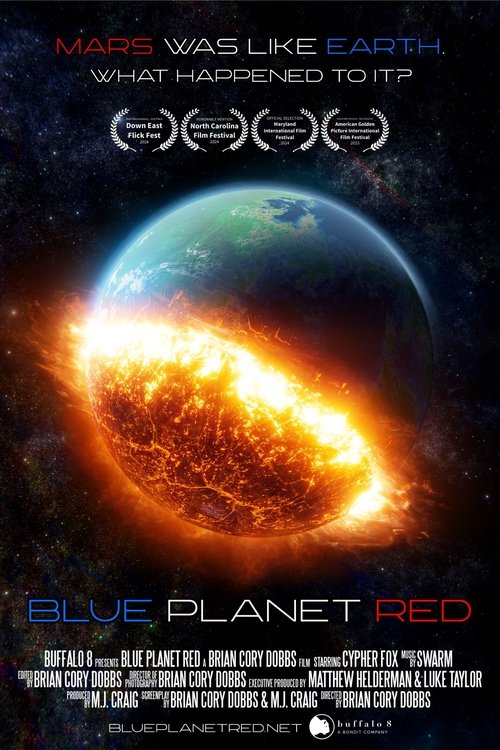
Blue Planet Red - Review
Blue Planet Red: A Dive into Martian Mysteries - Fact or Fiction?
The red dust of Mars has always been fertile ground for speculation, conspiracy, and the wildest of imaginations. From Percival Lowell's canals to Elon Musk's ambitious colonization plans, the planet has captivated humanity. Now, in Blue Planet Red, director Anya Sharma plunges headfirst into the deep end of Martian lore, presenting a documentary that promises to unveil shocking truths about the planet's past, present, and perhaps, our own future. Released on August 22nd, 2025, the film arrives with a hefty dose of intrigue, promising evidence of water, life, pyramids, ruins, UFOs, and a global cataclysm that transformed a once-blue planet into the rusty landscape we see today. But does Blue Planet Red deliver on its ambitious promises, or is it just another trip to the Martian well, drawing up more sand than water?
Plot: A Martian Mosaic of Mysteries
Blue Planet Red eschews a traditional narrative structure, opting instead for a mosaic approach. The film is divided into distinct sections, each focusing on a specific aspect of the Martian enigma. It begins with a re-examination of well-known anomalies such as the "Face on Mars" and the "Martian Pyramids," presenting enhanced images and "expert" interpretations that suggest artificial construction. The film then delves into the evidence for past water activity, showcasing geological formations that resemble dried-up riverbeds and ancient coastlines. This section, while containing some scientifically accepted data, quickly veers into more speculative territory, claiming that these waterways were once part of a vast, planet-wide ocean teeming with life.
The middle act focuses on purported ruins and ancient cities, with computer-generated reconstructions showcasing sprawling metropolises supposedly buried beneath the Martian surface. These reconstructions are based on interpretations of NASA imagery, often stretching the limits of pareidolia – the human tendency to see patterns in random stimuli. The film then introduces the "UFO" element, presenting alleged sightings and leaked documents suggesting that Mars is, or was, a hotspot for extraterrestrial activity. This section relies heavily on anecdotal evidence and grainy footage, which, while visually intriguing, lacks concrete proof.
The final act attempts to tie all these disparate elements together, arguing that a global cataclysm – possibly a nuclear war or a natural disaster of unimaginable scale – wiped out the Martian civilization, turning the planet into the barren wasteland we see today. This cataclysm, the film suggests, may serve as a warning to humanity, highlighting the dangers of unchecked technological advancement and environmental destruction. The plot, therefore, is less a coherent story and more a collection of interconnected mysteries, each designed to raise questions and spark debate.
Characters: The Believers and the Skeptics (Mostly Believers)
Being a documentary, Blue Planet Red doesn't feature fictional characters. Instead, it relies on a cast of talking heads – scientists, researchers, historians, and self-proclaimed experts in various fields. The film leans heavily towards those who subscribe to the more unconventional theories surrounding Mars, giving them ample screen time to present their arguments. While a few skeptical voices are included, they are often presented in a way that subtly undermines their credibility, framing them as close-minded or resistant to new ideas.
Dr. Aris Thorne, a geologist who has spent years studying Martian surface features, serves as the film's primary scientific voice. While Dr. Thorne does present some legitimate scientific findings regarding past water activity, he also readily embraces more speculative interpretations, suggesting that certain geological formations are too symmetrical to be natural. Then there's Professor Evelyn Reed, a historian specializing in ancient civilizations. Professor Reed draws parallels between Martian "ruins" and ancient structures on Earth, arguing that both point to a shared origin or a common influence. However, her arguments often rely on tenuous connections and selective interpretations of historical data.
Perhaps the most controversial figure in the film is Marcus Vance, a self-proclaimed "UFO researcher" who claims to have access to classified documents proving extraterrestrial activity on Mars. Vance's testimony is presented without any independent verification, and his claims are often outlandish and unsubstantiated. While Vance adds an element of intrigue to the film, his presence also raises serious questions about the film's overall credibility.
Direction: A Visual Feast, Questionable Choices
Anya Sharma's direction in Blue Planet Red is both a strength and a weakness. On the one hand, the film is visually stunning. Sharma and her team have crafted breathtaking CGI reconstructions of ancient Martian cities and landscapes, bringing the planet's supposed past to life in vivid detail. The use of drone footage and high-resolution NASA imagery is also impressive, showcasing the beauty and mystery of the Martian terrain. The soundtrack is equally effective, creating a sense of wonder and intrigue that draws the viewer into the film's narrative.
However, Sharma's direction also suffers from a lack of critical distance. The film is clearly biased towards the more unconventional theories surrounding Mars, and Sharma makes little effort to present a balanced perspective. Skeptical voices are often marginalized, and alternative explanations for the evidence presented are rarely explored in depth. This lack of objectivity undermines the film's credibility and makes it feel more like a piece of advocacy than a genuine investigation.
Furthermore, Sharma relies heavily on emotional manipulation. The film is filled with dramatic music, slow-motion shots, and ominous voiceovers, all designed to create a sense of urgency and intrigue. While these techniques are effective in capturing the viewer's attention, they also serve to distract from the lack of concrete evidence supporting the film's claims.
Cinematography: Capturing the Martian Mystique
The cinematography in Blue Planet Red is undeniably impressive. The film makes extensive use of high-resolution NASA imagery, showcasing the stark beauty and otherworldly landscapes of Mars. Close-ups of Martian rocks and soil reveal intricate details that are both fascinating and unsettling, while panoramic shots capture the vastness and desolation of the planet. The CGI reconstructions of ancient Martian cities are particularly well-executed, creating a sense of realism and immersion that is both captivating and disturbing.
The film also employs a variety of visual effects to enhance the viewing experience. Dust storms swirl across the screen, creating a sense of drama and danger, while shimmering mirages hint at hidden secrets beneath the Martian surface. The use of color is also effective, with the film shifting between the rusty reds and browns of the present-day Martian landscape and the vibrant blues and greens of the planet's supposed past. Overall, the cinematography in Blue Planet Red is a visual feast, capturing the mystique and allure of Mars in stunning detail.
Performances: Conviction, But Questionable Expertise
As a documentary, Blue Planet Red doesn't feature traditional acting performances. However, the individuals interviewed in the film – the scientists, researchers, and self-proclaimed experts – all deliver compelling performances in their own right. Dr. Aris Thorne, for example, speaks with a passion and conviction that is infectious, even when his claims are questionable. Professor Evelyn Reed brings a sense of gravitas and authority to her interpretations of historical data, making her arguments seem more plausible than they might otherwise be.
However, the most memorable performance comes from Marcus Vance, the self-proclaimed "UFO researcher." Vance speaks with an unwavering certainty, presenting his claims with a dramatic flair that is both captivating and unsettling. Whether or not you believe Vance's claims, there's no denying that he is a compelling storyteller. However, the film's reliance on Vance's unsubstantiated testimony is a major weakness, raising serious questions about the film's overall credibility.
Themes and Messages: A Cautionary Tale?
Blue Planet Red explores a number of themes, including the search for extraterrestrial life, the dangers of unchecked technological advancement, and the fragility of civilization. The film argues that the fate of Mars serves as a cautionary tale for humanity, highlighting the potential consequences of environmental destruction and societal collapse. The message is clear: if we don't learn from the mistakes of the past, we are doomed to repeat them, perhaps even on our own planet.
However, the film's message is ultimately undermined by its lack of objectivity. By presenting a biased perspective and relying on unsubstantiated claims, Blue Planet Red risks alienating viewers who are skeptical of its conclusions. While the film may spark debate and raise important questions, it ultimately fails to provide convincing answers.
Comparison to Similar Films
Blue Planet Red shares similarities with other documentaries that explore unconventional theories and mysteries, such as "Ancient Aliens" and "The Pyramid Code." Like these films, Blue Planet Red relies on a combination of scientific data, anecdotal evidence, and speculative interpretations to support its claims. However, Blue Planet Red is arguably more visually stunning than its predecessors, thanks to its high-resolution NASA imagery and impressive CGI reconstructions.
Compared to Anya Sharma's previous work, Blue Planet Red represents a significant departure. Sharma's earlier films focused on more grounded scientific topics, such as climate change and biodiversity loss. While these films were also visually compelling, they were more rigorous in their approach and relied on more credible sources of information. Blue Planet Red, on the other hand, embraces speculation and conjecture to a much greater extent, making it a more controversial and divisive film.
Positive Aspects
- Visually stunning cinematography and CGI reconstructions
- Engaging and thought-provoking subject matter
- Compelling performances from the interviewees
- Raises important questions about the search for extraterrestrial life and the future of humanity
Constructive Criticism
- Lack of objectivity and balanced perspective
- Reliance on unsubstantiated claims and anecdotal evidence
- Marginalization of skeptical voices
- Overuse of emotional manipulation
- Ultimately fails to provide convincing answers
Conclusion
Blue Planet Red is a visually stunning and thought-provoking documentary that explores the mysteries of Mars. However, its lack of objectivity and reliance on unsubstantiated claims undermine its credibility. While the film may spark debate and raise important questions, it ultimately fails to provide convincing answers. Whether you find it to be a groundbreaking exposé or a fanciful flight of imagination will likely depend on your existing beliefs and biases. It's a rollercoaster of 'what ifs' and 'could it bes' presented with the finesse of a Hollywood blockbuster, but ultimately falls short of providing verifiable truth. Enter with an open mind, but a healthy dose of skepticism.